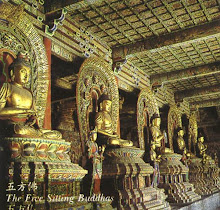
(The full title is:)
Great, Upright and Broad Tathagata's Unimaginable State Sutra
Or
Maha-Vaipulya Tathagata's Unimaginable State Sutra
(Dai Forng Gworng Yiu Loy Bud See Yee Ging Gai Ging)
(Tripitaka No. 301)
Translated during the Tang Dynasty by Kustana Tripitaka Master Siksananda
Thus I have heard. At one time the Buddha achieved Samyak-Sambodhi (Correct Peerless Enlightenment) under the Bodhi-tree in Magadha state. The Bodhi-tree's name is Ahsipah, its root was deep in the soil, its trunk was tall, straight and had no knot, like a sandalwood column. Whenever birds approach, they had to fly back because they could not fly over the tree. The tree's skin was fine and glossy, with various interlaced colors, just like damasks. The tree was branchy and the crown of it was bushy and green.
Around the tree, there were many beautiful and lovely flowers blooming and emanating fragrance. They were much more beautiful than all other flowers except the Kovidars and Parijatas.
Around the tree, there were also many shorter trees. This Bodhi-tree, the king of trees, was splendid and handsome. It was like the Sumeru Mountain, which is the king of all mountains. It was so tall that even the people beyond 1 Yojana could see it. Its fragrance flows all around and its halo shines all around. People who saw it far away at night would suspect that it is a group of huge fires. The area under the tree was majestic, beautiful, spacious, and flat, like the happy garden, with luxuriant fragrant grass. It was like the neck of the peacock king, beautiful and fragrant, people do not tire of watching it.
At such a place, the Tathagata sat rightly and divinely, with many beings around him, just like a moon surrounded by stars.
At that time, coming from other directions, there were Buddhas as many as the atoms of ten Buddha-Worlds. In order to make the Bodhi-manda(site of enlightenment) of Vairocana more sublime, those Buddhas appeared as Bodhisattvas and joined the congregation. The names of their leaders are: Avalokitesvara(Contemplator of the World's Sounds) Bodhisattva, Manjusri Bodhisattva, Ksitigarbha(Earth Store) Bodhisattva, Akasagarbha(Space Store) Bodhisattva, Vajragarbha Bodhisattva, Vimalakirti Bodhisattva, Virtuous mighty light Bodhisattva, Extinguish all eclipses Bodhisattva, Ratna-Pani(Treasure Hand) Bodhisattva, Mahamati(Great Wisdom) Bodhisattva, Samantabhadra(Universal Goodness) Bodhisattva, and so on.
Moreover, hundred billions of Bodhisattvas appeared as Sravakas and came to join the congregation. The names of their leaders are: Shariputra, Maha-Maudgalyayana, Subhuti, Rahula, Ajnata-Kaundinya, Maha-Kasyapa, Upali, Aniruddha, Revata, Ananda, Devadatta, Upandanda, and so on. All of them had practiced the Six-Paramitas for a long time, and had already been very close to the Bodhi of Buddhas. In order to enlighten living beings, they appeared as Sravakas in this defiled world.
There were also innumerable Bhikshunis headed by Maha-Prajapati. All of them had already accomplished the meritorious virtues of great and wise men, in order to soothe the inferior living beings, they appeared as women.
There were also innumerable Sakra Devanam Indras, Brahmas, guardian gods, Devas, dragons, Yaksas, Gandharvas, Asuras, Garudas, Kinnaras, Mahoragas, human and nonhuman beings. They were all great Bodhisattvas, none of them was mundane person.
At that time, the Bhagavan(World Honored One), who was sitting under the Bodhi-tree, was sublime, pure, refined and wonderful, like the Wish-fulfilling pearl under the Citta tree. With the immovable Correct-Mindfulness, he was like the Sumeru Mountain. In order to make all Bodhisattvas and living beings understand the mighty and holy power of Buddhas' profound and secret Dhyana(Zen)s, he entered a Samadhi named Tathagata's Unimaginable State. Suddenly, each mark of the 32 marks of the Bhagavan revealed infinite Buddha-Worlds and Buddhas of the ten directions, just like a bright mirror reflecting various colors. Moreover, each mark of the 80 minor marks of the Bhagavan revealed his previous Bodhisattva-practices. From the Radiance king to the final incarnation at the place of Dipamkara(Burning Lamp) Buddha, all the difficult and arduous practices, the history that he completely donated all his heads, eyes, bodies, skins, fleshes, arms, legs, wives, servants, and the kingships, palaces, and so on.
This Samadhi has the great mighty power, all Buddhas are always in this Samadhi when they are eating, walking, teaching Dharmas, and even in Nirvana. Why? Because all Buddhas rely on this Samadhi to achieve boundless great mighty sacrosanct power, as far as to realize-and-prove(pravista) the vacuum nature of all dharmas, so they can manifest various unrestricted things at all Buddha-Worlds of the ten directions. For example, a person visualizes various fantastic things in his dream, but when he wakes up, all those things disappear. Likewise, for the mundane persons, because of the dreams of ignorance, they mistakenly think that all things are entities; meanwhile, all Buddhas are awakened and do not cling to anything, thus they can freely show infinite Buddha-Activities(Buddha-karya) within one infinitesimal thought, to profit all living beings and make them succeed, to help them comprehend innumerable abstruse and wonderful Liberation-Gates.
At that time, Virtue Store Bodhisattva, who had not yet achieved the perfection of Bodhi-Practices, asked Samantabhadra Bodhisattva: "What is the name of the Samadhi that the Tathagata entered into just now? How can he freely show various Buddha-Activities in all the worlds of the ten directions to rescue living beings?"
Then Samantabhadra Bodhisattva spoke to Virtue Store Bodhisattva: "Listen carefully and I'll tell you." At that time, all Bodhisattvas looked at them intently and reverently, and glorified together with one voice: "What an excellent question! How profound, delicate and wonderful! Arya(sage) Samantabhadra, who knows everything, is going to preach now." Instantly, the earth shook in six different ways, heaven rained down exquisite flowers, all living beings suffering from afflictions and distresses were relieved for a while.
Showing posts with label Spiritual. Show all posts
Showing posts with label Spiritual. Show all posts
Sunday, August 17, 2008


Tuesday, August 12, 2008
A Spiritual Goal For This Lifetime
by Professor Li Ping-Nan
Master Chin Kung’s Dharma Teacher
--------------------------------------------
Professor Li Ping-Nan was Master Chin Kung’s Dharma Teacher. Professor Lee’s Dharma teacher was Patriarch Yin Guang.
The following article was adapted from a small book by Professor Lee titled “A Buddhist Goal that Can Be Achieved in One’s Present Life”. In this book, Professor Lee describes some of the characteristics of the Pure Land and explains how Pure Land practitioners can use the technique of Buddha recitation to achieve rebirth there.
Two important sections of this article are titled “Morning and Evening Devotions” and “The Ten Recitation Method”. These two sections explain exactly how you can practice Buddha recitation every day, at home.
--------------------------------------------
Life is difficult most of the time.
Who can avoid sickness, aging and weakness, separation from loved ones, deaths of friends and family members, loss of wealth, and hate and mistreatment from others?
The poor seek wealth, the childless want to have children, the unemployed want to find work, and on and on.
How many of these wishes can come true? Is there any way to solve these unfortunate problems?
Life is full of calamities.
Many people die in hurricanes, earthquakes, floods, and fires. Many others starve due to drought or too much rain. Unexpected death is facing us every year. In a nuclear or biological war, the human race could be eliminated. Is there any way to avoid these disasters?
The revolving wheel of birth and death is painful.
And death is not the end. A living body can die, but its consciousness never dies. Upon the death of the body, consciousness leaves the body and goes to one of the six paths: heaven, the human world, the asura world, the animal world, the hungry ghost world, or hell. Heaven and the human world are the better places of these six, but the cycle of birth and death is unavoidable. Everybody has to go through the birth-and-death cycle on one of the six paths. Imagine how terrible it must be in the animal world, and how painful it must be in hell! The birth-and-death cycle through the six paths is known as the “six-path revolving wheel of Birth-and-Death”. Is there any way to escape this revolving wheel of Birth-and-Death and secure a peaceful, happy eternal life?
Overcoming Life’s Difficulties and Escaping From the Cycle of Birth and Death
Eliminate life’s difficulties and divert calamities.
Whether we have a fortunate life or an unfortunate life is determined by our own mind and our own behavior. It is a system of cause and effect.
Causes and effects involve three time periods: the past, the present, and the future. A difficult life and the occurrence of disasters are results of previous evil thoughts or bad behavior. But can divert and avoid unfortunate events by reciting Buddha’s name. The Sutras tell us that serious offenses and crimes committed aeons ago can be eliminated by sincerely reciting Buddha’s name.
The Sutras also say that there is a limitless number of Buddhas in the universe who protect those who recite, “Amitabha Buddha”. Buddha possesses infinite virtue, supreme wisdom, and boundless might. If you have Buddha’s blessing, no disaster can befall you.
Master Chin Kung’s Dharma Teacher
--------------------------------------------
Professor Li Ping-Nan was Master Chin Kung’s Dharma Teacher. Professor Lee’s Dharma teacher was Patriarch Yin Guang.
The following article was adapted from a small book by Professor Lee titled “A Buddhist Goal that Can Be Achieved in One’s Present Life”. In this book, Professor Lee describes some of the characteristics of the Pure Land and explains how Pure Land practitioners can use the technique of Buddha recitation to achieve rebirth there.
Two important sections of this article are titled “Morning and Evening Devotions” and “The Ten Recitation Method”. These two sections explain exactly how you can practice Buddha recitation every day, at home.
--------------------------------------------
Life is difficult most of the time.
Who can avoid sickness, aging and weakness, separation from loved ones, deaths of friends and family members, loss of wealth, and hate and mistreatment from others?
The poor seek wealth, the childless want to have children, the unemployed want to find work, and on and on.
How many of these wishes can come true? Is there any way to solve these unfortunate problems?
Life is full of calamities.
Many people die in hurricanes, earthquakes, floods, and fires. Many others starve due to drought or too much rain. Unexpected death is facing us every year. In a nuclear or biological war, the human race could be eliminated. Is there any way to avoid these disasters?
The revolving wheel of birth and death is painful.
And death is not the end. A living body can die, but its consciousness never dies. Upon the death of the body, consciousness leaves the body and goes to one of the six paths: heaven, the human world, the asura world, the animal world, the hungry ghost world, or hell. Heaven and the human world are the better places of these six, but the cycle of birth and death is unavoidable. Everybody has to go through the birth-and-death cycle on one of the six paths. Imagine how terrible it must be in the animal world, and how painful it must be in hell! The birth-and-death cycle through the six paths is known as the “six-path revolving wheel of Birth-and-Death”. Is there any way to escape this revolving wheel of Birth-and-Death and secure a peaceful, happy eternal life?
Overcoming Life’s Difficulties and Escaping From the Cycle of Birth and Death
Eliminate life’s difficulties and divert calamities.
Whether we have a fortunate life or an unfortunate life is determined by our own mind and our own behavior. It is a system of cause and effect.
Causes and effects involve three time periods: the past, the present, and the future. A difficult life and the occurrence of disasters are results of previous evil thoughts or bad behavior. But can divert and avoid unfortunate events by reciting Buddha’s name. The Sutras tell us that serious offenses and crimes committed aeons ago can be eliminated by sincerely reciting Buddha’s name.
The Sutras also say that there is a limitless number of Buddhas in the universe who protect those who recite, “Amitabha Buddha”. Buddha possesses infinite virtue, supreme wisdom, and boundless might. If you have Buddha’s blessing, no disaster can befall you.
Monday, August 11, 2008
Words of Wisdom - Venerable Master Chin Kung

1. Buddhism is an education, not a religion. We do not worship the Buddha, we respect him as a teacher. His teachings enable us to leave suffering and attain happiness.
2. "Buddha" means enlightenment /understanding. Complete understanding is when one realizes the truth about life and the universe. It is when one is apart from all delusions.
3. Cultivation is not something unusual, it is part of our everyday life. Whenever we recognize and correct our faults, we are cultivating.
4. To keep our mind pure and at peace is like keeping a pond clean and undisturbed. When the water is clear and still, it can reflect the sky, sun and trees just as they are, without distortion. When we are polluted by greed, hatred, ignorance and disturbed by discriminations and attachments, we distort our picture of reality and fail to see things as they are. Wrong perceptions of reality can prevent us from enjoying a clear and happy life.
5. What is purity? Purity is apart from defilement. Defilement is the greed, hatred, and stupidity present in our minds. Cultivation is cleansing these impurities from out hearts.
6. The Buddha's teachings should be introduced as an education, not a religion. Using spiritual penetrations and psychic abilities to attract people to believe in Buddhism is not the proper teachings and only serve to mislead others.
7. We should not be afraid to see our faults and mistakes because only then can be corrected. People who fail to see their own mistakes will not be able to change for the better.
8. A student of the Buddha does not just read Buddhist text, he/she studies them to reach a deeper understanding of life and the universe and puts the teachings into practice in everyday life.
9. In putting the teachings into practice, the first thing we should cultivate is the Pure Heart. The Pure Heart is a mind without discrimination or attachments. We must also develop proper understanding by listening to explanations of the Buddha's Teachings.
10. We should treat all people with respect and sincerity. We must be responsible for our actions and careful when handling other's properties. Be conservative with speech and actions to avoid harming others.
Saturday, August 9, 2008
The Sutra in Forty-two Sections Spoken by the Buddha (Section 38 to 42)
Lectures by the Venerable Master Hsuan Hua,
Given at Gold Mountain Monastery,
San Francisco, California, in 1974
The Sutra in Forty-two Sections Spoken by the Buddha
Section 38 to 42
-----------------------------------------------------------------------
Section 38
Birth Leads to Death
The Buddha asked a Shramana, how long is the human life span? "He replied, few days. "The Buddha said, you have not yet understood the Way."
He asked another Shramana, how long is the human life span? "The reply was, the space of a meal. "The Buddha said, you have not yet understood the Way."
He asked another Shramana, how long is the human life span? "He replied, the length of a single breath. "The Buddha said, excellent. You have understood the Way."
The Buddha asked a Shramana, how long is the human life span? "The Buddha asked this question deliberately. It wasn’t that the Buddha didn’t know the answer himself and had to ask the Shramana to find out. The Buddha asked because he knew that people don’t know the length of the human life span. So he asked a Shramana, how long is a human being life? How much time does a human life last? " He replied, few days. "The first Shramana said, probably after a few days we will die. Life is not very long. " The Buddha said, you have not yet understood the Way. You still don understand. "
He asked another Shramana, how long is the human life span? "The reply was, he space of a meal. "The Shramana answered, n the time it takes to eat a single meal, a person life is over. " The Buddha said, you have not yet understood the Way. "He, too, didn understand.
He asked another Shramana, how long is the human life span? "He replied, he length of a single breath. The life span of a human being lasts for one breath. "The Buddha said, excellent. You have understood the Way." The Shramana who gave this answer understood the Way.
In India there was once a king who believed in adherents of non-Buddhist religions that cultivated many kinds of ascetic practices. Some followed the precepts of cows and some the precepts of dogs; some smeared ashes on their bodies; and some slept on beds of nails. They cultivated all sorts of ascetic practices, such as those undertaken by yogis. Meanwhile, the Bhikshus who cultivated the Buddhadharma had it comparatively easy, because they didn cultivate those kinds of ascetic practices. Now, the king of that country said to the Buddha disciples, believe that although these non-Buddhists cultivate all kinds of ascetic practices, they still cannot stop their thoughts of sexual desire. How much less are you Bhikshus, who are so casual, able to stop your afflictions and your thoughts of sexual desire. You surely cannot put a stop to them. "
One of the Dharma Masters answered the king this way, take a man from jail who has been sentenced to execution and say to him, take this bowl of oil and carry it in your hands as you walk down the street. If you spill a single drop of the oil, I’ll have you executed. If you don’t spill a single drop, I’ll release you when you return. ' Then, send some beautiful women musicians out on the street to sing and play their instruments where the sentenced man is walking with his bowl of oil. If he should spill any oil, of course you’ll execute him. If he comes back without spilling a single drop, ask him what he seen on the road, and see what he says! "
Given at Gold Mountain Monastery,
San Francisco, California, in 1974
The Sutra in Forty-two Sections Spoken by the Buddha
Section 38 to 42
-----------------------------------------------------------------------
Section 38
Birth Leads to Death
The Buddha asked a Shramana, how long is the human life span? "He replied, few days. "The Buddha said, you have not yet understood the Way."
He asked another Shramana, how long is the human life span? "The reply was, the space of a meal. "The Buddha said, you have not yet understood the Way."
He asked another Shramana, how long is the human life span? "He replied, the length of a single breath. "The Buddha said, excellent. You have understood the Way."
The Buddha asked a Shramana, how long is the human life span? "The Buddha asked this question deliberately. It wasn’t that the Buddha didn’t know the answer himself and had to ask the Shramana to find out. The Buddha asked because he knew that people don’t know the length of the human life span. So he asked a Shramana, how long is a human being life? How much time does a human life last? " He replied, few days. "The first Shramana said, probably after a few days we will die. Life is not very long. " The Buddha said, you have not yet understood the Way. You still don understand. "
He asked another Shramana, how long is the human life span? "The reply was, he space of a meal. "The Shramana answered, n the time it takes to eat a single meal, a person life is over. " The Buddha said, you have not yet understood the Way. "He, too, didn understand.
He asked another Shramana, how long is the human life span? "He replied, he length of a single breath. The life span of a human being lasts for one breath. "The Buddha said, excellent. You have understood the Way." The Shramana who gave this answer understood the Way.
In India there was once a king who believed in adherents of non-Buddhist religions that cultivated many kinds of ascetic practices. Some followed the precepts of cows and some the precepts of dogs; some smeared ashes on their bodies; and some slept on beds of nails. They cultivated all sorts of ascetic practices, such as those undertaken by yogis. Meanwhile, the Bhikshus who cultivated the Buddhadharma had it comparatively easy, because they didn cultivate those kinds of ascetic practices. Now, the king of that country said to the Buddha disciples, believe that although these non-Buddhists cultivate all kinds of ascetic practices, they still cannot stop their thoughts of sexual desire. How much less are you Bhikshus, who are so casual, able to stop your afflictions and your thoughts of sexual desire. You surely cannot put a stop to them. "
One of the Dharma Masters answered the king this way, take a man from jail who has been sentenced to execution and say to him, take this bowl of oil and carry it in your hands as you walk down the street. If you spill a single drop of the oil, I’ll have you executed. If you don’t spill a single drop, I’ll release you when you return. ' Then, send some beautiful women musicians out on the street to sing and play their instruments where the sentenced man is walking with his bowl of oil. If he should spill any oil, of course you’ll execute him. If he comes back without spilling a single drop, ask him what he seen on the road, and see what he says! "
Tuesday, August 5, 2008
The Sutra in Forty-two Sections Spoken by the Buddha (Section 27 to 30)
Lectures by the Venerable Master Hsuan Hua,
Given at Gold Mountain Monastery,
San Francisco, California, in 1974
The Sutra in Forty-two Sections Spoken by the Buddha
Section 27 to 30
-----------------------------------------------------------------------
Section 27
One Attains the Way after Letting Go of Attachments
The Buddha said, person who follows the Way is like a floating piece of wood that courses along with the current. If it does not touch either shore; if people do not pluck it out; if ghosts and spirits do not intercept it; if it is not trapped in whirlpools; and if it does not rot, I guarantee that the piece of wood will reach the sea. If students of the Way are not deluded by emotion and desire, and if they are not caught up in the many crooked views, but are vigorous in their cultivation of the unconditioned, I guarantee that they will certainly attain the Way. "
The twenty-seventh section sets forth an analogy to explain that in cultivating the Way, one should stay clear of all kinds of obstacles. What are the two shores? The two shores refer to emotion and desire. Emotion and desire further divide into two kinds: (1) the emotion and desire of views and thought and (2) the emotion and desire of ignorance. With the first, you grow attached to birth and death, which is represented by this shore. With the second, you become attached to Nirvana, which is represented by the other shore. Wood that is plucked out by people is analogous to cultivators getting caught in the nets of crooked views. Wood that is intercepted by ghosts and spirits is analogous to cultivators who get covered by the nets of views and thoughts.
Being caught up in a whirlpool refers to being lazy, which is the opposite of being vigorous. Rotten wood represents the opposite of unconditioned dharmas. Some cultivators are not properly mindful of True Suchness in a straightforward manner, and although they often wish to be vigorous, they end up retreating. It is as if they were in a whirlpool: although the water flows fast, it merely circles in the same spot. Similarly, they return to where they started and cannot reach unconditioned dharmas. Since they cannot reach the unconditioned, they become attached to appearances and cannot perfect the cultivation of blessings and wisdom. People in this situation are likened to rotting wood. They are bound to sink, and they will not reach the other shore of Nirvana. They won be able to end birth and death. That the result of being confused by emotional desire and caught up in the myriad crooked bypaths of love and views. If one is properly mindful of True Suchness and vigorously cultivates, understands that the fundamental nature of the Dharma is originally unconditioned, and can withstand being turned by emotions and love, then one will certainly attain the Way. That is the general meaning of this section of the text.
Given at Gold Mountain Monastery,
San Francisco, California, in 1974
The Sutra in Forty-two Sections Spoken by the Buddha
Section 27 to 30
-----------------------------------------------------------------------
Section 27
One Attains the Way after Letting Go of Attachments
The Buddha said, person who follows the Way is like a floating piece of wood that courses along with the current. If it does not touch either shore; if people do not pluck it out; if ghosts and spirits do not intercept it; if it is not trapped in whirlpools; and if it does not rot, I guarantee that the piece of wood will reach the sea. If students of the Way are not deluded by emotion and desire, and if they are not caught up in the many crooked views, but are vigorous in their cultivation of the unconditioned, I guarantee that they will certainly attain the Way. "
The twenty-seventh section sets forth an analogy to explain that in cultivating the Way, one should stay clear of all kinds of obstacles. What are the two shores? The two shores refer to emotion and desire. Emotion and desire further divide into two kinds: (1) the emotion and desire of views and thought and (2) the emotion and desire of ignorance. With the first, you grow attached to birth and death, which is represented by this shore. With the second, you become attached to Nirvana, which is represented by the other shore. Wood that is plucked out by people is analogous to cultivators getting caught in the nets of crooked views. Wood that is intercepted by ghosts and spirits is analogous to cultivators who get covered by the nets of views and thoughts.
Being caught up in a whirlpool refers to being lazy, which is the opposite of being vigorous. Rotten wood represents the opposite of unconditioned dharmas. Some cultivators are not properly mindful of True Suchness in a straightforward manner, and although they often wish to be vigorous, they end up retreating. It is as if they were in a whirlpool: although the water flows fast, it merely circles in the same spot. Similarly, they return to where they started and cannot reach unconditioned dharmas. Since they cannot reach the unconditioned, they become attached to appearances and cannot perfect the cultivation of blessings and wisdom. People in this situation are likened to rotting wood. They are bound to sink, and they will not reach the other shore of Nirvana. They won be able to end birth and death. That the result of being confused by emotional desire and caught up in the myriad crooked bypaths of love and views. If one is properly mindful of True Suchness and vigorously cultivates, understands that the fundamental nature of the Dharma is originally unconditioned, and can withstand being turned by emotions and love, then one will certainly attain the Way. That is the general meaning of this section of the text.
Saturday, August 2, 2008
The Sutra in Forty-two Sections Spoken by the Buddha (Section 11 to 12)
Lectures by the Venerable Master Hsuan Hua,
Given at Gold Mountain Monastery,
San Francisco, California, in 1974
The Sutra in Forty-two Sections Spoken by the Buddha
Section 11 to 12
--------------------------------------------------------------------------------
Section 11
The Increase in Merit Gained by Bestowing Food
The Buddha said, iving food to a hundred bad people is not as good as giving food to a single good person. Giving food to a thousand good people is not as good as giving food to one person who holds the Five Precepts. Giving food to ten thousand people who hold the Five Precepts is not as good as giving food to a single Srotaapanna.
Giving food to a million Srotaapannas is not as good as giving food to a single Sakridagamin. Giving food to ten million Sakri dagamins is not as good as giving food to a single Anagamin. Giving food to a hundred million Anaga mins is not as good as giving food to a single Arhat. Giving food to one billion Arhats is not as good as giving food to a single Pratyekabuddha. Giving food to ten billion Pratyekabuddhas is not as good as giving food to a Buddha of the three periods of time. Giving food to a hundred billion Buddhas of the three periods of time is not as good as giving food to a single person who is without thoughts, without dwelling, without cultivation, and without accomplishment."
The eleventh section of the Sutra compares the superior and inferior fields of blessings and lets people understand the superior and inferior aspects of making offerings.
The Buddha said, Giving food to a hundred bad people is not as good as giving food to a single good person. The previous section discussed giving in general terms, but when one gives, the important thing is to know how to do it. If you plant blessings but you don know the right method, if you don plant in accord with Dharma, then you won get any blessings. So the text says that giving food to one good person plants a greater field of blessings than giving to one hundred evil people. Why? Because after you feed a hundred bad people, all they can do are evil deeds. You become an accomplice to the bad things that they do, because you helped them do their evil deeds. If you give food to even one good person, then the good things he does after he eaten his fill are deeds that, you could say, you helped him accomplish. That is why it doesn equal giving food to a single good person.
Giving food to a thousand good people is not as good as giving food to one person who holds the Five Precepts. ood " here implies every kind of offering: food, drink, jewels, money, even your head, your eyes, your brains, and your marrow. If you give your life energy to help people do good things, then the good deeds they do are done with your help. But if you give your life energy in order to help bad people, you actually create offenses. Therefore the merit and virtue of feeding one thousand good people is not as great as that which accrues from giving to even one person who holds the Five Precepts.
Giving food to ten thousand people who hold the Five Precepts is not as good as giving food to a single Srotaapanna. eople who hold the Five Precepts " here refers to people who have taken refuge with the Triple Jewel, who hold the Five Precepts, and who cultivate the Ten Good Deeds. The merit and virtue of giving food to ten thousand people who hold the Five Precepts is not as great as that of making an offering of food to a single Srotaapanna, a sage of the first fruition.
Giving food to a million Srotaapannas is not as good as giving food to a single Sakridagamin. Giving food to a million Srotaapannas, sages of the first fruition, wouldn be as good as giving food to a sage of the second fruition, a Sakridagamin, because those of the first fruition do not know the state of those of the second fruition. Sages of the first fruition have already broken through delusion in views; those of the second fruition have also cut off six grades of delusion in thought in the desire realm. This was discussed in a previous section. Therefore, making an offering of food to a Sakridagamin of the second fruition has more merit and virtue than making an offering to a Srotaapanna of the first fruition.
Giving food to ten million Sakridagamins is not as good as giving food to a single Anagamin. Giving food to ten million sages of the second fruition, who have cut off six grades of delusion of thought in the desire realm, would not be as good as giving food to a single Anagamin, a sage of the third fruition. An Anagamin has cut off all nine grades of delusion of thought in the desire realm.
Given at Gold Mountain Monastery,
San Francisco, California, in 1974
The Sutra in Forty-two Sections Spoken by the Buddha
Section 11 to 12
--------------------------------------------------------------------------------
Section 11
The Increase in Merit Gained by Bestowing Food
The Buddha said, iving food to a hundred bad people is not as good as giving food to a single good person. Giving food to a thousand good people is not as good as giving food to one person who holds the Five Precepts. Giving food to ten thousand people who hold the Five Precepts is not as good as giving food to a single Srotaapanna.
Giving food to a million Srotaapannas is not as good as giving food to a single Sakridagamin. Giving food to ten million Sakri dagamins is not as good as giving food to a single Anagamin. Giving food to a hundred million Anaga mins is not as good as giving food to a single Arhat. Giving food to one billion Arhats is not as good as giving food to a single Pratyekabuddha. Giving food to ten billion Pratyekabuddhas is not as good as giving food to a Buddha of the three periods of time. Giving food to a hundred billion Buddhas of the three periods of time is not as good as giving food to a single person who is without thoughts, without dwelling, without cultivation, and without accomplishment."
The eleventh section of the Sutra compares the superior and inferior fields of blessings and lets people understand the superior and inferior aspects of making offerings.
The Buddha said, Giving food to a hundred bad people is not as good as giving food to a single good person. The previous section discussed giving in general terms, but when one gives, the important thing is to know how to do it. If you plant blessings but you don know the right method, if you don plant in accord with Dharma, then you won get any blessings. So the text says that giving food to one good person plants a greater field of blessings than giving to one hundred evil people. Why? Because after you feed a hundred bad people, all they can do are evil deeds. You become an accomplice to the bad things that they do, because you helped them do their evil deeds. If you give food to even one good person, then the good things he does after he eaten his fill are deeds that, you could say, you helped him accomplish. That is why it doesn equal giving food to a single good person.
Giving food to a thousand good people is not as good as giving food to one person who holds the Five Precepts. ood " here implies every kind of offering: food, drink, jewels, money, even your head, your eyes, your brains, and your marrow. If you give your life energy to help people do good things, then the good deeds they do are done with your help. But if you give your life energy in order to help bad people, you actually create offenses. Therefore the merit and virtue of feeding one thousand good people is not as great as that which accrues from giving to even one person who holds the Five Precepts.
Giving food to ten thousand people who hold the Five Precepts is not as good as giving food to a single Srotaapanna. eople who hold the Five Precepts " here refers to people who have taken refuge with the Triple Jewel, who hold the Five Precepts, and who cultivate the Ten Good Deeds. The merit and virtue of giving food to ten thousand people who hold the Five Precepts is not as great as that of making an offering of food to a single Srotaapanna, a sage of the first fruition.
Giving food to a million Srotaapannas is not as good as giving food to a single Sakridagamin. Giving food to a million Srotaapannas, sages of the first fruition, wouldn be as good as giving food to a sage of the second fruition, a Sakridagamin, because those of the first fruition do not know the state of those of the second fruition. Sages of the first fruition have already broken through delusion in views; those of the second fruition have also cut off six grades of delusion in thought in the desire realm. This was discussed in a previous section. Therefore, making an offering of food to a Sakridagamin of the second fruition has more merit and virtue than making an offering to a Srotaapanna of the first fruition.
Giving food to ten million Sakridagamins is not as good as giving food to a single Anagamin. Giving food to ten million sages of the second fruition, who have cut off six grades of delusion of thought in the desire realm, would not be as good as giving food to a single Anagamin, a sage of the third fruition. An Anagamin has cut off all nine grades of delusion of thought in the desire realm.
Thursday, July 31, 2008
The Sutra in Forty-two Sections Spoken by the Buddha (Section 8 - 10)
Lectures by the Venerable Master Hsuan Hua,
Given at Gold Mountain Monastery,
San Francisco, California, in 1974
The Sutra in Forty-two Sections Spoken by the Buddha
(Section 8 to 10)
----------------------------------------
Section 8
Abusing Others Defiles Oneself
The Buddha said, an evil person who harms a sage is like one who raises his head and spits at heaven. Instead of reaching heaven, the spittle falls back on him. It is the same with someone who throws dust against the wind. Instead of going somewhere else, the dust returns to defile his own body. The sage can not be harmed. Misdeeds will inevitably destroy the doer."
In this eighth section, the Buddha teaches us that we must not do bad deeds, that we must not harm people, because to harm others is just to harm oneself. If you slight others, you only slight yourself. If you are bad to others, it the same as being bad to yourself.
The Buddha said, n evil person who harms a sage is like one who raises his head and spits at heaven. Instead of reaching heaven, the spittle falls back on him. "an evil person" refers to someone who does bad deeds of every kind, while a sage is a worthy and virtuous person. When an evil person who has no virtue tries to harm a sage who has genuine virtue, it as if he were tipping back his head to spit at the sky. The spit doesn’t reach the sky, but instead falls back on his own face. This is to say that an evil person is really unable to harm a sage. He may think of a way to harm him, but in the end he still actually harming himself. In this world there are underlying principles of justice which govern all things, and which make it wrong to harm people.
It is the same with someone who throws dust against the wind. Instead of going somewhere else, the dust returns to defile his own body. If you face the wind and toss out a handful of dust, instead of flying forward, it will fly back to you and fall on your own body.
The sage cannot be harmed. Misdeeds will in evitably destroy the doer. You can slander a sage or really harm him, because when you cause misfortune for others, you will also bring misfortune upon yourself. It you who will have to undergo the retribution.
--------------------------------------------
Section 9
By Returning to the Source, You Find the Way
The Buddha said, deep learning and a love of the Way make the Way difficult to attain. When you guard your mind and revere the Way, the Way is truly great! "
In this ninth section, the Buddha is teaching cultivators to hear the Dharma and to contemplate it, to contemplate the Dharma and to cultivate it, to cultivate the Dharma and then to realize it. Cultivators should not only be able to discuss or to listen to the Buddhadharma, they should also able to put it into practice. It only counts when you actually go and do it.
Given at Gold Mountain Monastery,
San Francisco, California, in 1974
The Sutra in Forty-two Sections Spoken by the Buddha
(Section 8 to 10)
----------------------------------------
Section 8
Abusing Others Defiles Oneself
The Buddha said, an evil person who harms a sage is like one who raises his head and spits at heaven. Instead of reaching heaven, the spittle falls back on him. It is the same with someone who throws dust against the wind. Instead of going somewhere else, the dust returns to defile his own body. The sage can not be harmed. Misdeeds will inevitably destroy the doer."
In this eighth section, the Buddha teaches us that we must not do bad deeds, that we must not harm people, because to harm others is just to harm oneself. If you slight others, you only slight yourself. If you are bad to others, it the same as being bad to yourself.
The Buddha said, n evil person who harms a sage is like one who raises his head and spits at heaven. Instead of reaching heaven, the spittle falls back on him. "an evil person" refers to someone who does bad deeds of every kind, while a sage is a worthy and virtuous person. When an evil person who has no virtue tries to harm a sage who has genuine virtue, it as if he were tipping back his head to spit at the sky. The spit doesn’t reach the sky, but instead falls back on his own face. This is to say that an evil person is really unable to harm a sage. He may think of a way to harm him, but in the end he still actually harming himself. In this world there are underlying principles of justice which govern all things, and which make it wrong to harm people.
It is the same with someone who throws dust against the wind. Instead of going somewhere else, the dust returns to defile his own body. If you face the wind and toss out a handful of dust, instead of flying forward, it will fly back to you and fall on your own body.
The sage cannot be harmed. Misdeeds will in evitably destroy the doer. You can slander a sage or really harm him, because when you cause misfortune for others, you will also bring misfortune upon yourself. It you who will have to undergo the retribution.
--------------------------------------------
Section 9
By Returning to the Source, You Find the Way
The Buddha said, deep learning and a love of the Way make the Way difficult to attain. When you guard your mind and revere the Way, the Way is truly great! "
In this ninth section, the Buddha is teaching cultivators to hear the Dharma and to contemplate it, to contemplate the Dharma and to cultivate it, to cultivate the Dharma and then to realize it. Cultivators should not only be able to discuss or to listen to the Buddhadharma, they should also able to put it into practice. It only counts when you actually go and do it.
Tuesday, July 29, 2008
The Sutra in Forty-two Sections Spoken by the Buddha (Introductory Sections)
Lectures by the Venerable Master Hsuan Hua,
Given at Gold Mountain Monastery,
San Francisco, California, in 1974
The Sutra in Forty-two Sections Spoken by the Buddha
Introductory Sections
--------------------------------------------------------------------------------
The Sutra in Forty-two Sections Spoken by the Buddha. The ten words of the title express both the general and individual names of this Sutra. All sutras spoken by the Buddha share the general name "sutra." The individual name, which accompanies the word "sutra," is the particular name of that sutra, which distinguishes it from other sutras. The word "sutra" is just like the word "human," which we use to describe all people. "Human" is the general name, and each person has his own individual name: this one is named Smith, and another is named Chang. The sutras the Buddha spoke are also like that; they have both general and individual names. "The Sutra in Forty-two Sections Spoken by the Buddha" is the individual name of this Sutra. Examining the words of the individual name, we find that the title of this Sutra is established on the basis of a person and a dharma. The Buddha is a person and "Forty-two Sections" is a dharma. Therefore, the title is referred to as established on the basis of a person and a dharma.
This Sutra is composed of Dharma spoken by the Buddha. When the Buddha disciples were compiling the Sutra Treasury , they selected individual passages and combined them into one work. You could also say it a Buddha-anthology . The Buddha's sayings were put together to make one sutra. The forty-two sections are the forty-two selections of the Sutra. This was the first sutra to be transmitted to China. The two Honorable Elders Kashyapa-matanga and Gobharana brought this Sutra to China from India on a white horse (around a.d. 67). White Horse Monastery was established in Loyang by Han Ming Di, the emperor of that time.
The Buddhadharma was transmitted to China during the Han Dynasty (206 b.c.d. 220). During that era, Taoism also flourished. When Buddhism came to China, the Taoist masters became jealous. They held an audience with the emperor and told him, "Buddhism is a false faith. It is a barbarian religion; it not Chinese. Therefore, you should not permit it to spread through China. You should abolish Buddhism!" they urged. "If you will not abolish it, then you should at least hold a contest."
What were the rules of the contest? The Taoists suggested that the emperor put the Buddha sutras together in a pile with the Taoists' texts and then set fire to them. Whichever books burned belonged to the false religion, and the texts that survived the flames would be recognized as the true ones.
The Taoist leader Chu Shanxin and five hundred other Taoist masters put the Taoist texts together with the Buddhist sutras and then prayed to the Venerable Great Master Laozi, "Divine Lord, O Virtuous One of the Way! You must grant us a magical response to ensure that our texts will not burn and that the Buddhist sutras will go up in flames!"
Many of the Taoist masters present had spiritual powers. Some could soar through the clouds and ride the fog. Others could sail through the heavens and hide in the earth. Some could vanish into thin air. You might see one in front of you, but suddenly he would disappear! There were Taoists who had the power to do almost anything. Some of them could make a quick escape by disappearing. They had used the charms and spells of the Taoist religion to gain a considerable number of spiritual powers.
When the fire was lit, guess what happened? Not only did the Buddhist sutras not burn, they emitted light instead! The relics (sharira) of the Buddha also emitted a five-colored light that flared into space as bright as the sun, shining over the entire world.
As soon as the Taoist texts were set on fire, they burned to ashes and were gone. Those who had been able to soar through the clouds couldn’t do it anymore; they had lost their spiritual powers. Those who had been able to sail to the heavens could no longer manage it. Those who had been able to hide in the earth could no longer hide in the earth. Those who had been able to vanish couldn’t vanish. The spells they mumbled no longer worked. There was no response. The Taoist texts burned to a crisp, and the Taoist masters Chu Shanxin and Fei Zhengqing died of rage right then and there! Witnessing the death of their leaders, two or three hundred Taoists shaved their heads and became Buddhist monks on the spot. So, the first time Taoism and Buddhism held a Dharma-contest, the Taoists lost.
After the book burning , the two Honorable Elders, Kashyapa-matanga and Gobharana, ascended into space and revealed the Eighteen Transformations of an Arhat. They emitted water from the upper part of their bodies and fire from the lower part; then they emitted fire from the upper part of their bodies and water from the lower part; they walked about in space; they lay down and went to sleep in space; and they manifested various spiritual transformations there. Right away the emperor and all the people simultaneously came to believe in Buddhism. That is why this Sutra is extremely important. It was the first Buddhist sutra to be transmitted to China. So, we have come together to investigate this text today.
Let look into the word "Buddha" first. Buddha is a Sanskrit word. The complete transliteration into Chinese is “fo tuo ye”; translated, it means "an enlightened one." There are three kinds of enlightenment: enlightenment of oneself, enlightenment of others, and perfection of enlightenment and practice.
1. Enlightenment of oneself: Someone who enlightens himself is different from an ordinary person who is not enlightened. Cultivators of the Two Vehicles , the Sound-hearers and Pratyekabuddhas , have enlightened themselves and are thus no longer the same as ordinary people, but they do not enlighten others.
2. Enlightenment of others: Someone who can enlighten others is different from the cultivators of the Two Vehicles. This person is called a Bodhisattva. Bodhisattvas can enlighten themselves and enlighten others. Being able to benefit themselves, they can also benefit others. They regard all living beings impartially. They themselves are enlightened, and they want all living beings to become enlightened also. This is called the enlightenment of others.
3. Perfection of enlightenment and practice: Although Bodhisattvas can enlighten others, they still have not reached the perfection of enlightenment and practice. Buddhas can enlighten themselves, can enlighten others, and also have perfected their enlightenment and practice. Because they have perfected the threefold enlightenment, they are Buddhas.
Spoken by. The Buddha spoke this Sutra because he found joy in his mind delights and wanted to share that joy with others. That means that he expressed the things that made him happy, and by doing so, his happiness increased.
Forty-two Sections. There are forty-two sections in this Sutra, and each of these is one of the Buddha discourses on Dharma.
Sutra. The word "sutra" has four meanings : to string together, to gather in, constant, and a method.
1. "To string together" is to unite the meanings that have been expounded. Just as we string together a set of recitation beads, the principles of a sutra are strung together word by word, connecting the meanings that were explained.
2. "To gather in" means to bring in those living beings who are ready for the teaching.
Given at Gold Mountain Monastery,
San Francisco, California, in 1974
The Sutra in Forty-two Sections Spoken by the Buddha
Introductory Sections
--------------------------------------------------------------------------------
The Sutra in Forty-two Sections Spoken by the Buddha. The ten words of the title express both the general and individual names of this Sutra. All sutras spoken by the Buddha share the general name "sutra." The individual name, which accompanies the word "sutra," is the particular name of that sutra, which distinguishes it from other sutras. The word "sutra" is just like the word "human," which we use to describe all people. "Human" is the general name, and each person has his own individual name: this one is named Smith, and another is named Chang. The sutras the Buddha spoke are also like that; they have both general and individual names. "The Sutra in Forty-two Sections Spoken by the Buddha" is the individual name of this Sutra. Examining the words of the individual name, we find that the title of this Sutra is established on the basis of a person and a dharma. The Buddha is a person and "Forty-two Sections" is a dharma. Therefore, the title is referred to as established on the basis of a person and a dharma.
This Sutra is composed of Dharma spoken by the Buddha. When the Buddha disciples were compiling the Sutra Treasury , they selected individual passages and combined them into one work. You could also say it a Buddha-anthology . The Buddha's sayings were put together to make one sutra. The forty-two sections are the forty-two selections of the Sutra. This was the first sutra to be transmitted to China. The two Honorable Elders Kashyapa-matanga and Gobharana brought this Sutra to China from India on a white horse (around a.d. 67). White Horse Monastery was established in Loyang by Han Ming Di, the emperor of that time.
The Buddhadharma was transmitted to China during the Han Dynasty (206 b.c.d. 220). During that era, Taoism also flourished. When Buddhism came to China, the Taoist masters became jealous. They held an audience with the emperor and told him, "Buddhism is a false faith. It is a barbarian religion; it not Chinese. Therefore, you should not permit it to spread through China. You should abolish Buddhism!" they urged. "If you will not abolish it, then you should at least hold a contest."
What were the rules of the contest? The Taoists suggested that the emperor put the Buddha sutras together in a pile with the Taoists' texts and then set fire to them. Whichever books burned belonged to the false religion, and the texts that survived the flames would be recognized as the true ones.
The Taoist leader Chu Shanxin and five hundred other Taoist masters put the Taoist texts together with the Buddhist sutras and then prayed to the Venerable Great Master Laozi, "Divine Lord, O Virtuous One of the Way! You must grant us a magical response to ensure that our texts will not burn and that the Buddhist sutras will go up in flames!"
Many of the Taoist masters present had spiritual powers. Some could soar through the clouds and ride the fog. Others could sail through the heavens and hide in the earth. Some could vanish into thin air. You might see one in front of you, but suddenly he would disappear! There were Taoists who had the power to do almost anything. Some of them could make a quick escape by disappearing. They had used the charms and spells of the Taoist religion to gain a considerable number of spiritual powers.
When the fire was lit, guess what happened? Not only did the Buddhist sutras not burn, they emitted light instead! The relics (sharira) of the Buddha also emitted a five-colored light that flared into space as bright as the sun, shining over the entire world.
As soon as the Taoist texts were set on fire, they burned to ashes and were gone. Those who had been able to soar through the clouds couldn’t do it anymore; they had lost their spiritual powers. Those who had been able to sail to the heavens could no longer manage it. Those who had been able to hide in the earth could no longer hide in the earth. Those who had been able to vanish couldn’t vanish. The spells they mumbled no longer worked. There was no response. The Taoist texts burned to a crisp, and the Taoist masters Chu Shanxin and Fei Zhengqing died of rage right then and there! Witnessing the death of their leaders, two or three hundred Taoists shaved their heads and became Buddhist monks on the spot. So, the first time Taoism and Buddhism held a Dharma-contest, the Taoists lost.
After the book burning , the two Honorable Elders, Kashyapa-matanga and Gobharana, ascended into space and revealed the Eighteen Transformations of an Arhat. They emitted water from the upper part of their bodies and fire from the lower part; then they emitted fire from the upper part of their bodies and water from the lower part; they walked about in space; they lay down and went to sleep in space; and they manifested various spiritual transformations there. Right away the emperor and all the people simultaneously came to believe in Buddhism. That is why this Sutra is extremely important. It was the first Buddhist sutra to be transmitted to China. So, we have come together to investigate this text today.
Let look into the word "Buddha" first. Buddha is a Sanskrit word. The complete transliteration into Chinese is “fo tuo ye”; translated, it means "an enlightened one." There are three kinds of enlightenment: enlightenment of oneself, enlightenment of others, and perfection of enlightenment and practice.
1. Enlightenment of oneself: Someone who enlightens himself is different from an ordinary person who is not enlightened. Cultivators of the Two Vehicles , the Sound-hearers and Pratyekabuddhas , have enlightened themselves and are thus no longer the same as ordinary people, but they do not enlighten others.
2. Enlightenment of others: Someone who can enlighten others is different from the cultivators of the Two Vehicles. This person is called a Bodhisattva. Bodhisattvas can enlighten themselves and enlighten others. Being able to benefit themselves, they can also benefit others. They regard all living beings impartially. They themselves are enlightened, and they want all living beings to become enlightened also. This is called the enlightenment of others.
3. Perfection of enlightenment and practice: Although Bodhisattvas can enlighten others, they still have not reached the perfection of enlightenment and practice. Buddhas can enlighten themselves, can enlighten others, and also have perfected their enlightenment and practice. Because they have perfected the threefold enlightenment, they are Buddhas.
Spoken by. The Buddha spoke this Sutra because he found joy in his mind delights and wanted to share that joy with others. That means that he expressed the things that made him happy, and by doing so, his happiness increased.
Forty-two Sections. There are forty-two sections in this Sutra, and each of these is one of the Buddha discourses on Dharma.
Sutra. The word "sutra" has four meanings : to string together, to gather in, constant, and a method.
1. "To string together" is to unite the meanings that have been expounded. Just as we string together a set of recitation beads, the principles of a sutra are strung together word by word, connecting the meanings that were explained.
2. "To gather in" means to bring in those living beings who are ready for the teaching.
Buddhist Vocabulary
This glossary is an aid for readers unfamiliar with the Buddhist vocabulary. Definitions have been kept simple, and are not necessarily complete.
AGAMAS – the Sutras of the Small Vehicle.
ANUTTARASAMYAKSAMBODHI – the Utmost, Proper, and Equal Enlightenment. The highest enlightenment, realized by Buddhas.
ARHAT – one of the fruits of the path of cultivation. Arhats have attained the cessation of involuntary physical birth and death. The word has three meanings, which are as follows:
1. Worthy of offerings.
2. Killer of thieves. Arhats have killed the thieves of the afflictions and outflows.
3. Non-born. An Arhat dwells in the forbearance of the non-arisal of dharmas.
ASAMKHYEYA – uncountable. An extremely large number.
AVALOKITESVARA – one of the major Bodhisattvas. His name means One Who Contemplates the Sounds of the World, and One Who Contemplates Sovereignty. In Chinese he is called Kuan Yin or Kuan Shih Yin.
BHIKSU – a monk who has received the transmission of the complete code of Bhiksu regulations (227-250), depending on recensions). Bhiksus and Bhiksunis, as well as corresponding novices, are the only members of the Sangha as it was instituted by the Buddha.
BHIKSUNI – feminine form of Bhiksu.
BODHI – enlightenment.
BODHISATTVA – from Bodhi, enlightenment, and Sattva, a being. A bodhisattva is an “enlightenment being,” i.e., one who has resolved to win enlightenment for himself and for all living beings.
BRAHMAN – a member of the highest Indian caste.
BUDDHA – from Budh-, to awaken, The Awakened One. One who has reached the Utmost, Right, and Equal Enlightenment. Buddhahood is inherent in all beings. As long as it remains unrealized they remain beings; once it is realized they are Buddhas. There are infinite numbers of Buddhas.
CHI LI SHE – a class of fire spirit.
CHI LI CH’A – a class of fire spirit.
DEVADATTA – the Buddha’s cousin and rival who constantly tried to oppose the Buddha’s teaching and create schisms in the Sangha. He tried to bury the Buddha under an avalanche and succeeded in injuring one of the Buddha’s toes. For having shed the Buddha’s blood he fell alive into the hells.
AGAMAS – the Sutras of the Small Vehicle.
ANUTTARASAMYAKSAMBODHI – the Utmost, Proper, and Equal Enlightenment. The highest enlightenment, realized by Buddhas.
ARHAT – one of the fruits of the path of cultivation. Arhats have attained the cessation of involuntary physical birth and death. The word has three meanings, which are as follows:
1. Worthy of offerings.
2. Killer of thieves. Arhats have killed the thieves of the afflictions and outflows.
3. Non-born. An Arhat dwells in the forbearance of the non-arisal of dharmas.
ASAMKHYEYA – uncountable. An extremely large number.
AVALOKITESVARA – one of the major Bodhisattvas. His name means One Who Contemplates the Sounds of the World, and One Who Contemplates Sovereignty. In Chinese he is called Kuan Yin or Kuan Shih Yin.
BHIKSU – a monk who has received the transmission of the complete code of Bhiksu regulations (227-250), depending on recensions). Bhiksus and Bhiksunis, as well as corresponding novices, are the only members of the Sangha as it was instituted by the Buddha.
BHIKSUNI – feminine form of Bhiksu.
BODHI – enlightenment.
BODHISATTVA – from Bodhi, enlightenment, and Sattva, a being. A bodhisattva is an “enlightenment being,” i.e., one who has resolved to win enlightenment for himself and for all living beings.
BRAHMAN – a member of the highest Indian caste.
BUDDHA – from Budh-, to awaken, The Awakened One. One who has reached the Utmost, Right, and Equal Enlightenment. Buddhahood is inherent in all beings. As long as it remains unrealized they remain beings; once it is realized they are Buddhas. There are infinite numbers of Buddhas.
CHI LI SHE – a class of fire spirit.
CHI LI CH’A – a class of fire spirit.
DEVADATTA – the Buddha’s cousin and rival who constantly tried to oppose the Buddha’s teaching and create schisms in the Sangha. He tried to bury the Buddha under an avalanche and succeeded in injuring one of the Buddha’s toes. For having shed the Buddha’s blood he fell alive into the hells.
Thursday, July 24, 2008
Sutra of the Past Vows of Earth Store Bodhisattva (Chapter 11)
CHAPTER ELEVEN
The Dharma Protection of the Earth Spirit
________________________________________
Commentary:
The name of the great earth spirit referred to in this chapter title is “Firm and Solid,” for that is a primary attribute of the earth. Living beings are to the earth as insects are to a great ocean-going vessel; although they may run back and forth across its surface, they are unable to move the vessel itself at all. Just as a liner moves through the sea, so too does our planet move through space, with living beings on it.
Earth spirits are very numerous. In the Agama Sutras the foremost earth spirit, Firm and Solid, appeared before the Buddha, took a haughty and arrogant stance, and blustered that there were no spirits besides her; she alone was the supreme spirit. She was rather upset to hear the Buddha explain that there were also water and fire spirits as well as earth spirits. When she finally heard the Buddha speak Dharma, she lost her haughtiness and took refuge with the Triple Jewel. Just as the four elemental spirits exist in space, so do the four elements exist within the body of living beings.
The term “earth” was explained earlier in the sutra. Now, it will be explained in another way, this time in terms of the four qualities of nirvana: permanence, happiness, purity, and true-self. Because of the Dharma Door of Prajnaparamita, the earth is unchanging and so can be called permanent; because it supports the ten thousand things it can be said to have the virtues of happiness. The earth gives birth to and supports all things, and since they are pure at birth, it has the virtue of purity; the earth is independent and self-sufficient, and can thus be said to have the virtues of true-self.
In this chapter, the spirit of the earth makes a vow to protect those who recite this sutra and the name of Earth Store Bodhisattva.
The Dharma Protection of the Earth Spirit
________________________________________
Commentary:
The name of the great earth spirit referred to in this chapter title is “Firm and Solid,” for that is a primary attribute of the earth. Living beings are to the earth as insects are to a great ocean-going vessel; although they may run back and forth across its surface, they are unable to move the vessel itself at all. Just as a liner moves through the sea, so too does our planet move through space, with living beings on it.
Earth spirits are very numerous. In the Agama Sutras the foremost earth spirit, Firm and Solid, appeared before the Buddha, took a haughty and arrogant stance, and blustered that there were no spirits besides her; she alone was the supreme spirit. She was rather upset to hear the Buddha explain that there were also water and fire spirits as well as earth spirits. When she finally heard the Buddha speak Dharma, she lost her haughtiness and took refuge with the Triple Jewel. Just as the four elemental spirits exist in space, so do the four elements exist within the body of living beings.
The term “earth” was explained earlier in the sutra. Now, it will be explained in another way, this time in terms of the four qualities of nirvana: permanence, happiness, purity, and true-self. Because of the Dharma Door of Prajnaparamita, the earth is unchanging and so can be called permanent; because it supports the ten thousand things it can be said to have the virtues of happiness. The earth gives birth to and supports all things, and since they are pure at birth, it has the virtue of purity; the earth is independent and self-sufficient, and can thus be said to have the virtues of true-self.
In this chapter, the spirit of the earth makes a vow to protect those who recite this sutra and the name of Earth Store Bodhisattva.
Monday, July 21, 2008
Sutra of the Past Vows of Earth Store Bodhisattva
CHAPTER NINE
The Names of Buddhas
________________________________________
Commentary:
Originally all Buddhas had ten thousand names each, but because no one could remember so many, the names were reduced to one thousand each. Since that was still too many to be remembered by most people, the names were further simplified to one hundred, which were reduced still further to ten. These Ten Designations, common to all Buddhas, were explained in Chapter Four. I will refresh your memory by reviewing the names once again. They are, the Thus Come One, the One Worthy of Offerings, the One of Right and Equal Enlightenment, the One Perfect in Clarity and Conduct, the Well-Gone-Forth One, the Unsurpassed Scholar Who Comprehends the World, the Valiant Tamer and Guide, the Master of Gods and Men, the Buddha, and the World-Honored One.
Sutra:
At that time Earth Store Bodhisattva Mahasattva, said to the Buddha, “World-Honored One, I shall now perform a profitable and beneficial act for the sake of living beings of the future, so that they may obtain great help and benefit in the midst of life and death. Please, World-Honored One, hear my words.”
The Buddha told Earth Store Bodhisattva, “With your great compassion you now wish to undertake the inconceivable task of rescuing all those in the Six Paths who suffer for their offenses. The time is just right, speak quickly, for I am about to enter nirvana. You should complete this vow soon so that I have no need to be concerned for living beings of the present or future.”
Earth Store Bodhisattva said to the Buddha, “In the past, numberless asamkhyeyas of aeons ago, a Buddha named Limitless Body Thus Come One appeared in the world. If a man or woman hears this Buddha’s name and suddenly gives rise to a thought of respect, that person will overstep the heavy offenses of forty aeons of birth and death. How much more will he be able to do this if he sculpts or paints this Buddha’s image, or praises and makes offerings to him. The merit of this is limitless and unbounded.”
Commentary:
Here is a famous story concerning the practice discussed in the preceding text:
The Names of Buddhas
________________________________________
Commentary:
Originally all Buddhas had ten thousand names each, but because no one could remember so many, the names were reduced to one thousand each. Since that was still too many to be remembered by most people, the names were further simplified to one hundred, which were reduced still further to ten. These Ten Designations, common to all Buddhas, were explained in Chapter Four. I will refresh your memory by reviewing the names once again. They are, the Thus Come One, the One Worthy of Offerings, the One of Right and Equal Enlightenment, the One Perfect in Clarity and Conduct, the Well-Gone-Forth One, the Unsurpassed Scholar Who Comprehends the World, the Valiant Tamer and Guide, the Master of Gods and Men, the Buddha, and the World-Honored One.
Sutra:
At that time Earth Store Bodhisattva Mahasattva, said to the Buddha, “World-Honored One, I shall now perform a profitable and beneficial act for the sake of living beings of the future, so that they may obtain great help and benefit in the midst of life and death. Please, World-Honored One, hear my words.”
The Buddha told Earth Store Bodhisattva, “With your great compassion you now wish to undertake the inconceivable task of rescuing all those in the Six Paths who suffer for their offenses. The time is just right, speak quickly, for I am about to enter nirvana. You should complete this vow soon so that I have no need to be concerned for living beings of the present or future.”
Earth Store Bodhisattva said to the Buddha, “In the past, numberless asamkhyeyas of aeons ago, a Buddha named Limitless Body Thus Come One appeared in the world. If a man or woman hears this Buddha’s name and suddenly gives rise to a thought of respect, that person will overstep the heavy offenses of forty aeons of birth and death. How much more will he be able to do this if he sculpts or paints this Buddha’s image, or praises and makes offerings to him. The merit of this is limitless and unbounded.”
Commentary:
Here is a famous story concerning the practice discussed in the preceding text:
Monday, July 14, 2008
Sutra of the Past Vows of Earth Store Bodhisattva (Chapter 7)
CHAPTER SEVEN
Benefits for the Living and the Dead
________________________________________
Sutra:
At that time Earth Store Bodhisattva, Mahasattva, said to the Buddha, “World-Honored One, I see that almost every motion and stirring of thought of the living beings of Jambudvipa is an offense, and that those living beings lose the benefits they have obtained, many of them retreating from their initial resolve. If they encounter evil conditions, they harbor them in every thought. This is like a man carrying a heavy rock through the mud. With each step his rock becomes heavier and more ponderous, and he sinks even deeper. If he meets a powerful guide he may be exhorted and warned to set his feet on firm ground again; his load may be lightened or even totally removed. If he reaches level ground he should remain aware of the evil road and never traverse it again.”
Commentary:
When living beings in Jambudvipa generate thoughts, they usually commit offenses, because most of their thoughts are motivated by greed, desire, jealousy, obstructions, and arrogance. Proper thoughts respect those who are better in something than oneself and aid those who are less able. Because we beings have not resolved to act in this fashion, our thoughts almost all constitute offenses.
Many people study for a year or two and then decide to quit the Buddhadharma. In the first year of study the Buddha seems to be right before their eyes; after two years he seems to retreat a bit, and by the end of the third year he is eighty-four thousand miles away. After this he seems to retreat to the very border of the universe. These feelings represent withdrawal from one’s initial resolve. Even those who do not think about quitting should constantly inspect their thoughts and actions to be sure they are in accord with their resolve as it was when they first left home life. For example, those who have gone forth into the homeless life cannot speak casually all the time, because talking is a useless waste of vital energy and spirit and an impediment to cultivation. Constant inspection of your own behavior to ascertain that it is in accord with your initial resolve to study the Buddhadharma is a sign that you are not retreating from that resolve. Many people begin to cultivate and then encounter some demon or other and are turned away by it. Once you encounter evil conditions and become involved in them, they tend to increase and grow. However, the resolve for enlightenment can either grow day by day or diminish and scatter. Most living beings tend to decrease their thoughts of enlightenment, and to grow toward evil.
In the analogy given in this passage, the rock represents the heavy load of evil karma, the muddy bog represents the three states of woe, and the good guide is the Buddha, a Bodhisattva, or a Good- Knowing Adviser with great wisdom who takes some of the load.
Sutra:
“World-Honored One, the habitual evil of living beings extends from the subtle to the overwhelmingly great. Since all beings have such habits, their parents or relatives should create merit for them when they are on the verge of dying in order to assist them on the road ahead. This may be done by hanging banners and canopies, lighting lamps, reciting the holy sutras, or making offerings before the images of Buddhas and sages. It includes recitation of the names of Buddhas, Bodhisattvas, and Pratyekabuddhas in such a way that the recitation of each name passes by the ear of the dying one and is heard in his fundamental consciousness.
“The evil deeds done by living beings bear corresponding results, yet even if one ought to fall into the Evil Paths, his offenses may be eradicated if his survivors cultivate holy causes for him. During a period of forty-nine days after the death, they should do many good deeds that can cause the dead one to leave the Evil Paths, be born among male gods, and receive supremely wonderful bliss. The benefits that accrue to the survivors are also unlimited.”
Benefits for the Living and the Dead
________________________________________
Sutra:
At that time Earth Store Bodhisattva, Mahasattva, said to the Buddha, “World-Honored One, I see that almost every motion and stirring of thought of the living beings of Jambudvipa is an offense, and that those living beings lose the benefits they have obtained, many of them retreating from their initial resolve. If they encounter evil conditions, they harbor them in every thought. This is like a man carrying a heavy rock through the mud. With each step his rock becomes heavier and more ponderous, and he sinks even deeper. If he meets a powerful guide he may be exhorted and warned to set his feet on firm ground again; his load may be lightened or even totally removed. If he reaches level ground he should remain aware of the evil road and never traverse it again.”
Commentary:
When living beings in Jambudvipa generate thoughts, they usually commit offenses, because most of their thoughts are motivated by greed, desire, jealousy, obstructions, and arrogance. Proper thoughts respect those who are better in something than oneself and aid those who are less able. Because we beings have not resolved to act in this fashion, our thoughts almost all constitute offenses.
Many people study for a year or two and then decide to quit the Buddhadharma. In the first year of study the Buddha seems to be right before their eyes; after two years he seems to retreat a bit, and by the end of the third year he is eighty-four thousand miles away. After this he seems to retreat to the very border of the universe. These feelings represent withdrawal from one’s initial resolve. Even those who do not think about quitting should constantly inspect their thoughts and actions to be sure they are in accord with their resolve as it was when they first left home life. For example, those who have gone forth into the homeless life cannot speak casually all the time, because talking is a useless waste of vital energy and spirit and an impediment to cultivation. Constant inspection of your own behavior to ascertain that it is in accord with your initial resolve to study the Buddhadharma is a sign that you are not retreating from that resolve. Many people begin to cultivate and then encounter some demon or other and are turned away by it. Once you encounter evil conditions and become involved in them, they tend to increase and grow. However, the resolve for enlightenment can either grow day by day or diminish and scatter. Most living beings tend to decrease their thoughts of enlightenment, and to grow toward evil.
In the analogy given in this passage, the rock represents the heavy load of evil karma, the muddy bog represents the three states of woe, and the good guide is the Buddha, a Bodhisattva, or a Good- Knowing Adviser with great wisdom who takes some of the load.
Sutra:
“World-Honored One, the habitual evil of living beings extends from the subtle to the overwhelmingly great. Since all beings have such habits, their parents or relatives should create merit for them when they are on the verge of dying in order to assist them on the road ahead. This may be done by hanging banners and canopies, lighting lamps, reciting the holy sutras, or making offerings before the images of Buddhas and sages. It includes recitation of the names of Buddhas, Bodhisattvas, and Pratyekabuddhas in such a way that the recitation of each name passes by the ear of the dying one and is heard in his fundamental consciousness.
“The evil deeds done by living beings bear corresponding results, yet even if one ought to fall into the Evil Paths, his offenses may be eradicated if his survivors cultivate holy causes for him. During a period of forty-nine days after the death, they should do many good deeds that can cause the dead one to leave the Evil Paths, be born among male gods, and receive supremely wonderful bliss. The benefits that accrue to the survivors are also unlimited.”
Sunday, July 13, 2008
Sutra of the Past Vows of Earth Store Bodhisatva (Chapter 5)
CHAPTER FIVE
The Names of the Hells
________________________________________
Sutra:
At that time Universal Worthy Bodhisattva, Mahasattva, said to Earth Store Bodhisattva, “Humane One, for the sake of the gods, dragons, and the fourfold assembly, as well as for all living beings of the present and future, please speak about the names of the hells and describe the retributions for evil undergone by living beings of Jambudvipa in the Saha world.”
Earth Store Bodhisattva replied, “Humane One, receiving the Buddha’s awesome spirit as well as your strength, I shall speak in general terms of the names of the hells, and of the retributions for offenses and evil.
“Humane One, east of Jambudvipa there is a mountain called Iron Ring, which is totally black and has neither sun nor moonlight. There is a great hell there called Uninterrupted, and another called the Great Avici. There is also a hell called Four Pointed, a hell called Flying Knives, a hell called Flying Arrows, and a hell called Squeezing Mountains; a hell called Piercing Spears, a hell called Iron Carts, a hell called Iron Beds, and a hell called Iron Ox; a hell called Iron Clothing, a hell called Thousand Blades, a hell called Iron Asses, and a hell called Molten Brass; a hell called Embracing Pillar, a hell called Flowing Fire, a hell called Plowing Tongues, and a hell called Head Chopping; a hell called Burning Feet, a hell called Eye Pecking, a hell called Iron Pellets, and a hell called Quarreling; a hell called Iron Ax, and a hell called Much Hatred.”
Earth Store Bodhisattva said, “Humane One, such is the unlimited number of hells within the Iron Ring. In addition there is the hell of Crying Out, the hell of Pulling Tongues, the hell of Dung and Urine, and the hell of Brazen Locks; the hell of Fire Elephants, the hell of Fire Dogs, the hell of Fire Horses, and the hell of Fire Oxen; the hell of Fire Mountains, the hell of Fire Stones, the hell of Fire Beds, and the hell of Fire Beams; the hell of Fire Eagles, the hell of Sawing Teeth, the hell of Flaying skin, and the hell of Blood Drinking; the hell of Burning Hands, the hell of Burning Feet, the hell of Hanging Thorns, and the hell of Fire Houses; the hell of Iron Rooms, and the hell of Fire Wolves.
“Such are the hells, and within each of them there are one, two, three, four, or as many as hundreds of thousands of smaller hells, each with its own name.”
Earth Store Bodhisattva told the Universal Worthy Bodhisattva, “Humane One, such are the karmic retributions of the living beings of Jambudvipa who do evil. The power of karma is extremely great and can rival Mount Sumeru; it can deepen the great ocean and can obstruct the way of wisdom. For this reason, living beings should not slight small evils and consider them as being no offense, for after death retribution is undergone in the most exact detail. Father and son may be close, but their roads diverge and each goes his own way, and even if they should meet, neither would consent to undergo suffering in the other’s place. Now, drawing on the awesome spiritual power of the Buddha, I shall speak of the events of hellish retributions for offenses. Please, Humane One, hear these words.”
The Names of the Hells
________________________________________
Sutra:
At that time Universal Worthy Bodhisattva, Mahasattva, said to Earth Store Bodhisattva, “Humane One, for the sake of the gods, dragons, and the fourfold assembly, as well as for all living beings of the present and future, please speak about the names of the hells and describe the retributions for evil undergone by living beings of Jambudvipa in the Saha world.”
Earth Store Bodhisattva replied, “Humane One, receiving the Buddha’s awesome spirit as well as your strength, I shall speak in general terms of the names of the hells, and of the retributions for offenses and evil.
“Humane One, east of Jambudvipa there is a mountain called Iron Ring, which is totally black and has neither sun nor moonlight. There is a great hell there called Uninterrupted, and another called the Great Avici. There is also a hell called Four Pointed, a hell called Flying Knives, a hell called Flying Arrows, and a hell called Squeezing Mountains; a hell called Piercing Spears, a hell called Iron Carts, a hell called Iron Beds, and a hell called Iron Ox; a hell called Iron Clothing, a hell called Thousand Blades, a hell called Iron Asses, and a hell called Molten Brass; a hell called Embracing Pillar, a hell called Flowing Fire, a hell called Plowing Tongues, and a hell called Head Chopping; a hell called Burning Feet, a hell called Eye Pecking, a hell called Iron Pellets, and a hell called Quarreling; a hell called Iron Ax, and a hell called Much Hatred.”
Earth Store Bodhisattva said, “Humane One, such is the unlimited number of hells within the Iron Ring. In addition there is the hell of Crying Out, the hell of Pulling Tongues, the hell of Dung and Urine, and the hell of Brazen Locks; the hell of Fire Elephants, the hell of Fire Dogs, the hell of Fire Horses, and the hell of Fire Oxen; the hell of Fire Mountains, the hell of Fire Stones, the hell of Fire Beds, and the hell of Fire Beams; the hell of Fire Eagles, the hell of Sawing Teeth, the hell of Flaying skin, and the hell of Blood Drinking; the hell of Burning Hands, the hell of Burning Feet, the hell of Hanging Thorns, and the hell of Fire Houses; the hell of Iron Rooms, and the hell of Fire Wolves.
“Such are the hells, and within each of them there are one, two, three, four, or as many as hundreds of thousands of smaller hells, each with its own name.”
Earth Store Bodhisattva told the Universal Worthy Bodhisattva, “Humane One, such are the karmic retributions of the living beings of Jambudvipa who do evil. The power of karma is extremely great and can rival Mount Sumeru; it can deepen the great ocean and can obstruct the way of wisdom. For this reason, living beings should not slight small evils and consider them as being no offense, for after death retribution is undergone in the most exact detail. Father and son may be close, but their roads diverge and each goes his own way, and even if they should meet, neither would consent to undergo suffering in the other’s place. Now, drawing on the awesome spiritual power of the Buddha, I shall speak of the events of hellish retributions for offenses. Please, Humane One, hear these words.”
Thursday, July 10, 2008
Sutra of the Past Vows of Earth Store Bodhisattva (Chapter 4)
CHAPTER FOUR
Karmic Retribution of Living Beings
________________________________________
Sutra:
At that time Earth Store Bodhisattva said to the Buddha, “World-Honored One, because I have received the awesome spiritual power of the Buddha, the Thus Come One, I reduplicate my body and rescue living beings from their karmic retributions everywhere, throughout hundreds of thousands of millions of worlds. If it were not for the great compassionate strength of the Thus Come One, I would be unable to perform such changes and transformations. Now, I receive the World-Honored One’s entrustment; until the coming of Ajita, I will cause all living beings in the Six Paths to attain liberation. So it is, World-Honored One, do not be concerned.”
Commentary:
Earth Store Bodhisattva does not brag, “I have great spiritual penetrations, far-reaching wisdom, and charismatic eloquence.” Instead, he says humbly that because he has received the Buddha’s power, he is able to reduplicate his body and rescue living beings who have doubts, commit karma, and undergo subsequent retributions. The process by which the reduplicated bodies which did not formerly exist come into being is called “transformation.”
Ajita is another name of the Bodhisattva Maitreya, and it means both “invincible” and “the kind one.” Since there is none who can overcome him, he can be victorious over all, and since he cannot be defeated, he constantly laughs and is never angry. It is from these qualities that his wisdom comes.
Sutra:
The Buddha then told Earth Store Bodhisattva, “Living beings who have not yet obtained liberation have unfixed natures and consciousness. They may practice evil or good and reap the corresponding karma. Their good or evil acts arise in accordance with their states, and they turn in the Five Paths without a moment’s rest. They pass through kalpas as numerous as motes of dust, confused, deluded, obstructed, and afflicted by difficulties, like fish swimming down a long stream through nets. They may slip about through the nets for a long time, but, after temporary liberation, they again are snagged. It is for such as these that I would be concerned, but since you have made extensive vows and sworn to cross over such offenders throughout many kalpas, I have no cause for worry.”
Commentary:
People who have unfixed natures and consciousness have no determined resolve. First they decide to study the Buddhadharma and then they change their minds. Their good or evil acts arise in accordance with their states. If they encounter a healthy environment, good friends who explain Dharma and teach them to benefit others, they continue their study. If they meet bad friends who lead them into debauchery, they follow along and their good acts cease.
The same process of influences is at work everywhere. If you are always with energetic people, little by little you too become vigorous. If you associate with lazy people, even though you may be energetic by nature, you become lazy too. This is what is meant by the proverb, “Be near rouge and turn red, be near ink and turn black.” Things take on the color to which they are exposed. Dye cloth tan and it becomes tan; put it in yellow dye and it turns yellow. If you become friends with drinkers, you unsuspectingly become one of them; if you run with people who take drugs, you end up like them. We should always be cautious in choosing our friends, since it is their advice to which we listen most. If your friends are good ones, you should listen to them, but if they are bad, they should be ignored.
The Five Paths are the hells, hungry ghosts, animals, humans, and gods. While it is common to refer to the Six Paths, they may also be reckoned as five, since asuras appear in all paths. Living beings turn in the paths like fish swimming down a long stream through nets. The analogies in the Buddhist sutras certainly are fitting.
Sutra:
When this was said, a Bodhisattva, Mahasattva, named Samadhi Self-Existent King arose from the midst of the assembly and said to the Buddha, “World-Honored One, what vows has Earth Store Bodhisattva made during these many kalpas that he now receives the World-Honored One’s special praise? Please, World-Honored One, speak about this.”
The World-Honored One said to Samadhi Self-Existent King, “Listen attentively, consider this well. I shall now explain this matter for you.”
Commentary:
A Mahasattva is a great being. Because he cultivated samadhi and attained a self-contained existence, this Bodhisattva is called Samadhi Self-Existent King.
Sutra:
“Once, limitless asamkhyeyas of nayutas of kalpas ago, there was a Buddha named All-Knowledge-Accomplished Thus Come One, the One Worthy of Offerings, the One of Right and Equal Enlightenment, the One Perfect in Clarity and Conduct, the Well-Gone-Forth One, the Unsurpassed Scholar Who Comprehends the World, the Valiant Tamer and Guide, the Master of Gods and Men, the Buddha, the World-Honored One. That Buddha’s lifespan was sixty thousand kalpas. Before leaving home he had been the king of a small country and had been friendly with the king of a neighboring country with whom he practiced the Ten Good Deeds and benefited living beings. Because the citizens of these countries did many evil acts, the kings agreed to perfect expedient devices for them. One vowed, ‘I will accomplish the Buddha Way quickly and then cross over all the others without exception.”
“The other king vowed, ‘If I do not first cross over all those who suffer for their offenses, and cause them to attain peace and Bodhi, I shall not accomplish Buddhahood.’”
The Buddha told the Bodhisattva Samadhi Self-Existent King, “The King who vowed to become a Buddha quickly is All-Knowing-Accomplished Thus Come One. The king who vowed not to become a Buddha until he had seen all others safely across is Earth Store Bodhisattva.”
Commentary:
Asamkhyeya and nayuta are the names of very large numbers that describe the time when All-Knowledge-Accomplished Thus Come One appeared in the world. There are Three Kinds of Knowledge:
1. All Knowledge
2. Knowledge of the Way
3. Knowledge of All Modes
The third of these encompasses the other two.
The sutra text describes this Buddha by means of the Ten Designations of the Buddha. The first is Thus Come One. A layman once asked me if Amitabha Buddha and Thus Come One Buddha were different. You should know that all Buddhas are called Thus Come One. There is Amitabha Thus Come One, Sakyamuni Thus come One, Medicine Master Thus Come One, and so forth. This use of names is similar to that found among people. Everyone has his own personal name, which may be used by his peers or by those above him who know him well, but most people also have a title by which they are known to people with whom they are only distantly acquainted. Each of the Ten Designations of the Buddha has its own descriptive title. The designation Thus Come One, for example, has the title “Identity with the Former Virtuous Ones.”
Karmic Retribution of Living Beings
________________________________________
Sutra:
At that time Earth Store Bodhisattva said to the Buddha, “World-Honored One, because I have received the awesome spiritual power of the Buddha, the Thus Come One, I reduplicate my body and rescue living beings from their karmic retributions everywhere, throughout hundreds of thousands of millions of worlds. If it were not for the great compassionate strength of the Thus Come One, I would be unable to perform such changes and transformations. Now, I receive the World-Honored One’s entrustment; until the coming of Ajita, I will cause all living beings in the Six Paths to attain liberation. So it is, World-Honored One, do not be concerned.”
Commentary:
Earth Store Bodhisattva does not brag, “I have great spiritual penetrations, far-reaching wisdom, and charismatic eloquence.” Instead, he says humbly that because he has received the Buddha’s power, he is able to reduplicate his body and rescue living beings who have doubts, commit karma, and undergo subsequent retributions. The process by which the reduplicated bodies which did not formerly exist come into being is called “transformation.”
Ajita is another name of the Bodhisattva Maitreya, and it means both “invincible” and “the kind one.” Since there is none who can overcome him, he can be victorious over all, and since he cannot be defeated, he constantly laughs and is never angry. It is from these qualities that his wisdom comes.
Sutra:
The Buddha then told Earth Store Bodhisattva, “Living beings who have not yet obtained liberation have unfixed natures and consciousness. They may practice evil or good and reap the corresponding karma. Their good or evil acts arise in accordance with their states, and they turn in the Five Paths without a moment’s rest. They pass through kalpas as numerous as motes of dust, confused, deluded, obstructed, and afflicted by difficulties, like fish swimming down a long stream through nets. They may slip about through the nets for a long time, but, after temporary liberation, they again are snagged. It is for such as these that I would be concerned, but since you have made extensive vows and sworn to cross over such offenders throughout many kalpas, I have no cause for worry.”
Commentary:
People who have unfixed natures and consciousness have no determined resolve. First they decide to study the Buddhadharma and then they change their minds. Their good or evil acts arise in accordance with their states. If they encounter a healthy environment, good friends who explain Dharma and teach them to benefit others, they continue their study. If they meet bad friends who lead them into debauchery, they follow along and their good acts cease.
The same process of influences is at work everywhere. If you are always with energetic people, little by little you too become vigorous. If you associate with lazy people, even though you may be energetic by nature, you become lazy too. This is what is meant by the proverb, “Be near rouge and turn red, be near ink and turn black.” Things take on the color to which they are exposed. Dye cloth tan and it becomes tan; put it in yellow dye and it turns yellow. If you become friends with drinkers, you unsuspectingly become one of them; if you run with people who take drugs, you end up like them. We should always be cautious in choosing our friends, since it is their advice to which we listen most. If your friends are good ones, you should listen to them, but if they are bad, they should be ignored.
The Five Paths are the hells, hungry ghosts, animals, humans, and gods. While it is common to refer to the Six Paths, they may also be reckoned as five, since asuras appear in all paths. Living beings turn in the paths like fish swimming down a long stream through nets. The analogies in the Buddhist sutras certainly are fitting.
Sutra:
When this was said, a Bodhisattva, Mahasattva, named Samadhi Self-Existent King arose from the midst of the assembly and said to the Buddha, “World-Honored One, what vows has Earth Store Bodhisattva made during these many kalpas that he now receives the World-Honored One’s special praise? Please, World-Honored One, speak about this.”
The World-Honored One said to Samadhi Self-Existent King, “Listen attentively, consider this well. I shall now explain this matter for you.”
Commentary:
A Mahasattva is a great being. Because he cultivated samadhi and attained a self-contained existence, this Bodhisattva is called Samadhi Self-Existent King.
Sutra:
“Once, limitless asamkhyeyas of nayutas of kalpas ago, there was a Buddha named All-Knowledge-Accomplished Thus Come One, the One Worthy of Offerings, the One of Right and Equal Enlightenment, the One Perfect in Clarity and Conduct, the Well-Gone-Forth One, the Unsurpassed Scholar Who Comprehends the World, the Valiant Tamer and Guide, the Master of Gods and Men, the Buddha, the World-Honored One. That Buddha’s lifespan was sixty thousand kalpas. Before leaving home he had been the king of a small country and had been friendly with the king of a neighboring country with whom he practiced the Ten Good Deeds and benefited living beings. Because the citizens of these countries did many evil acts, the kings agreed to perfect expedient devices for them. One vowed, ‘I will accomplish the Buddha Way quickly and then cross over all the others without exception.”
“The other king vowed, ‘If I do not first cross over all those who suffer for their offenses, and cause them to attain peace and Bodhi, I shall not accomplish Buddhahood.’”
The Buddha told the Bodhisattva Samadhi Self-Existent King, “The King who vowed to become a Buddha quickly is All-Knowing-Accomplished Thus Come One. The king who vowed not to become a Buddha until he had seen all others safely across is Earth Store Bodhisattva.”
Commentary:
Asamkhyeya and nayuta are the names of very large numbers that describe the time when All-Knowledge-Accomplished Thus Come One appeared in the world. There are Three Kinds of Knowledge:
1. All Knowledge
2. Knowledge of the Way
3. Knowledge of All Modes
The third of these encompasses the other two.
The sutra text describes this Buddha by means of the Ten Designations of the Buddha. The first is Thus Come One. A layman once asked me if Amitabha Buddha and Thus Come One Buddha were different. You should know that all Buddhas are called Thus Come One. There is Amitabha Thus Come One, Sakyamuni Thus come One, Medicine Master Thus Come One, and so forth. This use of names is similar to that found among people. Everyone has his own personal name, which may be used by his peers or by those above him who know him well, but most people also have a title by which they are known to people with whom they are only distantly acquainted. Each of the Ten Designations of the Buddha has its own descriptive title. The designation Thus Come One, for example, has the title “Identity with the Former Virtuous Ones.”
Tuesday, July 8, 2008
Sutra of the Past Vows of Earth Store Bodhisattva (Chapter 3)
CHAPTER THREE
Contemplating the Karmic Conditions of Living Beings
_____________________________________________
Sutra:
At that time the Buddha’s mother, the Lady Maya, placed her palms together respectfully and said to Earth Store Bodhisattva, “Holy One, the deeds done by the living beings of Jambudvipa differ. What are their respective retributions?”
Earth Store replied, “In a thousand ten thousands of worlds and lands, whether with or without hells, with or without women, the Buddhadharma, Sound-Hearers, Pratyekabuddhas, and others, the retributions of the hells differ.”
Commentary:
The term “living beings” is composed of two words in Chinese, literally, many/born. Living beings are said to grasp at the many aggregates (form, reception, thought, activity, and consciousness) and thereby attain bodies. They are born into various states as a result of manifold causes and conditions, which are collectively called karma. Karma is a Sanskrit term that refers to that which is made by the activity of speech, body, or mind. What is the difference between “cause” and “karma”? Cause refers to a single incident; karma is a long accumulation of causes. There are many causes and conditions that constitute karma, and each being has his own. Therefore the states encountered by living beings differ. Some encounter great joy because they planted good seeds long ago, while others must endure a great deal of hardship, always living in difficult situations, because they have only sown bad causes. In general, if you plant good seeds, you reap good fruit; if you plant bad seeds, you reap bad fruit.
Good and bad are done by you alone, and no one forces you to do either. Even the work of becoming a Buddha is something to which you alone must apply effort; no one else can make you do it, and nobody can do it for you. If you do the work, you will plant the seeds of Buddhahood and find accomplishment. If you do the deeds, the karma, of Buddhas, you will be a Buddha in the future; if you do the deeds of demons, you will become a demon. Didn’t the text say earlier that the hells are called forth in response to the Three Evil Karmas?
After Sakyamuni Buddha accomplished the Way, he spoke Dharma for forty-nine years in over three hundred Dharma assemblies. When he was about to enter nirvana he realized that he had not yet crossed over his mother, the Lady Maya, and so he went to the Trayastrimsa Heaven to speak Dharma for her.
Some worlds have hells and some do not. The Land of Ultimate Bliss, for example, does not have any of the Three Evil Paths, nor any hells, hungry ghosts, or animals. In this world of ours, on the other hand, they do exist.
Some worlds – ours for example – have both men and women as well as sages and common people. The Land of Ultimate Bliss has only men. How does this come about? Men remain men, but when women go to that world they become men. Since there are no women, the people in the world of Ultimate Bliss are born transformationally from lotus flowers. When we recite the Buddha’s name once here, our lotus-flower mother in the Land of Ultimate Bliss grows a bit. The more we recite it here, the more our flower grows. The more sincere our recitation is, the more flourishing our lotus.
When the Eighth Consciousness has not yet become a person, a god, a ghost, etc., it is called the Intermediate Skandha Body. When we die, the Intermediate Skandha, or Intermediate Shadow Body, is led into the lotus flower. When that flower opens, a person is born.
In some worlds a Buddha may be speaking Dharma; in others, the Dharma of a Buddha may circulate. Places where no one speaks Dharma, where there are no Buddha images, sutras, or people who have left the home life, are called places without Buddhadharma. According to the sutras, the northern continent, Uttarakuru, does not have Buddhadharma, and is classed among the Eight Difficulties, circumstances in which it is hard to encounter Buddhadharma.
From the point of view of common people, Sound-hearers are very happy, but from the standpoint of the Bodhisattva, the Sound-Hearers, too, have their sufferings. The passage cited above refers to places that have the sufferings of Sound-Hearers or the sufferings of the Pratyekabuddhas.
Regardless of who you are, if you create karma, you will undergo the appropriate retribution; avoiding karma you avoid the retribution that follows it. This is a certain principle that works impartially, with equality for all.
Sutra:
The Lady Maya again spoke to Earth Store Bodhisattva; “I wish to hear only of the bad paths that are the retribution from offenses in Jambudvipa.”
Earth Store Bodhisattva replied, “Holy Mother, please listen and I will explain it in general terms.”
The Buddha’s mother answered, “I hope that you will do so.”
Earth Store Bodhisattva said to the Holy Mother, “These are the names of the retributions for offenses in Jambudvipa. Living beings who are not filial to their parents, who harm or kill them, will fall into the uninterrupted hell, where, for a thousand millions of kalpas, they will seek in vain to escape.”
Commentary:
We living beings should be filial to our parents, for those who are not filial commit offenses. Filial piety is important because it is the basis of humanity; if people are not filial, they forget their very origin. Therefore, it is said, “Father gave me a life, mother raised me; their kindness – as vast as high heaven, as manifold as the hairs on the head – is difficult to repay.”
What is filial piety? Does it mean buying rare delicacies to feed one’s parents? Is it perhaps seeing that they are dressed in fine clothes? No. These are a superficial form of filial piety. The inner functioning of filial piety is to comply with one’s parents’ fundamental intent.
Suppose my father likes to smoke opium. If he smoked one once a day, and I smoked two, wouldn’t that be filial piety? It certainly would not. When I said “comply,” I meant to comply with the basic parental desire for the children’s welfare, not with a parent’s superficial habits. If the latter were intended, you might as well say that if your father likes bread and butter, you should say to him, “I like that, too. You’re just going to have to wait while I eat it.” That would be belligerence about a superficial matter, not compliance with your father’s basic benevolent intentions towards you. To comply means to be in accordance with another’s wishes.
There is a couplet that says,
The lamb kneels to drink its milk,
The young crow returns to the nest.
When the lamb drinks its mother’s milk, it kneels to do so. The crow is called filial bird in Chinese since the young crows return with food for their aged mother who can no longer fly. If we are not filial to our parents, we humans are not even the equals of birds and beasts.
There are Five Virtues possessed by humans: humaneness, propriety, etiquette, knowledge, and trust. Since we have the ability to practice these qualities, can we not even equal the best aspects of the behavior of crows and sheep? There is nothing more important than being filial.
Someone might ask, “I want to be filial, but now I have left the home life and my parents are nowhere nearby. How can I be filial?” Leaving one’s home life can be an act of great filial piety. There is a saying,
When one son enters the Buddha’s door,
Nine generations ascend to heaven.
If you leave home to cultivate the Way, nine generations of ancestors receive the benefit and can ascend to heaven. In this way, you are being filial not only to your parents but to your grandparents and to parents and grandparents of past lives. Of course, you must continue to cultivate. If you do not do so, your nine generations will fall into hell, where they will wail and moan: “We had a descendant who left home to cultivate, and because of him we should have been born in the heavens. Who would have thought that all he does is sleep, causing us to fall into hell.”
Contemplating the Karmic Conditions of Living Beings
_____________________________________________
Sutra:
At that time the Buddha’s mother, the Lady Maya, placed her palms together respectfully and said to Earth Store Bodhisattva, “Holy One, the deeds done by the living beings of Jambudvipa differ. What are their respective retributions?”
Earth Store replied, “In a thousand ten thousands of worlds and lands, whether with or without hells, with or without women, the Buddhadharma, Sound-Hearers, Pratyekabuddhas, and others, the retributions of the hells differ.”
Commentary:
The term “living beings” is composed of two words in Chinese, literally, many/born. Living beings are said to grasp at the many aggregates (form, reception, thought, activity, and consciousness) and thereby attain bodies. They are born into various states as a result of manifold causes and conditions, which are collectively called karma. Karma is a Sanskrit term that refers to that which is made by the activity of speech, body, or mind. What is the difference between “cause” and “karma”? Cause refers to a single incident; karma is a long accumulation of causes. There are many causes and conditions that constitute karma, and each being has his own. Therefore the states encountered by living beings differ. Some encounter great joy because they planted good seeds long ago, while others must endure a great deal of hardship, always living in difficult situations, because they have only sown bad causes. In general, if you plant good seeds, you reap good fruit; if you plant bad seeds, you reap bad fruit.
Good and bad are done by you alone, and no one forces you to do either. Even the work of becoming a Buddha is something to which you alone must apply effort; no one else can make you do it, and nobody can do it for you. If you do the work, you will plant the seeds of Buddhahood and find accomplishment. If you do the deeds, the karma, of Buddhas, you will be a Buddha in the future; if you do the deeds of demons, you will become a demon. Didn’t the text say earlier that the hells are called forth in response to the Three Evil Karmas?
After Sakyamuni Buddha accomplished the Way, he spoke Dharma for forty-nine years in over three hundred Dharma assemblies. When he was about to enter nirvana he realized that he had not yet crossed over his mother, the Lady Maya, and so he went to the Trayastrimsa Heaven to speak Dharma for her.
Some worlds have hells and some do not. The Land of Ultimate Bliss, for example, does not have any of the Three Evil Paths, nor any hells, hungry ghosts, or animals. In this world of ours, on the other hand, they do exist.
Some worlds – ours for example – have both men and women as well as sages and common people. The Land of Ultimate Bliss has only men. How does this come about? Men remain men, but when women go to that world they become men. Since there are no women, the people in the world of Ultimate Bliss are born transformationally from lotus flowers. When we recite the Buddha’s name once here, our lotus-flower mother in the Land of Ultimate Bliss grows a bit. The more we recite it here, the more our flower grows. The more sincere our recitation is, the more flourishing our lotus.
When the Eighth Consciousness has not yet become a person, a god, a ghost, etc., it is called the Intermediate Skandha Body. When we die, the Intermediate Skandha, or Intermediate Shadow Body, is led into the lotus flower. When that flower opens, a person is born.
In some worlds a Buddha may be speaking Dharma; in others, the Dharma of a Buddha may circulate. Places where no one speaks Dharma, where there are no Buddha images, sutras, or people who have left the home life, are called places without Buddhadharma. According to the sutras, the northern continent, Uttarakuru, does not have Buddhadharma, and is classed among the Eight Difficulties, circumstances in which it is hard to encounter Buddhadharma.
From the point of view of common people, Sound-hearers are very happy, but from the standpoint of the Bodhisattva, the Sound-Hearers, too, have their sufferings. The passage cited above refers to places that have the sufferings of Sound-Hearers or the sufferings of the Pratyekabuddhas.
Regardless of who you are, if you create karma, you will undergo the appropriate retribution; avoiding karma you avoid the retribution that follows it. This is a certain principle that works impartially, with equality for all.
Sutra:
The Lady Maya again spoke to Earth Store Bodhisattva; “I wish to hear only of the bad paths that are the retribution from offenses in Jambudvipa.”
Earth Store Bodhisattva replied, “Holy Mother, please listen and I will explain it in general terms.”
The Buddha’s mother answered, “I hope that you will do so.”
Earth Store Bodhisattva said to the Holy Mother, “These are the names of the retributions for offenses in Jambudvipa. Living beings who are not filial to their parents, who harm or kill them, will fall into the uninterrupted hell, where, for a thousand millions of kalpas, they will seek in vain to escape.”
Commentary:
We living beings should be filial to our parents, for those who are not filial commit offenses. Filial piety is important because it is the basis of humanity; if people are not filial, they forget their very origin. Therefore, it is said, “Father gave me a life, mother raised me; their kindness – as vast as high heaven, as manifold as the hairs on the head – is difficult to repay.”
What is filial piety? Does it mean buying rare delicacies to feed one’s parents? Is it perhaps seeing that they are dressed in fine clothes? No. These are a superficial form of filial piety. The inner functioning of filial piety is to comply with one’s parents’ fundamental intent.
Suppose my father likes to smoke opium. If he smoked one once a day, and I smoked two, wouldn’t that be filial piety? It certainly would not. When I said “comply,” I meant to comply with the basic parental desire for the children’s welfare, not with a parent’s superficial habits. If the latter were intended, you might as well say that if your father likes bread and butter, you should say to him, “I like that, too. You’re just going to have to wait while I eat it.” That would be belligerence about a superficial matter, not compliance with your father’s basic benevolent intentions towards you. To comply means to be in accordance with another’s wishes.
There is a couplet that says,
The lamb kneels to drink its milk,
The young crow returns to the nest.
When the lamb drinks its mother’s milk, it kneels to do so. The crow is called filial bird in Chinese since the young crows return with food for their aged mother who can no longer fly. If we are not filial to our parents, we humans are not even the equals of birds and beasts.
There are Five Virtues possessed by humans: humaneness, propriety, etiquette, knowledge, and trust. Since we have the ability to practice these qualities, can we not even equal the best aspects of the behavior of crows and sheep? There is nothing more important than being filial.
Someone might ask, “I want to be filial, but now I have left the home life and my parents are nowhere nearby. How can I be filial?” Leaving one’s home life can be an act of great filial piety. There is a saying,
When one son enters the Buddha’s door,
Nine generations ascend to heaven.
If you leave home to cultivate the Way, nine generations of ancestors receive the benefit and can ascend to heaven. In this way, you are being filial not only to your parents but to your grandparents and to parents and grandparents of past lives. Of course, you must continue to cultivate. If you do not do so, your nine generations will fall into hell, where they will wail and moan: “We had a descendant who left home to cultivate, and because of him we should have been born in the heavens. Who would have thought that all he does is sleep, causing us to fall into hell.”
Monday, July 7, 2008
Sutra of the Past Vows of Earth Store Bodhisattva (Chapter 2)
CHAPTER TWO
The Assembly of the Reduplicated Bodies
________________________________________
Sutra:
At that time the reduplicated bodies of Earth Store Bodhisattva assembled in the palace of the Trayastrimsa Heaven from a hundred thousand tens of thousands of millions of inconceivable, unutterable, immeasurable, ineffable, asamkhyeyas of worlds, from all the places where there are hells. Because of the spiritual power of the Thus Come One, each came from his own direction together with thousands of ten thousands of nayutas of those who had obtained liberation from the paths of karma. All came holding incense and flowers as offerings to the Buddha. Because of the teachings of Earth Store Bodhisattva all of those who came were irreversible from Anuttarasamyaksambodhi, even though long kalpas ago they had been wandering in birth and death, undergoing suffering within Six Paths without even temporary respite. Because of Earth Store Bodhisattva’s great compassion and deep vows, however, each had borned testimony to the fruits. When they came to the Trayastrimsa Heaven, their hearts jumping, they gazed at the Thus Come One, their eyes not leaving him for a moment.
Commentary:
It could be said that the reduplicated body is also the “reduplicated spirit,” “reduplicated nature,” or “reduplicated heart.” Bodhisattvas have a king of spiritually efficacious response, and thus it is said, “A penetration effected, everywhere there is response.” This is also what is meant by the phrases,
A thousand pools of water,
Moons in a thousand pools;
Ten thousand miles without a cloud,
Ten thousand miles of sky.
The moon is reflected in as many pools of water as there are; if there are ten thousand pools, there are as many reflected moons. The moon in the pool represents the “spiritual” being discussed here. It is also “nature” and you might say a “thought” as well. Although there are the appearances of a thousand moons reflected in a thousand pools, the substance of the moon does not reduplicate.
Likewise, the reduplicated bodies of Earth Store Bodhisattva created by living beings. By way of a simple analogy, the reduplicated bodies are like photographs. Originally, there is just one person, but an unlimited number of copies of his photograph may be made. The difference between photographs and reduplicated bodies is that the photographs do not have the ability to function, spiritual response, or the breath of life. The reduplicated bodies of Earth Store Bodhisattva, on the other hand, are identical with his original body and are referred to as the “hundred thousand million transformation bodies.” Wherever Earth Store Bodhisattva sees a hell, no matter where in the world system of a billion worlds it may be, he dispatches a transformation body to teach living beings there. He does this in accord with his vow to teach all the living beings in the hells.
The number of worlds from which the reduplicated bodies of Earth Store Bodhisattva returned to the Trayastrimsa Heaven is completely beyond calculation or comprehension, for the reduplicated bodies exist because of the needs of the limitless number of living beings who are flowing, floating and drowning, dying, and then being reborn again and again in the wheel of life and death, as many as waves on the sea. Because of Earth Store Bodhisattva’s great compassion and deep vows, many had borne testimony to the fruits of the path. He vowed, “Only when the hells are emptied will I become a Buddha; only when living beings have all been saved, will I attain to Bodhi.” Their hearts jumping, they gazed at the Thus Come One, their eyes not leaving him for a moment. This is a sign of utmost sincerity.
Sutra:
At that time the World-Honored One stretched forth his golden-colored arm and rubbed the crowns of all the reduplicated bodies of Earth Store Bodhisattva, from the hundreds of thousands of tens of thousands of millions of unthinkable, unutterable, immeasurable, ineffable, limitless asamkhyeyas of worlds, and said, “I teach and transform obstinate living beings within the evil worlds of the Five Turbidities, causing their minds to be regulated and subdued, to renounce the improper and return to the proper. One or two of ten, however, have bad habits remaining and I also divide into hundreds of thousands of millions of bodies in order to establish numerous expedient devices for them. There are those of keen roots who hear and then faithfully accept; there are others who have already reaped good retribution and who have been energetically exhorted to accomplishment. Yet others are dark and dull and must long be taught and transformed in order to effect their return, while others whose karma is heavy do not give rise to respect. The reduplication bodies cross over and release all of these manifold kinds of living beings by being manifested as the bodies of men, women, gods, dragons, spirits, or ghosts. They may be manifested as mountains, forests, streams, springs, and rivers; as lakes, fountains, or wells, in order to benefit people. All of these may save beings. The bodes of divine emperors, Brahma kings, wheel-turning kings, laymen, kings of countries, prime ministers, officials, bhiksus, bhiksunis, upasakas, upasika, Sound-Hearers, Arhats, Pratyekabuddhas, and Bodhisattvas, may be manifested in order to teach and rescue beings. It is not only the body of a Buddha which manifests.”
The Assembly of the Reduplicated Bodies
________________________________________
Sutra:
At that time the reduplicated bodies of Earth Store Bodhisattva assembled in the palace of the Trayastrimsa Heaven from a hundred thousand tens of thousands of millions of inconceivable, unutterable, immeasurable, ineffable, asamkhyeyas of worlds, from all the places where there are hells. Because of the spiritual power of the Thus Come One, each came from his own direction together with thousands of ten thousands of nayutas of those who had obtained liberation from the paths of karma. All came holding incense and flowers as offerings to the Buddha. Because of the teachings of Earth Store Bodhisattva all of those who came were irreversible from Anuttarasamyaksambodhi, even though long kalpas ago they had been wandering in birth and death, undergoing suffering within Six Paths without even temporary respite. Because of Earth Store Bodhisattva’s great compassion and deep vows, however, each had borned testimony to the fruits. When they came to the Trayastrimsa Heaven, their hearts jumping, they gazed at the Thus Come One, their eyes not leaving him for a moment.
Commentary:
It could be said that the reduplicated body is also the “reduplicated spirit,” “reduplicated nature,” or “reduplicated heart.” Bodhisattvas have a king of spiritually efficacious response, and thus it is said, “A penetration effected, everywhere there is response.” This is also what is meant by the phrases,
A thousand pools of water,
Moons in a thousand pools;
Ten thousand miles without a cloud,
Ten thousand miles of sky.
The moon is reflected in as many pools of water as there are; if there are ten thousand pools, there are as many reflected moons. The moon in the pool represents the “spiritual” being discussed here. It is also “nature” and you might say a “thought” as well. Although there are the appearances of a thousand moons reflected in a thousand pools, the substance of the moon does not reduplicate.
Likewise, the reduplicated bodies of Earth Store Bodhisattva created by living beings. By way of a simple analogy, the reduplicated bodies are like photographs. Originally, there is just one person, but an unlimited number of copies of his photograph may be made. The difference between photographs and reduplicated bodies is that the photographs do not have the ability to function, spiritual response, or the breath of life. The reduplicated bodies of Earth Store Bodhisattva, on the other hand, are identical with his original body and are referred to as the “hundred thousand million transformation bodies.” Wherever Earth Store Bodhisattva sees a hell, no matter where in the world system of a billion worlds it may be, he dispatches a transformation body to teach living beings there. He does this in accord with his vow to teach all the living beings in the hells.
The number of worlds from which the reduplicated bodies of Earth Store Bodhisattva returned to the Trayastrimsa Heaven is completely beyond calculation or comprehension, for the reduplicated bodies exist because of the needs of the limitless number of living beings who are flowing, floating and drowning, dying, and then being reborn again and again in the wheel of life and death, as many as waves on the sea. Because of Earth Store Bodhisattva’s great compassion and deep vows, many had borne testimony to the fruits of the path. He vowed, “Only when the hells are emptied will I become a Buddha; only when living beings have all been saved, will I attain to Bodhi.” Their hearts jumping, they gazed at the Thus Come One, their eyes not leaving him for a moment. This is a sign of utmost sincerity.
Sutra:
At that time the World-Honored One stretched forth his golden-colored arm and rubbed the crowns of all the reduplicated bodies of Earth Store Bodhisattva, from the hundreds of thousands of tens of thousands of millions of unthinkable, unutterable, immeasurable, ineffable, limitless asamkhyeyas of worlds, and said, “I teach and transform obstinate living beings within the evil worlds of the Five Turbidities, causing their minds to be regulated and subdued, to renounce the improper and return to the proper. One or two of ten, however, have bad habits remaining and I also divide into hundreds of thousands of millions of bodies in order to establish numerous expedient devices for them. There are those of keen roots who hear and then faithfully accept; there are others who have already reaped good retribution and who have been energetically exhorted to accomplishment. Yet others are dark and dull and must long be taught and transformed in order to effect their return, while others whose karma is heavy do not give rise to respect. The reduplication bodies cross over and release all of these manifold kinds of living beings by being manifested as the bodies of men, women, gods, dragons, spirits, or ghosts. They may be manifested as mountains, forests, streams, springs, and rivers; as lakes, fountains, or wells, in order to benefit people. All of these may save beings. The bodes of divine emperors, Brahma kings, wheel-turning kings, laymen, kings of countries, prime ministers, officials, bhiksus, bhiksunis, upasakas, upasika, Sound-Hearers, Arhats, Pratyekabuddhas, and Bodhisattvas, may be manifested in order to teach and rescue beings. It is not only the body of a Buddha which manifests.”
Sunday, June 29, 2008
Buddhist temple thrives in Pensacola
by Troy Moon, Pensacola News Journal, June 28, 2008
The Buddhist Channel
Pensacola, FL (USA) -- The cars zip up and down Nine Mile Road, stopping at youth baseball fields, fast-food restaurants, big-box stores.
 It’s suburban America, so much like Anytown, USA. But turn down a little side street east of U.S. 29 and you’ll find a hidden gem.
Dieu De Temple on Nims Road is not only a spiritual center for nearly 100 Buddhist worshippers, it’s a reminder of another culture and of the past. It links to roots long left behind in South Vietnam as the country was overrun by communist forces in the 1970s.
“We left everything, and we lost everything,’’ said MyHanh Smiley, 70, a temple member since 1997 who came to the U.S. with her four children two years before.
“We had only our spiritual life to take along with us. I grew up in a family of devout Buddhists, so to be able to practice our religion here means a lot. It has helped us survive the hardships we have had to go through.’’
Winston Fontaine, a Presbyterian, has lived next door to the temple since its inception in 1993 and has donated money and two acres of adjoining land to the temple.
“I have nothing but admiration for them,’’ he said. “They came here with nothing but the clothes on their back, and it’s remarkable what they’ve done.’’
What they’ve done is preserve their Eastern spiritual belief in a Christian-dominated Western world. And while they’ve embraced the land they’ve come to call home, they have not forgotten the defining moments that have helped shape their faith and their culture.
The members of Dieu De Temple remember the hardships. They honor the martyrs who gave their lives for their beliefs. And they vow not to forget.
Which is why the three non-English speaking Vietnamese nuns who head the temple recently hosted a commemoration dinner to honor one of Vietnam’s most esteemed Buddhist figures.
The nun and their guests gathered to honor Buddhist monk Thick Quang Duc, who burned himself at a busy Saigon intersection on June 11, 1963, to protest the persecution of Buddhists by the South Vietnamese government.
Pictures of the monk’s death shocked the world, and President John F. Kennedy said shortly afterward that “no news picture in history has generated so much emotion around the world as that one.”
Throughout the rest of Pensacola, the anniversary of Thich Quang Duc’s death went unnoticed.
But not at Dieu De Temple, where it’s the members’ work to keep Buddhism as a vital part of everyday life, even here in Pensacola, the buckle of the Bible Belt.
The Buddhist Channel
Pensacola, FL (USA) -- The cars zip up and down Nine Mile Road, stopping at youth baseball fields, fast-food restaurants, big-box stores.
 It’s suburban America, so much like Anytown, USA. But turn down a little side street east of U.S. 29 and you’ll find a hidden gem.
Dieu De Temple on Nims Road is not only a spiritual center for nearly 100 Buddhist worshippers, it’s a reminder of another culture and of the past. It links to roots long left behind in South Vietnam as the country was overrun by communist forces in the 1970s.
“We left everything, and we lost everything,’’ said MyHanh Smiley, 70, a temple member since 1997 who came to the U.S. with her four children two years before.
“We had only our spiritual life to take along with us. I grew up in a family of devout Buddhists, so to be able to practice our religion here means a lot. It has helped us survive the hardships we have had to go through.’’
Winston Fontaine, a Presbyterian, has lived next door to the temple since its inception in 1993 and has donated money and two acres of adjoining land to the temple.
“I have nothing but admiration for them,’’ he said. “They came here with nothing but the clothes on their back, and it’s remarkable what they’ve done.’’
What they’ve done is preserve their Eastern spiritual belief in a Christian-dominated Western world. And while they’ve embraced the land they’ve come to call home, they have not forgotten the defining moments that have helped shape their faith and their culture.
The members of Dieu De Temple remember the hardships. They honor the martyrs who gave their lives for their beliefs. And they vow not to forget.
Which is why the three non-English speaking Vietnamese nuns who head the temple recently hosted a commemoration dinner to honor one of Vietnam’s most esteemed Buddhist figures.
The nun and their guests gathered to honor Buddhist monk Thick Quang Duc, who burned himself at a busy Saigon intersection on June 11, 1963, to protest the persecution of Buddhists by the South Vietnamese government.
Pictures of the monk’s death shocked the world, and President John F. Kennedy said shortly afterward that “no news picture in history has generated so much emotion around the world as that one.”
Throughout the rest of Pensacola, the anniversary of Thich Quang Duc’s death went unnoticed.
But not at Dieu De Temple, where it’s the members’ work to keep Buddhism as a vital part of everyday life, even here in Pensacola, the buckle of the Bible Belt.
Shurangama Sutra (Chapter 10)
[Chinese: 大佛頂如來密因修證了義諸菩薩萬行首楞嚴經 (Da foding rulai miyin xiuzheng liaoyi zhupusa wanxing shoulengyan jing)],
(The full title:)
Sutra of the Foremost Shurangama at the Crown of the Great Buddha; and of All the Bodhisattvas' Myriad Practices for Cultivating and Certifying to the Complete Meaning of the Tathagata's Secret Cause.
(Taisho Tripitaka 0945)
Translated during the Tang Dynasty by Shramana Paramiti from central India.
(Translated into English by the Buddhist Text Translation Society)
(Revised according to the original Chinese sutra)
--------------------------------------------------------------------------------Chapter 10
"Ananda, when the good person who is cultivating Samadhi has put an end to the thinking skandha, he is ordinarily free of dreaming and idle thinking, so he stays the same whether in wakefulness or in sleep. His mind is aware, clear, empty and still, like a cloudless sky, devoid of any coarse sense-impressions. He contemplates everything in the world--all the mountains, the rivers, and the vast land--as reflections in a bright mirror, appearing without attachment and vanishing without any trace; they are simply received and reflected. He does away with all his old habits, and only the essential truth remains. From this point on, as the origin of production and destruction is exposed, he will completely see all the twelve categories of living beings in the ten directions. Although he has not fathomed the source of their individual lives, he will see that they share a common basis of life, which appears as a mirage--shimmering and fluctuating--and is the ultimate, pivotal point of the illusory sense faculties and sense objects. This is the region of the formations skandha.
"Once the basic nature of this shimmering fluctuation returns to its original clarity, his habits will cease, like waves subsiding to become clear, calm water. This is the end of the formations skandha. This person will then be able to transcend the turbidity of living beings. Contemplating the cause of the formations skandha, one sees that subtle and hidden false thoughts are its source.
"Ananda, you should know that when such a good person has obtained proper knowledge in his practice of Shamatha, his mind is unmoving, clear, and proper, and it cannot be disturbed by the ten kinds of demons from the heavens. He is now able to intently and thoroughly investigate the origin of all categories of beings. As the origin of each category becomes apparent, he can contemplate the source of the subtle, fleeting, and pervasive fluctuation. But if he begins to speculate on that pervasive source, he could fall into error with two theories postulating the absence of cause.
"(1) First, perhaps this person sees no cause for the origin of life. Why? Since he has completely destroyed the mechanism of production, he can, by means of the eight hundred merits of the eye organ, see all living beings in the swirling flow of karma during eighty thousand eons, dying in one place and being reborn in another as they undergo transmigration. But he cannot see beyond eighty thousand eons. Therefore, he concludes that for the last eighty thousand eons living beings in the ten directions of this and other worlds have come into being without any cause. Because of this speculation, he will lose proper and pervasive knowledge, fall into externalism, and become confused about the Bodhi nature.
"(2) Second, perhaps this person sees no cause for the end of life. And why? Since he perceives the origin of life, he believes that people are always born as people and birds are always born as birds; that crows have always been black and swans have always been white; that humans and gods have always stood upright and animals have always walked on four legs; that whiteness does not come from being washed and blackness does not come from being dyed; and that there have never been nor will there be any changes for eighty thousand eons. He says: "As I now examine to the end of this life, I find the same holds true. In fact, I have never seen Bodhi, so how can there be such a thing as the attainment of Bodhi? You should now realize that there is no cause for the existence of any phenomena." Because of this speculation, he will lose proper and pervasive knowledge, fall into externalism, and become confused about the Bodhi nature. This is the first externalist teaching, in which one postulates the absence of cause.
"Ananda, in his practice of Samadhi, such a good person's mind is unmoving, clear, and proper and can no longer be disturbed by demons. He can thoroughly investigate the origin of all categories of beings and contemplate the source of the subtle, fleeting, and constant fluctuation. But if he begins to speculate on its pervasive constancy, he could fall into error with four theories of pervasive permanence.
"(1) First, as this person thoroughly investigates the mind and its states, he may conclude that both are causeless. Through his cultivation, he knows that in twenty thousand eons, as living beings in the ten directions undergo endless rounds of production and destruction, they are never annihilated. Therefore, he speculates that the mind and its states are permanent.
"(2) Second, as this person thoroughly investigates the source of the four elements, he may conclude that they are permanent in nature. Through his cultivation, he knows that in forty thousand eons, as living beings in the ten directions undergo production and destruction, their substances exist permanently and are never annihilated. Therefore, he speculates that this situation is permanent.
"(3) Third, as this person thoroughly investigates the sixth sense faculty, the manas, and the consciousness that grasps and receives, he concludes that the origin of mind, intellect, and consciousness is permanent. Through his cultivation, he knows that in eighty thousand eons, as all living beings in the ten directions revolve in transmigration, this origin is never destroyed and exists permanently. Investigating this undestroyed origin, he speculates that it is permanent.
"(4) Fourth, since this person has ended the source of thoughts, there is no more reason for them to arise. In the state of flowing, halting, and turning, the thinking mind--which was the cause of production and destruction--has now ceased forever, and so he naturally thinks that this is a state of non-production and non-destruction. As a result of such reasoning, he speculates that this state is permanent.
"Because of these speculations of permanence, he will lose proper and pervasive knowledge, fall into externalism, and become confused about the Bodhi nature. This is the second externalist teaching, in which one postulates the pervasiveness of permanence.
"Further, in his practice of Samadhi, such a good person's mind is firm, unmoving, and proper and can no longer be disturbed by demons. He can thoroughly investigate the origin of all categories of beings and contemplate the source of the subtle, fleeting, and constant fluctuation. But if he begins to speculate about self and others, he could fall into error with theories of partial impermanence and partial permanence based on four distorted views.
"(1) First, as this person contemplates the wonderfully bright mind pervading the ten directions, he concludes that this state of profound stillness is the ultimate spiritual self. Then he speculates, "My spiritual self, which is settled, bright, and unmoving, pervades the ten directions. All living beings are within my mind, and there they are born and die by themselves. Therefore, my mind is permanent, while those who undergo birth and death there are truly impermanent."
"(2) Second, instead of contemplating his own mind, this person contemplates in the ten directions worlds as many as the Ganges' sands. He regards as ultimately impermanent those worlds that are in eons of decay, and as ultimately permanent those that are not in eons of decay.
"(3) Third, this person closely examines his own mind and finds it to be subtle and mysterious, like fine motes of dust swirling in the ten directions, unchanging in nature. And yet it can cause his body to be produced and then to be destroyed. He regards that indestructible nature as his permanent intrinsic nature, and that which undergoes birth and death and flows forth from him as impermanent.
"(4) Fourth, knowing that the skandha of thinking has ended and seeing the flowing of the skandha of formations, this person speculates that the continuous flow of the skandha of formations is permanent, and that the skandhas of form, feeling, and thinking which have already ended are impermanent.
"Because of these speculations of impermanence and permanence, he will fall into externalism and become confused about the Bodhi nature. This is the third externalist teaching, in which one postulates partial permanence.
"Further, in his practice of Samadhi, such a good person's mind is firm, unmoving, and proper and can no longer be disturbed by demons. He can thoroughly investigate the origin of all categories of beings and contemplate the source of the subtle, fleeting, and constant fluctuation. But if he begins to speculate about the making of certain distinctions, he could fall into error with four theories of finiteness.
"(1) First, this person speculates that the origin of life flows and functions ceaselessly. He judges that the past and the future are finite and that the continuity of the mind is infinite.
"(2) Second, as this person contemplates an interval of eighty thousand eons, he can see living beings; but earlier than eighty thousand eons is a time of stillness in which he cannot hear or see anything. He regards as infinite that time in which nothing is heard or seen, and as finite that interval in which living beings are seen to exist.
"(3) Third, this person speculates that his own pervasive knowledge is infinite and that all other people appear within his awareness. And yet, since he himself has never perceived the nature of their awareness, he says they have not obtained an infinite mind, but have only a finite one.
"(4) Fourth, this person thoroughly investigates the formations skandha to the point that it becomes empty. Based on what he sees, in his mind he speculates that each and every living being, in its given body, is half living and half dead. From this he concludes that everything in the world is half finite and half infinite.
"Because of these speculations about the finite and the infinite, he will fall into externalism and become confused about the Bodhi nature. This is the fourth externalist teaching, in which one postulates finiteness.
"Further, in his practice of Samadhi, such a good person's mind is firm, unmoving, and proper and can no longer be disturbed by demons. He can thoroughly investigate the origin of all categories of beings and contemplate the source of the subtle, fleeting, and constant fluctuation. But if he begins to speculate on what he knows and sees, he could fall into error with four distorted, false theories, which are total speculation based on the sophistry of immortality.
" (1) First, this person contemplates the source of transformations. Seeing the movement and flow, he says there is change. Seeing the continuity, he says there is constancy. Where he can perceive something, he says there is production. Where he cannot perceive anything, he says there is destruction. He says that the unbroken continuity of causes is increasing and that the pauses within the continuity are decreasing. He says that the arising of all things is existence and that the perishing of all things is non-existence. The light of reason shows that his application of mind has led to inconsistent views. If someone comes to seek the Dharma, asking about its meaning, he replies, "I am both alive and dead, both existent and non-existent, both increasing and decreasing." He always speaks in a confusing way, causing that person to forget what he was going to say.
"(2) Second, this person attentively contemplates his mind and finds that everything is non-existent. He has a realization based on non-existence. When anyone comes to ask him questions, he replies with only one word. He only says "no." Aside from saying "no," he does not speak.
"(3) Third, this person attentively contemplates his mind and finds that everything is existent. He has a realization based on existence. When anyone comes to ask him questions, he replies with only one word. He only says "yes." Aside from saying "yes," he does not speak.
"(4) Fourth, this person perceives both existence and non-existence. Experiencing this branching, his mind becomes confused. When anyone comes to ask questions, he tells them, "Existence is also non-existence. But within non-existence there is no existence." It is all sophistry and does not stand up under scrutiny.
"Because of these speculations, which are empty sophistries, he will fall into externalism and become confused about the Bodhi nature. This is the fifth externalist teaching, in which one postulates four distorted, false theories that are total speculation based on the sophistry of immortality.
"Further, in his practice of Samadhi, the good person's mind is firm, unmoving, and proper and can no longer be disturbed by demons. He can thoroughly investigate the origin of all categories of beings and contemplate the source of the subtle, fleeting, and constant fluctuation. But if he begins to speculate on the endless flow, he could fall into error with the confused idea that forms exist after death. He may strongly identify with his body and say that form is himself; or he may see himself as perfectly encompassing all worlds and say that he contains form; or he may perceive all external conditions as contingent upon himself and say that form belongs to him; or he may decide that he relies on the continuity of the formations skandha and say that he is within form. In all of these speculations, he says that form exists after death. Considering back and forth in this way, he comes up with sixteen cases of the existence of forms. Then he may speculate that afflictions are always afflictions, and Bodhi is always Bodhi, and the two exist side by side without contradicting each other.
"Because of these speculations about what exists after death, he will fall into externalism and become confused about the Bodhi nature. This is the sixth externalist teaching, which postulates confused theories of the existence of forms after death in the realm of the five skandhas.
"Further, in his practice of Samadhi, such a good person's mind is firm, unmoving, and proper, and can no longer be disturbed by demons. He can thoroughly investigate the origin of all categories of beings and contemplate the source of the subtle, fleeting, and constant fluctuation. But if he begins to speculate on the skandhas of form, feeling, and thinking, which have already ended, he could fall into error with the confused idea that form do not exist after death.
"Seeing that his form is gone, his physical shape seems to lack a cause. As he contemplates the absence of thought, there is nothing to which his mind can become attached. Knowing that his feelings are gone, he has no further involvements. Those skandhas have vanished. Although there is still some coming into being, there is no feeling or thought, and he concludes that he is like grass or wood. Since those qualities do not exist at present, how can there be any existence of forms after death? Because of his examinations and comparisons, he decides that after death there is no existence. Expanding the idea, he comes up with eight cases of the non-existence of forms. From that, he may speculate that Nirvana and cause and effect are all empty, that they are mere names which ultimately do not exist. Because of those speculations that forms does not exist after death, he will fall into externalism and become confused about the Bodhi nature. This is the seventh externalist teaching, which postulates confused theories of the nonexistence of forms after death in the realm of the five skandhas.
"Further, in his practice of Samadhi, the good person's mind is f irm, unmoving, and proper and can no longer be disturbed by demons. He can thoroughly investigate the origin of all categories of beings and contemplate the source of the subtle, fleeting, and constant fluctuation. In this state where the skandha of formations remains, but the skandhas of feeling and thinking are gone, if he begins to speculate that there is both existence and non-existence, thus contradicting himself, he could fall into error with confused theories that deny both existence and non-existence after death. Regarding form, feeling, and thinking, he sees that existence is not really existence. Within the flow of the formations skandha, he sees that non-existence is not really non-existence. Considering back and forth in this way, he thoroughly investigates the realms of these skandhas and derives an eightfold negation of form. No matter which skandha is mentioned, he says that after death, it neither exists nor does not exist. Further, because he speculates that all formations are changing in nature, an "insight" flashes through his mind, leading him to derive a negation of both existence and non-existence. He cannot determine what is unreal and what is real. Because of these speculations that deny both existence and non-existence after death, the future is murky to him and he cannot say anything about it. Therefore, he will fall into externalism and become confused about the Bodhi nature. This is the eighth externalist teaching, which postulates confused theories that deny both existence and non-existence after death in the realm of the five skandhas.
"Further, in his practice of Samadhi, the good person's mind is firm, unmoving, and proper and can no longer be disturbed by demons. He can thoroughly investigate the origin of all categories of beings and contemplate the source of the subtle, fleeting, and constant fluctuation. But if he begins to speculate that there is no existence after death, he could fall into error with seven theories of the cessation of existence. He may speculate that the body will cease to exist; or that when desire has ended, there is cessation of existence; or that after suffering has ended, there is cessation of existence; or that when bliss reaches an ultimate point, there is cessation of existence; or that when renunciation reaches an ultimate point, there is cessation of existence. Considering back and forth in this way, he exhaustively investigates the limits of the seven places and sees that they have already ceased to be and will not exist again. Because of these speculations that existence ceases after death, he will fall into externalism and become confused about the Bodhi nature. This is the ninth externalist teaching, which postulates confused theories of the cessation of existence after death in the realm of the five skandhas.
"Further, in his practice of Samadhi, the good person's mind is firm, unmoving, and proper and can no longer be disturbed by demons. He can thoroughly investigate the origin of all categories of beings and contemplate the source of the subtle, fleeting, and constant fluctuation. But if he begins to speculate on existence after death, he could fall into error with five theories of Nirvana. He may consider the heavens of the Desire Realm a true refuge, because he contemplates their extensive brightness and longs for it; or he may take refuge in the First Dhyana, because there his nature is free from worry; or he may take refuge in the Second Dhyana, because there his mind is free from suffering; or he may take refuge in the Third Dhyana, because he delights in its extreme joy; or he may take refuge in the Fourth Dhyana, reasoning that suffering and bliss are both ended there and that he will no longer undergo transmigration. These heavens are subject to outflows, but in his confusion he thinks that they are unconditioned; and he takes these five states of tranquility to be refuges of supreme purity. Considering back and forth in this way, he decides that these five states are ultimate. Because of these speculations about five kinds of immediate Nirvana, he will fall into externalism and become confused about the Bodhi nature. This is the tenth externalist teaching, which postulates confused theories of five kinds of immediate Nirvana in the realm of the five skandhas.
"Ananda, all ten of these crazy explanations may occur in Dhyana as one's mental effort interacts with the formations skandha. That is why these "insights" appear. Dull and confused living beings do not evaluate themselves. Encountering such situations, they mistake their confusion for understanding and say that they have become Sages, thereby uttering a great lie. They will fall into the Relentless Hells. After my Nirvana, all of you should pass on the Tathagata's teachings, transmitting and revealing them to those in the Dharma-ending Age, so that living beings everywhere can awaken to these truths. Do not let demons arise in their minds and cause them to commit grave offenses. Offer protection so that deviant views will be eradicated. Teach them to awaken to true principles in body and mind, so that they do not stray off the Unsurpassed Path. Do not let them aspire to and be content with small attainments. You should become kings of great enlightenment and serve as guides of purity.
"Ananda, when that good person, in cultivating Samadhi, has put an end to the formations skandha, the subtle, fleeting fluctuations--the deep, imperceptible, pivotal source and the common foundation from which all life in the world springs--are suddenly obliterated. In the submerged network of retributive karma of the Pudgala, the karmic resonances are interrupted. There is about to be a great illumination in the sky of Nirvana. It is like gazing east at the cock's last crow to see the bright glow of dawn already appearing. The six sense faculties are empty and still; there is no further racing about. Inside and outside there is a profound brightness. He enters without entering. Fathoming the original life-source of the twelve categories of beings throughout the ten directions, he can contemplate that source without being drawn into any of the categories. He has already become identical with the realms of the ten directions. The bright glow does not fade, and what was obscure and hidden is revealed. This is the region of the consciousness skandha.
"If he has already become identical with the beckoning masses, he may obliterate the individuality of the six gates and succeed in uniting and opening them. Seeing and hearing become linked so that they function interchangeably and purely. The worlds of the ten directions and his own body and mind are as bright and transparent as vaidurya. This is the end of the consciousness skandha. This person can then transcend the turbidity of life spans. Contemplating the cause of the consciousness skandha, one sees that the negation of existence and the negation of non-existence are both unreal, and that upside-down false thoughts are its source.
"Ananda, you should know that the good person has thoroughly seen the formations skandha as empty, and he must return consciousness to the source. He has already ended production and destruction, but he has not yet perfected the subtle wonder of ultimate serenity. He can cause the individual sense faculties of his body to unite and open. He also has a pervasive awareness of all the categories of beings in the ten directions. Since his awareness is pervasive, he can enter the perfect source. But if he regards what he is returning to as the cause of true permanence and interprets this as a supreme state, he will fall into the error of holding to that cause. Kapila the Sankhyan, with his theory of returning to the Truth of the Unmanifest, will become his companion. Confused about the Bodhi of the Buddhas, he will lose his knowledge and understanding.
"This is the first state, in which he creates a place to which to return, based on the idea that there is something to attain. He strays far from perfect penetration and turns his back on the City of Nirvana, thus sowing the seeds of externalism.
"Further, Ananda, the good person has thoroughly seen the formations skandha as empty. He has already ended production and destruction, but he has not yet perfected the subtle wonder of ultimate serenity. He may regard that to which he is returning as his own body and see all living beings in the twelve categories throughout space as flowing forth from his body. If he interprets this as a supreme state, he will fall into the error of maintaining that he has an ability which he does not really have. Maheshvara, who manifests his boundless body, will become his companion. Confused about the Bodhi of the Buddhas, he will lose his knowledge and understanding.
"This is the second state, in which he creates a specific ability based on the idea that he has such an ability. He strays far from perfect penetration and turns his back on the City of Nirvana, thus sowing the seeds for being born in the Heaven of Great Pride where the self is considered all-pervading and perfect.
"Further, the good person has thoroughly seen the formations skandha as empty. He has already ended production and destruction, but he has not yet perfected the subtle wonder of ultimate serenity. If he regards what he is returning to as a refuge, he will suspect that his body and mind come forth from there, and that all things in the ten directions of space arise from there as well. He will explain that that place from which all things issue forth is the truly permanent body, which is not subject to production and destruction. While still within production and destruction, he prematurely reckons that he abides in permanence. Since he is deluded about non-production, he is also confused about production and destruction. He is sunk in confusion. If he interprets this as a supreme state, he will fall into the error of taking what is not permanent to be permanent. He will speculate that the God of Sovereignty (Ishvaradeva) is his companion. Confused about the Bodhi of the Buddhas, he will lose his knowledge and understanding.
"This is the third state, in which he makes a false speculation based on the idea that there is a refuge. He strays far from perfect penetration and turns his back on the City of Nirvana, thus sowing the seeds of an distorted view of perfection.
"Further, the good person has thoroughly seen the formations skandha as empty. He has already ended production and destruction, but he has not yet perfected the subtle wonder of ultimate serenity. Based on his idea that there is universal awareness, he formulates a theory that all the plants and trees in the ten directions are sentient, not different from human beings. He claims that plants and trees can become people, and that when people die they again become plants and trees in the ten directions. If he considers this idea of unrestricted, universal awareness to be supreme, he will fall into the error of maintaining that what is not aware has awareness. Vasishtha and Sainika, who maintained the idea of comprehensive awareness, will become his companions. Confused about the Bodhi of the Buddhas, he will lose his knowledge and understanding.
"This is the fourth state, in which he creates an erroneous interpretation based on the idea that there is a universal awareness. He strays far from perfect penetration and turns his back on the City of Nirvana, thus sowing the seeds of a distorted view of awareness.
"Further, the good person has thoroughly seen the formations skandha as empty. He has already ended production and destruction, but he has not yet perfected the subtle wonder of ultimate serenity. If he has attained versatility in the perfect fusion and interchangeable functioning of the sense faculties, he may speculate that all things arise from these perfect transformations. He then seeks the light of fire, delights in the purity of water, loves the wind's circuitous flow, and contemplates the accomplishments of the earth. He reveres and serves them all. He takes these mundane elements to be a fundamental cause and considers them to be everlasting. He will then fall into the error of taking what is not production to be production. Kashyapa and the Brahmans who seek to transcend birth and death by diligently serving fire and worshipping water will become his companions. Confused about the Bodhi of the Buddhas, he will lose his knowledge and understanding.
"This is the fifth state, in which he confusedly pursues the elements, creating a false cause that leads to false aspirations based on speculations about his attachment to worship. He strays far from perfect penetration and turns his back on the City of Nirvana, thus sowing the seeds of a distorted view of transformation.
"Further, the good person has thoroughly seen the formations skandha as empty. He has ended production and destruction, but he has not yet perfected the subtle wonder of ultimate serenity. He may speculate that there is an emptiness within the perfect brightness, and based on that he denies the myriad transformations, taking their eternal cessation as his refuge. If he interprets this as a supreme state, he will fall into the error of taking what is not a refuge to be a refuge. Those abiding in Shunyata in the Heaven of [Neither Thought nor] Non-Thought will become his companions. Confused about the Bodhi of the Buddhas, he will lose his knowledge and understanding.
"This is the sixth state, in which he realizes a state of voidness based on the idea of emptiness within the perfect brightness. He strays far from perfect penetration and turns his back on the City of Nirvana, thus sowing the seeds of annihilationism.
"Further, the good person has thoroughly seen the formations skandha as empty. He has already ended production and destruction, but he has not yet perfected the subtle wonder of ultimate serenity. In the state of perfect permanence, he may bolster his body, hoping to live for a long time in that subtle and perfect condition without dying. If he interprets this as a supreme state, he will fall into the error of being greedy for something unattainable. Asita and those who seek long life will become his companions. Confused about the Bodhi of the Buddhas, he will lose his knowledge and understanding.
"This is the seventh state, in which he creates the false cause of bolstering and aspires to permanent worldly existence, based on his attachment to the life-source. He strays far from perfect penetration and turns his back on the City of Nirvana, thus sowing the seeds for false thoughts of lengthening life.
"Further, the good person has thoroughly seen the formations skandha as empty. He has already ended production and destruction, but he has not yet perfected the subtle wonder of ultimate serenity. As he contemplates the interconnection of all lives, he wants to hang on to worldly enjoyments and is afraid they will come to an end. Caught up in this thought, he will, by the power of transformation, seat himself in a lotus flower palace, conjure up an abundance of the seven precious things, increase his retinue of beautiful women, and indulge his mind. If he interprets this as a supreme state, he will fall into the error of taking what is not the truth to be the truth. Vignakara will become his companion. Confused about the Bodhi of the Buddhas, he will lose his knowledge and understanding.
"This is the eighth state, in which he sets up the result of indulging in worldly enjoyments, based on the cause of his deviant thinking. He strays far from perfect penetration and turns his back on the City of Nirvana, thus sowing the seeds for becoming a demon of the heavens.
"Further, the good person has thoroughly seen the formations skandha as empty. He has already ended production and destruction, but he has not yet perfected the subtle wonder of ultimate serenity. In his understanding of life, he distinguishes the subtle and the coarse and determines the true and the false. But he only seeks a response in the mutual repayment of cause and effect, and he turns his back on the Way of Purity. In the practice of seeing suffering, eliminating accumulation, realizing cessation, and cultivating the Way, he dwells in cessation and stops there, making no further progress. If he interprets this as a supreme state, he will fall and become a fixed-nature Hearer. Unlearned Sanghans and those of overweening pride will become his companions. Confused about the Bodhi of the Buddhas, he will lose his knowledge and understanding.
"This is the ninth state, in which he aspires toward the fruition of cessation, based on perfecting the mind that seeks responses. He strays far from perfect penetration and turns his back on the City of Nirvana, thus sowing the seeds for becoming enmeshed in emptiness.
"Further, the good person has thoroughly seen the formations skandha as empty. He has already ended production and destruction, but he has not yet perfected the subtle wonder of ultimate serenity. In that perfectly fused, pure, bright enlightenment, as he investigates the profound wonder, he may take it to be Nirvana and fail to make further progress. If he interprets this as a supreme state, he will fall and become a fixed-nature Pratyeka. Those Enlightened by Conditions and Solitarily Enlightened Ones who do not turn their minds to the Mahayana will become his companions. Confused about the Bodhi of the Buddhas, he will lose his knowledge and understanding.
"This is the tenth state, in which he realizes the fruition of profound brightness based on fusing the mind with perfect enlightenment. He strays far from perfect penetration and turns his back on the City of Nirvana, thus sowing the seeds for being unable to surpass his attachment to the brightness of perfect enlightenment.
"Ananda, these ten states of Dhyana are due to crazy explanations along the way. Relying on them, the cultivator becomes confused and claims to have attained complete realization before actually having done so. All these states are the result of interactions between the consciousness skandha and his mental efforts. Dull and confused living beings do not evaluate themselves. Encountering such situations, their minds are confused by their individual likings and past habits, so they stop to rest in what they take to be the ultimate refuge. They claim to have fully realized unsurpassed Bodhi, thus uttering a great lie. After their karmic retribution as externalists and deviant demons comes to an end, they will fall into the Relentless Hells. The Hearers and Those Enlightened by Conditions cannot make further progress."
"All of you should cherish the resolve to sustain the Way of the Tathagata. After my Nirvana, transmit this Dharma-door to those in the Dharma-ending Age, universally causing living beings to awaken to its meaning. Do not let the demons of views cause them to create their own grave offenses and fall. Protect, comfort, and compassionately rescue them and dispel evil conditions. Enable them to enter the Buddhas' knowledge and understanding with body and mind so that from the beginning to the final accomplishment they never go astray. It is by relying on this Dharma-door that the Tathagatas of the past, as many as atoms of universe in eons as many as the Ganges' sands, have had their hearts open and attained the Unsurpassed Way."
"When the consciousness skandha ends, your present sense faculties will function interchangeably. Within that interchangeable functioning, you will be able to enter the Bodhisattvas' Vajra Dry Wisdom. In your perfect, bright, pure mind, there will be a transformation. It will be like pure vaidurya that contains a precious moon, and in that way you will transcend the Ten Faiths, the Ten Dwellings the Ten Practices, the Ten Transferences, the Four Additional Practices, the Vajra-like Ten Grounds of a Bodhisattva's practice, and the perfect brightness of Equal Enlightenment. You will enter the Tathagata's sea of wondrous adornments, perfect the cultivation of Bodhi, and return to the state of non-attainment."
"These are subtle demonic states that all Buddhas, Bhagavans, of the past, discerned with their enlightened clarity while in the state of Shamatha-Vipashyana. If you can recognize a demonic state when it appears and wash away the filth in your mind, you will not fall into error with deviant views. The demons of the skandhas will melt away, and the demons of the heavens will be obliterated. The mighty ghosts and spirits will lose their wits and flee. And the li, mei, and wang liang will not dare to show themselves again. You will directly arrive at Bodhi without the slightest weariness, progressing from lower positions to Great Nirvana without becoming confused or discouraged."
"If there are living beings in the Dharma-ending Age who delight in cultivating Samadhi, but who are stupid and dull, who fail to recognize the importance of Dhyana, or who have not heard the Dharma spoken, you should be concerned lest they get caught up in deviant ways. You should single-mindedly exhort them to uphold the Dharani Mantra of the Buddha's Summit. If they cannot recite it from memory, they should have it written out and placed it in the Dhyana Meditation Hall or wear on their person. Then none of the demons will be able to disturb them."
"You should revere this final paradigm of the ultimate cultivation and progress by the Tathagatas of the ten directions."
Ananda then arose from his seat. Having heard the Buddha's instruction, he bowed and respectfully upheld it, remembering every word and forgetting none. Then once more in the great assembly he spoke to the Buddha, "The Buddha has told us that in the manifestation of the five skandhas, there are five kinds of falseness that come from our own thinking minds. We have never before been blessed with such subtle and wonderful instructions as the Tathagata has now given. Further, are these five skandhas obliterated all at the same time, or are they extinguished in sequence? What are the boundaries of these five layers? We only hope the Tathagata, out of great compassion, will explain this in order to purify the eyes and illuminate the minds of those in the great assembly, and in order to serve as eyes for living beings of the future."
The Buddha told Ananda, "The essential, true, wonderful brightness and perfect purity of basic enlightenment does not admit birth and death, nor any mundane defilements, nor even empty space itself. All these are brought forth because of false thinking. The source of basic enlightenment, which is wonderfully bright, true, and pure, falsely gives rise to the material world, just as Yajnadatta became confused about his head when he saw his own reflection. The falseness basically has no cause, but in your false thinking, you set up causes and conditions. But those who are confused about the principle of causes and conditions call it spontaneity. Even empty space is an illusory creation. How much the more so are causes and conditions and spontaneity, which are mere speculations made by the false minds of living beings."
"Ananda, if you perceive the arising of falseness, you can speak of the causes and conditions of that falseness. But if the falseness has no source, you will have to say that the causes and conditions of that falseness basically have no source. How much the more is this the case for those who fail to understand this and advocate spontaneity. Therefore, the Tathagata has explained to you that the fundamental cause of all five skandhas is false thinking."
"Your body's initial cause was a thought on the part of your parents. But if you had not entertained any thought in your own mind, you would not have been born. It is by means of thought that life is perpetuated. As I have said before, when you call to mind the taste of vinegar, your mouth waters. When you think of walking along a precipice, the soles of your feet tingle. Since the precipice doesn't exist and there isn't any vinegar, how could your mouth be watering at the mere mention of vinegar, if it were not the case that your body came from falseness? Therefore, you should know that your present physical body is brought about by the first kind of false thinking, which is characterized by solidity."
"As described earlier, merely thinking about a high place can actually cause your body to tingle and ache. Due to that cause, feelings arise and affect your physical body, so that at present you pursue favorable feelings and are repelled by adverse feelings. These two kinds of feelings that compel you are brought about by the second kind of false thinking, which is characterized by illusory clarity."
"Once your thoughts arise, they can control your body. Since your body is not the same as your thoughts, and yet, why is it that your body follows your thoughts and engage in every sort of grasping at objects? A thought arises and the body grasps in response to the thought. When you are awake, your mind thinks. When you are asleep, you dream. Thus your thinking is stirred to perceive false situations. This is the third kind of false thinking, which is characterized by interconnectedness."
"The metabolic processes never stop; they progress through subtle changes: your nails become long, your hair grows, your energy wanes, and your skin becomes wrinkled. By day and by night the processes continue, and yet you never wake up to them. If these things aren't part of you, Ananda, then why does your body keep changing? And if they are really part of you, then why aren't you aware of them? Your formations skandha continues in thought after thought without cease. It is the fourth kind of false thinking, which is characterized as subtle and hidden."
"Finally, if your pure, bright, clear, and unmoving state is permanent, then there should be no seeing, hearing, awareness or knowing in your body. If it is genuinely pure and true, it should not contain habits and falseness. How does it happen, then, that having seen some unusual thing in the past, you eventually forget it over time, until neither memory nor forgetfulness of it remain; but then later, upon suddenly seeing that unusual thing again, you remember it clearly from before without one detail omitted? How can you reckon the permeation which goes on in thought after thought in this pure, clear, and unmoving consciousness? Ananda, you should know that this state of clarity is not real. It is like rapidly flowing water that appears to be still on the surface. Because of its rapid speed, you cannot perceive the flow, but that does not mean it is not flowing. If this were not the source of thinking, then how could one be subject to false habits? If you do not open and unite your six sense faculties so that they function interchangeably, this false thinking will never cease. That's why your seeing, hearing, awareness, and knowing are presently strung together by subtle habits, such that within the profound clarity, existence and non-existence are both illusory. This is the fifth kind of upside-down, minutely subtle thinking."
"Ananda, these five skandhas of reception develop with five kinds of false thinking. You also wanted to know the depth and scope of each realm. Form and emptiness are the boundaries of form. Contact and separation are the boundaries of feeling. Remembering and forgetting are the boundaries of thinking. Destruction and production are the boundaries of formations. Deep purity entering to unite with deep purity belongs to the boundaries of consciousness."
"At their source, these five skandhas arise in layers. Their arising is due to consciousness. Their cessation begins with the elimination of form. You may have a sudden awakening to the principle, at which point they all simultaneously vanish. But in terms of the specifics, they are eliminated not all at once, but in sequence. I have already shown you the knots tied in the Karpasa cloth. What is it that you do not understand, that causes you to ask about it again?"
"You should gain a thorough understanding of the origin of this false thinking and then transmit your understanding to cultivators in the future Dharma-ending Age. Let them recognize this falseness and naturally give rise to deep disdain for it. Let them know of Nirvana so that they will not linger in the Triple Realm."
"Ananda, suppose someone were to present a quantity of the seven precious things that filled the space in the ten directions to Buddhas as many as atoms of universe, attentively serving and making offerings to them without letting a moment go by in vain. Do you think this person would reap many blessings from making such an offering to the Buddhas?"
Ananda answered, "Since space is limitless, the precious things would be boundless. In the past, someone gave the Buddha seven coins and consequently was reborn as a Wheel-turning King in his next life. As to this person who now fills up all of space and all the Buddhalands with an offering of precious things that could not be reckoned through endless eons, how could there be a limit to his blessings?"
The Buddha told Ananda, "All Buddhas, Tathagatas, speak words which are not false. There might be another person who had personally committed the Four Major Offenses and the Ten Parajikas so that, in an instant, he would have to pass through the Avichi Hells in this world and other worlds, until he had passed through all the Relentless Hells in the ten directions without exception. And yet, if he could explain this Dharma-door for even just the space of a thought to those in the Dharma-ending Age who have not yet studied it, his obstacles from offenses would be eradicated in response to that thought, and all the hells where he was to undergo suffering would become lands of peace and bliss. The blessings he would obtain would surpass those of the person previously mentioned by hundreds of thousands of millions of billions of times, indeed by so many times that no calculations or analogies could express it. Ananda, if living beings are able to recite this Sutra and uphold this mantra, I could not describe in endless kalpas how great the advantages will be. Rely on the teaching I have spoken. Cultivate in accord with it, and you will directly realize Bodhi without encountering demonic karma."
When the Buddha finished speaking this Sutra, the Bhikshus, Bhikshunis, Upasakas, Upasikas, and all the gods, humans, and asuras in this world, as well as all the Bodhisattvas, those of the Two Vehicles, Sages, immortals, and pure youths in other directions, and the mighty ghosts and spirits of initial resolve all felt elated, made obeisance, and withdrew.
(End of Translation)
---------------------------------------
(The full title:)
Sutra of the Foremost Shurangama at the Crown of the Great Buddha; and of All the Bodhisattvas' Myriad Practices for Cultivating and Certifying to the Complete Meaning of the Tathagata's Secret Cause.
(Taisho Tripitaka 0945)
Translated during the Tang Dynasty by Shramana Paramiti from central India.
(Translated into English by the Buddhist Text Translation Society)
(Revised according to the original Chinese sutra)
--------------------------------------------------------------------------------Chapter 10
"Ananda, when the good person who is cultivating Samadhi has put an end to the thinking skandha, he is ordinarily free of dreaming and idle thinking, so he stays the same whether in wakefulness or in sleep. His mind is aware, clear, empty and still, like a cloudless sky, devoid of any coarse sense-impressions. He contemplates everything in the world--all the mountains, the rivers, and the vast land--as reflections in a bright mirror, appearing without attachment and vanishing without any trace; they are simply received and reflected. He does away with all his old habits, and only the essential truth remains. From this point on, as the origin of production and destruction is exposed, he will completely see all the twelve categories of living beings in the ten directions. Although he has not fathomed the source of their individual lives, he will see that they share a common basis of life, which appears as a mirage--shimmering and fluctuating--and is the ultimate, pivotal point of the illusory sense faculties and sense objects. This is the region of the formations skandha.
"Once the basic nature of this shimmering fluctuation returns to its original clarity, his habits will cease, like waves subsiding to become clear, calm water. This is the end of the formations skandha. This person will then be able to transcend the turbidity of living beings. Contemplating the cause of the formations skandha, one sees that subtle and hidden false thoughts are its source.
"Ananda, you should know that when such a good person has obtained proper knowledge in his practice of Shamatha, his mind is unmoving, clear, and proper, and it cannot be disturbed by the ten kinds of demons from the heavens. He is now able to intently and thoroughly investigate the origin of all categories of beings. As the origin of each category becomes apparent, he can contemplate the source of the subtle, fleeting, and pervasive fluctuation. But if he begins to speculate on that pervasive source, he could fall into error with two theories postulating the absence of cause.
"(1) First, perhaps this person sees no cause for the origin of life. Why? Since he has completely destroyed the mechanism of production, he can, by means of the eight hundred merits of the eye organ, see all living beings in the swirling flow of karma during eighty thousand eons, dying in one place and being reborn in another as they undergo transmigration. But he cannot see beyond eighty thousand eons. Therefore, he concludes that for the last eighty thousand eons living beings in the ten directions of this and other worlds have come into being without any cause. Because of this speculation, he will lose proper and pervasive knowledge, fall into externalism, and become confused about the Bodhi nature.
"(2) Second, perhaps this person sees no cause for the end of life. And why? Since he perceives the origin of life, he believes that people are always born as people and birds are always born as birds; that crows have always been black and swans have always been white; that humans and gods have always stood upright and animals have always walked on four legs; that whiteness does not come from being washed and blackness does not come from being dyed; and that there have never been nor will there be any changes for eighty thousand eons. He says: "As I now examine to the end of this life, I find the same holds true. In fact, I have never seen Bodhi, so how can there be such a thing as the attainment of Bodhi? You should now realize that there is no cause for the existence of any phenomena." Because of this speculation, he will lose proper and pervasive knowledge, fall into externalism, and become confused about the Bodhi nature. This is the first externalist teaching, in which one postulates the absence of cause.
"Ananda, in his practice of Samadhi, such a good person's mind is unmoving, clear, and proper and can no longer be disturbed by demons. He can thoroughly investigate the origin of all categories of beings and contemplate the source of the subtle, fleeting, and constant fluctuation. But if he begins to speculate on its pervasive constancy, he could fall into error with four theories of pervasive permanence.
"(1) First, as this person thoroughly investigates the mind and its states, he may conclude that both are causeless. Through his cultivation, he knows that in twenty thousand eons, as living beings in the ten directions undergo endless rounds of production and destruction, they are never annihilated. Therefore, he speculates that the mind and its states are permanent.
"(2) Second, as this person thoroughly investigates the source of the four elements, he may conclude that they are permanent in nature. Through his cultivation, he knows that in forty thousand eons, as living beings in the ten directions undergo production and destruction, their substances exist permanently and are never annihilated. Therefore, he speculates that this situation is permanent.
"(3) Third, as this person thoroughly investigates the sixth sense faculty, the manas, and the consciousness that grasps and receives, he concludes that the origin of mind, intellect, and consciousness is permanent. Through his cultivation, he knows that in eighty thousand eons, as all living beings in the ten directions revolve in transmigration, this origin is never destroyed and exists permanently. Investigating this undestroyed origin, he speculates that it is permanent.
"(4) Fourth, since this person has ended the source of thoughts, there is no more reason for them to arise. In the state of flowing, halting, and turning, the thinking mind--which was the cause of production and destruction--has now ceased forever, and so he naturally thinks that this is a state of non-production and non-destruction. As a result of such reasoning, he speculates that this state is permanent.
"Because of these speculations of permanence, he will lose proper and pervasive knowledge, fall into externalism, and become confused about the Bodhi nature. This is the second externalist teaching, in which one postulates the pervasiveness of permanence.
"Further, in his practice of Samadhi, such a good person's mind is firm, unmoving, and proper and can no longer be disturbed by demons. He can thoroughly investigate the origin of all categories of beings and contemplate the source of the subtle, fleeting, and constant fluctuation. But if he begins to speculate about self and others, he could fall into error with theories of partial impermanence and partial permanence based on four distorted views.
"(1) First, as this person contemplates the wonderfully bright mind pervading the ten directions, he concludes that this state of profound stillness is the ultimate spiritual self. Then he speculates, "My spiritual self, which is settled, bright, and unmoving, pervades the ten directions. All living beings are within my mind, and there they are born and die by themselves. Therefore, my mind is permanent, while those who undergo birth and death there are truly impermanent."
"(2) Second, instead of contemplating his own mind, this person contemplates in the ten directions worlds as many as the Ganges' sands. He regards as ultimately impermanent those worlds that are in eons of decay, and as ultimately permanent those that are not in eons of decay.
"(3) Third, this person closely examines his own mind and finds it to be subtle and mysterious, like fine motes of dust swirling in the ten directions, unchanging in nature. And yet it can cause his body to be produced and then to be destroyed. He regards that indestructible nature as his permanent intrinsic nature, and that which undergoes birth and death and flows forth from him as impermanent.
"(4) Fourth, knowing that the skandha of thinking has ended and seeing the flowing of the skandha of formations, this person speculates that the continuous flow of the skandha of formations is permanent, and that the skandhas of form, feeling, and thinking which have already ended are impermanent.
"Because of these speculations of impermanence and permanence, he will fall into externalism and become confused about the Bodhi nature. This is the third externalist teaching, in which one postulates partial permanence.
"Further, in his practice of Samadhi, such a good person's mind is firm, unmoving, and proper and can no longer be disturbed by demons. He can thoroughly investigate the origin of all categories of beings and contemplate the source of the subtle, fleeting, and constant fluctuation. But if he begins to speculate about the making of certain distinctions, he could fall into error with four theories of finiteness.
"(1) First, this person speculates that the origin of life flows and functions ceaselessly. He judges that the past and the future are finite and that the continuity of the mind is infinite.
"(2) Second, as this person contemplates an interval of eighty thousand eons, he can see living beings; but earlier than eighty thousand eons is a time of stillness in which he cannot hear or see anything. He regards as infinite that time in which nothing is heard or seen, and as finite that interval in which living beings are seen to exist.
"(3) Third, this person speculates that his own pervasive knowledge is infinite and that all other people appear within his awareness. And yet, since he himself has never perceived the nature of their awareness, he says they have not obtained an infinite mind, but have only a finite one.
"(4) Fourth, this person thoroughly investigates the formations skandha to the point that it becomes empty. Based on what he sees, in his mind he speculates that each and every living being, in its given body, is half living and half dead. From this he concludes that everything in the world is half finite and half infinite.
"Because of these speculations about the finite and the infinite, he will fall into externalism and become confused about the Bodhi nature. This is the fourth externalist teaching, in which one postulates finiteness.
"Further, in his practice of Samadhi, such a good person's mind is firm, unmoving, and proper and can no longer be disturbed by demons. He can thoroughly investigate the origin of all categories of beings and contemplate the source of the subtle, fleeting, and constant fluctuation. But if he begins to speculate on what he knows and sees, he could fall into error with four distorted, false theories, which are total speculation based on the sophistry of immortality.
" (1) First, this person contemplates the source of transformations. Seeing the movement and flow, he says there is change. Seeing the continuity, he says there is constancy. Where he can perceive something, he says there is production. Where he cannot perceive anything, he says there is destruction. He says that the unbroken continuity of causes is increasing and that the pauses within the continuity are decreasing. He says that the arising of all things is existence and that the perishing of all things is non-existence. The light of reason shows that his application of mind has led to inconsistent views. If someone comes to seek the Dharma, asking about its meaning, he replies, "I am both alive and dead, both existent and non-existent, both increasing and decreasing." He always speaks in a confusing way, causing that person to forget what he was going to say.
"(2) Second, this person attentively contemplates his mind and finds that everything is non-existent. He has a realization based on non-existence. When anyone comes to ask him questions, he replies with only one word. He only says "no." Aside from saying "no," he does not speak.
"(3) Third, this person attentively contemplates his mind and finds that everything is existent. He has a realization based on existence. When anyone comes to ask him questions, he replies with only one word. He only says "yes." Aside from saying "yes," he does not speak.
"(4) Fourth, this person perceives both existence and non-existence. Experiencing this branching, his mind becomes confused. When anyone comes to ask questions, he tells them, "Existence is also non-existence. But within non-existence there is no existence." It is all sophistry and does not stand up under scrutiny.
"Because of these speculations, which are empty sophistries, he will fall into externalism and become confused about the Bodhi nature. This is the fifth externalist teaching, in which one postulates four distorted, false theories that are total speculation based on the sophistry of immortality.
"Further, in his practice of Samadhi, the good person's mind is firm, unmoving, and proper and can no longer be disturbed by demons. He can thoroughly investigate the origin of all categories of beings and contemplate the source of the subtle, fleeting, and constant fluctuation. But if he begins to speculate on the endless flow, he could fall into error with the confused idea that forms exist after death. He may strongly identify with his body and say that form is himself; or he may see himself as perfectly encompassing all worlds and say that he contains form; or he may perceive all external conditions as contingent upon himself and say that form belongs to him; or he may decide that he relies on the continuity of the formations skandha and say that he is within form. In all of these speculations, he says that form exists after death. Considering back and forth in this way, he comes up with sixteen cases of the existence of forms. Then he may speculate that afflictions are always afflictions, and Bodhi is always Bodhi, and the two exist side by side without contradicting each other.
"Because of these speculations about what exists after death, he will fall into externalism and become confused about the Bodhi nature. This is the sixth externalist teaching, which postulates confused theories of the existence of forms after death in the realm of the five skandhas.
"Further, in his practice of Samadhi, such a good person's mind is firm, unmoving, and proper, and can no longer be disturbed by demons. He can thoroughly investigate the origin of all categories of beings and contemplate the source of the subtle, fleeting, and constant fluctuation. But if he begins to speculate on the skandhas of form, feeling, and thinking, which have already ended, he could fall into error with the confused idea that form do not exist after death.
"Seeing that his form is gone, his physical shape seems to lack a cause. As he contemplates the absence of thought, there is nothing to which his mind can become attached. Knowing that his feelings are gone, he has no further involvements. Those skandhas have vanished. Although there is still some coming into being, there is no feeling or thought, and he concludes that he is like grass or wood. Since those qualities do not exist at present, how can there be any existence of forms after death? Because of his examinations and comparisons, he decides that after death there is no existence. Expanding the idea, he comes up with eight cases of the non-existence of forms. From that, he may speculate that Nirvana and cause and effect are all empty, that they are mere names which ultimately do not exist. Because of those speculations that forms does not exist after death, he will fall into externalism and become confused about the Bodhi nature. This is the seventh externalist teaching, which postulates confused theories of the nonexistence of forms after death in the realm of the five skandhas.
"Further, in his practice of Samadhi, the good person's mind is f irm, unmoving, and proper and can no longer be disturbed by demons. He can thoroughly investigate the origin of all categories of beings and contemplate the source of the subtle, fleeting, and constant fluctuation. In this state where the skandha of formations remains, but the skandhas of feeling and thinking are gone, if he begins to speculate that there is both existence and non-existence, thus contradicting himself, he could fall into error with confused theories that deny both existence and non-existence after death. Regarding form, feeling, and thinking, he sees that existence is not really existence. Within the flow of the formations skandha, he sees that non-existence is not really non-existence. Considering back and forth in this way, he thoroughly investigates the realms of these skandhas and derives an eightfold negation of form. No matter which skandha is mentioned, he says that after death, it neither exists nor does not exist. Further, because he speculates that all formations are changing in nature, an "insight" flashes through his mind, leading him to derive a negation of both existence and non-existence. He cannot determine what is unreal and what is real. Because of these speculations that deny both existence and non-existence after death, the future is murky to him and he cannot say anything about it. Therefore, he will fall into externalism and become confused about the Bodhi nature. This is the eighth externalist teaching, which postulates confused theories that deny both existence and non-existence after death in the realm of the five skandhas.
"Further, in his practice of Samadhi, the good person's mind is firm, unmoving, and proper and can no longer be disturbed by demons. He can thoroughly investigate the origin of all categories of beings and contemplate the source of the subtle, fleeting, and constant fluctuation. But if he begins to speculate that there is no existence after death, he could fall into error with seven theories of the cessation of existence. He may speculate that the body will cease to exist; or that when desire has ended, there is cessation of existence; or that after suffering has ended, there is cessation of existence; or that when bliss reaches an ultimate point, there is cessation of existence; or that when renunciation reaches an ultimate point, there is cessation of existence. Considering back and forth in this way, he exhaustively investigates the limits of the seven places and sees that they have already ceased to be and will not exist again. Because of these speculations that existence ceases after death, he will fall into externalism and become confused about the Bodhi nature. This is the ninth externalist teaching, which postulates confused theories of the cessation of existence after death in the realm of the five skandhas.
"Further, in his practice of Samadhi, the good person's mind is firm, unmoving, and proper and can no longer be disturbed by demons. He can thoroughly investigate the origin of all categories of beings and contemplate the source of the subtle, fleeting, and constant fluctuation. But if he begins to speculate on existence after death, he could fall into error with five theories of Nirvana. He may consider the heavens of the Desire Realm a true refuge, because he contemplates their extensive brightness and longs for it; or he may take refuge in the First Dhyana, because there his nature is free from worry; or he may take refuge in the Second Dhyana, because there his mind is free from suffering; or he may take refuge in the Third Dhyana, because he delights in its extreme joy; or he may take refuge in the Fourth Dhyana, reasoning that suffering and bliss are both ended there and that he will no longer undergo transmigration. These heavens are subject to outflows, but in his confusion he thinks that they are unconditioned; and he takes these five states of tranquility to be refuges of supreme purity. Considering back and forth in this way, he decides that these five states are ultimate. Because of these speculations about five kinds of immediate Nirvana, he will fall into externalism and become confused about the Bodhi nature. This is the tenth externalist teaching, which postulates confused theories of five kinds of immediate Nirvana in the realm of the five skandhas.
"Ananda, all ten of these crazy explanations may occur in Dhyana as one's mental effort interacts with the formations skandha. That is why these "insights" appear. Dull and confused living beings do not evaluate themselves. Encountering such situations, they mistake their confusion for understanding and say that they have become Sages, thereby uttering a great lie. They will fall into the Relentless Hells. After my Nirvana, all of you should pass on the Tathagata's teachings, transmitting and revealing them to those in the Dharma-ending Age, so that living beings everywhere can awaken to these truths. Do not let demons arise in their minds and cause them to commit grave offenses. Offer protection so that deviant views will be eradicated. Teach them to awaken to true principles in body and mind, so that they do not stray off the Unsurpassed Path. Do not let them aspire to and be content with small attainments. You should become kings of great enlightenment and serve as guides of purity.
"Ananda, when that good person, in cultivating Samadhi, has put an end to the formations skandha, the subtle, fleeting fluctuations--the deep, imperceptible, pivotal source and the common foundation from which all life in the world springs--are suddenly obliterated. In the submerged network of retributive karma of the Pudgala, the karmic resonances are interrupted. There is about to be a great illumination in the sky of Nirvana. It is like gazing east at the cock's last crow to see the bright glow of dawn already appearing. The six sense faculties are empty and still; there is no further racing about. Inside and outside there is a profound brightness. He enters without entering. Fathoming the original life-source of the twelve categories of beings throughout the ten directions, he can contemplate that source without being drawn into any of the categories. He has already become identical with the realms of the ten directions. The bright glow does not fade, and what was obscure and hidden is revealed. This is the region of the consciousness skandha.
"If he has already become identical with the beckoning masses, he may obliterate the individuality of the six gates and succeed in uniting and opening them. Seeing and hearing become linked so that they function interchangeably and purely. The worlds of the ten directions and his own body and mind are as bright and transparent as vaidurya. This is the end of the consciousness skandha. This person can then transcend the turbidity of life spans. Contemplating the cause of the consciousness skandha, one sees that the negation of existence and the negation of non-existence are both unreal, and that upside-down false thoughts are its source.
"Ananda, you should know that the good person has thoroughly seen the formations skandha as empty, and he must return consciousness to the source. He has already ended production and destruction, but he has not yet perfected the subtle wonder of ultimate serenity. He can cause the individual sense faculties of his body to unite and open. He also has a pervasive awareness of all the categories of beings in the ten directions. Since his awareness is pervasive, he can enter the perfect source. But if he regards what he is returning to as the cause of true permanence and interprets this as a supreme state, he will fall into the error of holding to that cause. Kapila the Sankhyan, with his theory of returning to the Truth of the Unmanifest, will become his companion. Confused about the Bodhi of the Buddhas, he will lose his knowledge and understanding.
"This is the first state, in which he creates a place to which to return, based on the idea that there is something to attain. He strays far from perfect penetration and turns his back on the City of Nirvana, thus sowing the seeds of externalism.
"Further, Ananda, the good person has thoroughly seen the formations skandha as empty. He has already ended production and destruction, but he has not yet perfected the subtle wonder of ultimate serenity. He may regard that to which he is returning as his own body and see all living beings in the twelve categories throughout space as flowing forth from his body. If he interprets this as a supreme state, he will fall into the error of maintaining that he has an ability which he does not really have. Maheshvara, who manifests his boundless body, will become his companion. Confused about the Bodhi of the Buddhas, he will lose his knowledge and understanding.
"This is the second state, in which he creates a specific ability based on the idea that he has such an ability. He strays far from perfect penetration and turns his back on the City of Nirvana, thus sowing the seeds for being born in the Heaven of Great Pride where the self is considered all-pervading and perfect.
"Further, the good person has thoroughly seen the formations skandha as empty. He has already ended production and destruction, but he has not yet perfected the subtle wonder of ultimate serenity. If he regards what he is returning to as a refuge, he will suspect that his body and mind come forth from there, and that all things in the ten directions of space arise from there as well. He will explain that that place from which all things issue forth is the truly permanent body, which is not subject to production and destruction. While still within production and destruction, he prematurely reckons that he abides in permanence. Since he is deluded about non-production, he is also confused about production and destruction. He is sunk in confusion. If he interprets this as a supreme state, he will fall into the error of taking what is not permanent to be permanent. He will speculate that the God of Sovereignty (Ishvaradeva) is his companion. Confused about the Bodhi of the Buddhas, he will lose his knowledge and understanding.
"This is the third state, in which he makes a false speculation based on the idea that there is a refuge. He strays far from perfect penetration and turns his back on the City of Nirvana, thus sowing the seeds of an distorted view of perfection.
"Further, the good person has thoroughly seen the formations skandha as empty. He has already ended production and destruction, but he has not yet perfected the subtle wonder of ultimate serenity. Based on his idea that there is universal awareness, he formulates a theory that all the plants and trees in the ten directions are sentient, not different from human beings. He claims that plants and trees can become people, and that when people die they again become plants and trees in the ten directions. If he considers this idea of unrestricted, universal awareness to be supreme, he will fall into the error of maintaining that what is not aware has awareness. Vasishtha and Sainika, who maintained the idea of comprehensive awareness, will become his companions. Confused about the Bodhi of the Buddhas, he will lose his knowledge and understanding.
"This is the fourth state, in which he creates an erroneous interpretation based on the idea that there is a universal awareness. He strays far from perfect penetration and turns his back on the City of Nirvana, thus sowing the seeds of a distorted view of awareness.
"Further, the good person has thoroughly seen the formations skandha as empty. He has already ended production and destruction, but he has not yet perfected the subtle wonder of ultimate serenity. If he has attained versatility in the perfect fusion and interchangeable functioning of the sense faculties, he may speculate that all things arise from these perfect transformations. He then seeks the light of fire, delights in the purity of water, loves the wind's circuitous flow, and contemplates the accomplishments of the earth. He reveres and serves them all. He takes these mundane elements to be a fundamental cause and considers them to be everlasting. He will then fall into the error of taking what is not production to be production. Kashyapa and the Brahmans who seek to transcend birth and death by diligently serving fire and worshipping water will become his companions. Confused about the Bodhi of the Buddhas, he will lose his knowledge and understanding.
"This is the fifth state, in which he confusedly pursues the elements, creating a false cause that leads to false aspirations based on speculations about his attachment to worship. He strays far from perfect penetration and turns his back on the City of Nirvana, thus sowing the seeds of a distorted view of transformation.
"Further, the good person has thoroughly seen the formations skandha as empty. He has ended production and destruction, but he has not yet perfected the subtle wonder of ultimate serenity. He may speculate that there is an emptiness within the perfect brightness, and based on that he denies the myriad transformations, taking their eternal cessation as his refuge. If he interprets this as a supreme state, he will fall into the error of taking what is not a refuge to be a refuge. Those abiding in Shunyata in the Heaven of [Neither Thought nor] Non-Thought will become his companions. Confused about the Bodhi of the Buddhas, he will lose his knowledge and understanding.
"This is the sixth state, in which he realizes a state of voidness based on the idea of emptiness within the perfect brightness. He strays far from perfect penetration and turns his back on the City of Nirvana, thus sowing the seeds of annihilationism.
"Further, the good person has thoroughly seen the formations skandha as empty. He has already ended production and destruction, but he has not yet perfected the subtle wonder of ultimate serenity. In the state of perfect permanence, he may bolster his body, hoping to live for a long time in that subtle and perfect condition without dying. If he interprets this as a supreme state, he will fall into the error of being greedy for something unattainable. Asita and those who seek long life will become his companions. Confused about the Bodhi of the Buddhas, he will lose his knowledge and understanding.
"This is the seventh state, in which he creates the false cause of bolstering and aspires to permanent worldly existence, based on his attachment to the life-source. He strays far from perfect penetration and turns his back on the City of Nirvana, thus sowing the seeds for false thoughts of lengthening life.
"Further, the good person has thoroughly seen the formations skandha as empty. He has already ended production and destruction, but he has not yet perfected the subtle wonder of ultimate serenity. As he contemplates the interconnection of all lives, he wants to hang on to worldly enjoyments and is afraid they will come to an end. Caught up in this thought, he will, by the power of transformation, seat himself in a lotus flower palace, conjure up an abundance of the seven precious things, increase his retinue of beautiful women, and indulge his mind. If he interprets this as a supreme state, he will fall into the error of taking what is not the truth to be the truth. Vignakara will become his companion. Confused about the Bodhi of the Buddhas, he will lose his knowledge and understanding.
"This is the eighth state, in which he sets up the result of indulging in worldly enjoyments, based on the cause of his deviant thinking. He strays far from perfect penetration and turns his back on the City of Nirvana, thus sowing the seeds for becoming a demon of the heavens.
"Further, the good person has thoroughly seen the formations skandha as empty. He has already ended production and destruction, but he has not yet perfected the subtle wonder of ultimate serenity. In his understanding of life, he distinguishes the subtle and the coarse and determines the true and the false. But he only seeks a response in the mutual repayment of cause and effect, and he turns his back on the Way of Purity. In the practice of seeing suffering, eliminating accumulation, realizing cessation, and cultivating the Way, he dwells in cessation and stops there, making no further progress. If he interprets this as a supreme state, he will fall and become a fixed-nature Hearer. Unlearned Sanghans and those of overweening pride will become his companions. Confused about the Bodhi of the Buddhas, he will lose his knowledge and understanding.
"This is the ninth state, in which he aspires toward the fruition of cessation, based on perfecting the mind that seeks responses. He strays far from perfect penetration and turns his back on the City of Nirvana, thus sowing the seeds for becoming enmeshed in emptiness.
"Further, the good person has thoroughly seen the formations skandha as empty. He has already ended production and destruction, but he has not yet perfected the subtle wonder of ultimate serenity. In that perfectly fused, pure, bright enlightenment, as he investigates the profound wonder, he may take it to be Nirvana and fail to make further progress. If he interprets this as a supreme state, he will fall and become a fixed-nature Pratyeka. Those Enlightened by Conditions and Solitarily Enlightened Ones who do not turn their minds to the Mahayana will become his companions. Confused about the Bodhi of the Buddhas, he will lose his knowledge and understanding.
"This is the tenth state, in which he realizes the fruition of profound brightness based on fusing the mind with perfect enlightenment. He strays far from perfect penetration and turns his back on the City of Nirvana, thus sowing the seeds for being unable to surpass his attachment to the brightness of perfect enlightenment.
"Ananda, these ten states of Dhyana are due to crazy explanations along the way. Relying on them, the cultivator becomes confused and claims to have attained complete realization before actually having done so. All these states are the result of interactions between the consciousness skandha and his mental efforts. Dull and confused living beings do not evaluate themselves. Encountering such situations, their minds are confused by their individual likings and past habits, so they stop to rest in what they take to be the ultimate refuge. They claim to have fully realized unsurpassed Bodhi, thus uttering a great lie. After their karmic retribution as externalists and deviant demons comes to an end, they will fall into the Relentless Hells. The Hearers and Those Enlightened by Conditions cannot make further progress."
"All of you should cherish the resolve to sustain the Way of the Tathagata. After my Nirvana, transmit this Dharma-door to those in the Dharma-ending Age, universally causing living beings to awaken to its meaning. Do not let the demons of views cause them to create their own grave offenses and fall. Protect, comfort, and compassionately rescue them and dispel evil conditions. Enable them to enter the Buddhas' knowledge and understanding with body and mind so that from the beginning to the final accomplishment they never go astray. It is by relying on this Dharma-door that the Tathagatas of the past, as many as atoms of universe in eons as many as the Ganges' sands, have had their hearts open and attained the Unsurpassed Way."
"When the consciousness skandha ends, your present sense faculties will function interchangeably. Within that interchangeable functioning, you will be able to enter the Bodhisattvas' Vajra Dry Wisdom. In your perfect, bright, pure mind, there will be a transformation. It will be like pure vaidurya that contains a precious moon, and in that way you will transcend the Ten Faiths, the Ten Dwellings the Ten Practices, the Ten Transferences, the Four Additional Practices, the Vajra-like Ten Grounds of a Bodhisattva's practice, and the perfect brightness of Equal Enlightenment. You will enter the Tathagata's sea of wondrous adornments, perfect the cultivation of Bodhi, and return to the state of non-attainment."
"These are subtle demonic states that all Buddhas, Bhagavans, of the past, discerned with their enlightened clarity while in the state of Shamatha-Vipashyana. If you can recognize a demonic state when it appears and wash away the filth in your mind, you will not fall into error with deviant views. The demons of the skandhas will melt away, and the demons of the heavens will be obliterated. The mighty ghosts and spirits will lose their wits and flee. And the li, mei, and wang liang will not dare to show themselves again. You will directly arrive at Bodhi without the slightest weariness, progressing from lower positions to Great Nirvana without becoming confused or discouraged."
"If there are living beings in the Dharma-ending Age who delight in cultivating Samadhi, but who are stupid and dull, who fail to recognize the importance of Dhyana, or who have not heard the Dharma spoken, you should be concerned lest they get caught up in deviant ways. You should single-mindedly exhort them to uphold the Dharani Mantra of the Buddha's Summit. If they cannot recite it from memory, they should have it written out and placed it in the Dhyana Meditation Hall or wear on their person. Then none of the demons will be able to disturb them."
"You should revere this final paradigm of the ultimate cultivation and progress by the Tathagatas of the ten directions."
Ananda then arose from his seat. Having heard the Buddha's instruction, he bowed and respectfully upheld it, remembering every word and forgetting none. Then once more in the great assembly he spoke to the Buddha, "The Buddha has told us that in the manifestation of the five skandhas, there are five kinds of falseness that come from our own thinking minds. We have never before been blessed with such subtle and wonderful instructions as the Tathagata has now given. Further, are these five skandhas obliterated all at the same time, or are they extinguished in sequence? What are the boundaries of these five layers? We only hope the Tathagata, out of great compassion, will explain this in order to purify the eyes and illuminate the minds of those in the great assembly, and in order to serve as eyes for living beings of the future."
The Buddha told Ananda, "The essential, true, wonderful brightness and perfect purity of basic enlightenment does not admit birth and death, nor any mundane defilements, nor even empty space itself. All these are brought forth because of false thinking. The source of basic enlightenment, which is wonderfully bright, true, and pure, falsely gives rise to the material world, just as Yajnadatta became confused about his head when he saw his own reflection. The falseness basically has no cause, but in your false thinking, you set up causes and conditions. But those who are confused about the principle of causes and conditions call it spontaneity. Even empty space is an illusory creation. How much the more so are causes and conditions and spontaneity, which are mere speculations made by the false minds of living beings."
"Ananda, if you perceive the arising of falseness, you can speak of the causes and conditions of that falseness. But if the falseness has no source, you will have to say that the causes and conditions of that falseness basically have no source. How much the more is this the case for those who fail to understand this and advocate spontaneity. Therefore, the Tathagata has explained to you that the fundamental cause of all five skandhas is false thinking."
"Your body's initial cause was a thought on the part of your parents. But if you had not entertained any thought in your own mind, you would not have been born. It is by means of thought that life is perpetuated. As I have said before, when you call to mind the taste of vinegar, your mouth waters. When you think of walking along a precipice, the soles of your feet tingle. Since the precipice doesn't exist and there isn't any vinegar, how could your mouth be watering at the mere mention of vinegar, if it were not the case that your body came from falseness? Therefore, you should know that your present physical body is brought about by the first kind of false thinking, which is characterized by solidity."
"As described earlier, merely thinking about a high place can actually cause your body to tingle and ache. Due to that cause, feelings arise and affect your physical body, so that at present you pursue favorable feelings and are repelled by adverse feelings. These two kinds of feelings that compel you are brought about by the second kind of false thinking, which is characterized by illusory clarity."
"Once your thoughts arise, they can control your body. Since your body is not the same as your thoughts, and yet, why is it that your body follows your thoughts and engage in every sort of grasping at objects? A thought arises and the body grasps in response to the thought. When you are awake, your mind thinks. When you are asleep, you dream. Thus your thinking is stirred to perceive false situations. This is the third kind of false thinking, which is characterized by interconnectedness."
"The metabolic processes never stop; they progress through subtle changes: your nails become long, your hair grows, your energy wanes, and your skin becomes wrinkled. By day and by night the processes continue, and yet you never wake up to them. If these things aren't part of you, Ananda, then why does your body keep changing? And if they are really part of you, then why aren't you aware of them? Your formations skandha continues in thought after thought without cease. It is the fourth kind of false thinking, which is characterized as subtle and hidden."
"Finally, if your pure, bright, clear, and unmoving state is permanent, then there should be no seeing, hearing, awareness or knowing in your body. If it is genuinely pure and true, it should not contain habits and falseness. How does it happen, then, that having seen some unusual thing in the past, you eventually forget it over time, until neither memory nor forgetfulness of it remain; but then later, upon suddenly seeing that unusual thing again, you remember it clearly from before without one detail omitted? How can you reckon the permeation which goes on in thought after thought in this pure, clear, and unmoving consciousness? Ananda, you should know that this state of clarity is not real. It is like rapidly flowing water that appears to be still on the surface. Because of its rapid speed, you cannot perceive the flow, but that does not mean it is not flowing. If this were not the source of thinking, then how could one be subject to false habits? If you do not open and unite your six sense faculties so that they function interchangeably, this false thinking will never cease. That's why your seeing, hearing, awareness, and knowing are presently strung together by subtle habits, such that within the profound clarity, existence and non-existence are both illusory. This is the fifth kind of upside-down, minutely subtle thinking."
"Ananda, these five skandhas of reception develop with five kinds of false thinking. You also wanted to know the depth and scope of each realm. Form and emptiness are the boundaries of form. Contact and separation are the boundaries of feeling. Remembering and forgetting are the boundaries of thinking. Destruction and production are the boundaries of formations. Deep purity entering to unite with deep purity belongs to the boundaries of consciousness."
"At their source, these five skandhas arise in layers. Their arising is due to consciousness. Their cessation begins with the elimination of form. You may have a sudden awakening to the principle, at which point they all simultaneously vanish. But in terms of the specifics, they are eliminated not all at once, but in sequence. I have already shown you the knots tied in the Karpasa cloth. What is it that you do not understand, that causes you to ask about it again?"
"You should gain a thorough understanding of the origin of this false thinking and then transmit your understanding to cultivators in the future Dharma-ending Age. Let them recognize this falseness and naturally give rise to deep disdain for it. Let them know of Nirvana so that they will not linger in the Triple Realm."
"Ananda, suppose someone were to present a quantity of the seven precious things that filled the space in the ten directions to Buddhas as many as atoms of universe, attentively serving and making offerings to them without letting a moment go by in vain. Do you think this person would reap many blessings from making such an offering to the Buddhas?"
Ananda answered, "Since space is limitless, the precious things would be boundless. In the past, someone gave the Buddha seven coins and consequently was reborn as a Wheel-turning King in his next life. As to this person who now fills up all of space and all the Buddhalands with an offering of precious things that could not be reckoned through endless eons, how could there be a limit to his blessings?"
The Buddha told Ananda, "All Buddhas, Tathagatas, speak words which are not false. There might be another person who had personally committed the Four Major Offenses and the Ten Parajikas so that, in an instant, he would have to pass through the Avichi Hells in this world and other worlds, until he had passed through all the Relentless Hells in the ten directions without exception. And yet, if he could explain this Dharma-door for even just the space of a thought to those in the Dharma-ending Age who have not yet studied it, his obstacles from offenses would be eradicated in response to that thought, and all the hells where he was to undergo suffering would become lands of peace and bliss. The blessings he would obtain would surpass those of the person previously mentioned by hundreds of thousands of millions of billions of times, indeed by so many times that no calculations or analogies could express it. Ananda, if living beings are able to recite this Sutra and uphold this mantra, I could not describe in endless kalpas how great the advantages will be. Rely on the teaching I have spoken. Cultivate in accord with it, and you will directly realize Bodhi without encountering demonic karma."
When the Buddha finished speaking this Sutra, the Bhikshus, Bhikshunis, Upasakas, Upasikas, and all the gods, humans, and asuras in this world, as well as all the Bodhisattvas, those of the Two Vehicles, Sages, immortals, and pure youths in other directions, and the mighty ghosts and spirits of initial resolve all felt elated, made obeisance, and withdrew.
(End of Translation)
---------------------------------------
Subscribe to:
Posts (Atom)


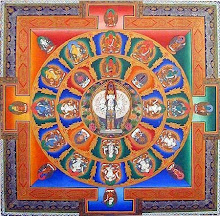


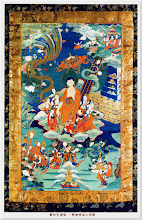

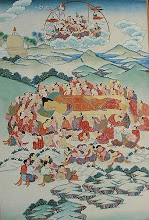


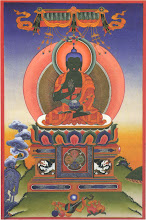


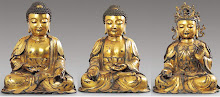.jpg)