Speech by Venerable Master Chin Kung
July 2007
----------------------------------
I left Taiwan in the 1970s, and have been traveling to various countries and regions to teach Buddhist principles based on what is taught in the Sutras. In each place I visited, I was most concerned with two things: First, the welfare of the elderly; and secondly, the rate of juvenile delinquency.
Why am I so concerned about the welfare of the elderly? The average age of the population is increasing and it is a world problem. How to take care of the livelihood of the senior citizens in a country is a major concern of most governments. To rear our children in the hope that they will look after us is wishful thinking and is not practical. Most of the members of our younger generation either failed to extend filial piety to their own parents or they lack the ability to take care of them. The home for the elderly seems to be the only solution in this situation.
When we examine the social structure of society in different countries, facilities for the elderly are hard to find. It is true that such facilities are found in some countries like the USA and Australia, especially in Australia. The Government there does look after their senior citizens. Yet, whether it was facilities provided by the Government or by private entities, the focus is on materialistic support and not support for their spiritual aspirations. The personnel involved look after the inmates like what is expected from mechanical devices. True love and compassion are seldom shown. The elderly would soon feel depressed, and abandoned. They live in solitude and would simply wait for their demise.
In such circumstances, we recently learnt from the Flower Adornment Sutra (also known as Avatamsaka Sutra). “The Four Immeasurable Compassions” concept has given us the inspiration that we have a duty to look after the aged. It is hoped that we should pull our resources together to help our senior citizens. Our senior citizens have made tremendous contribution to the society during their live time. They should have the opportunity to enjoy life in their final years. This is a way to build a selfless cordial society.
A few points for consideration:
1. Facilities and services similar to what is found in 5-star hotels should be made available. The accommodation provided should be comfortable in scenic areas. Single rooms complete with maid service should be made available. We could consider a fund raising exercise for donation or investment on a per room basis. Rooms not in use could be leased out. These could be made available to the guests of the inmates, or students who may need to make use of such facilities for study during their vacation.
Showing posts with label Culture. Show all posts
Showing posts with label Culture. Show all posts
Monday, August 11, 2008


Sunday, July 6, 2008
Sutra of the Past Vows of Earth Store Bodhisattva
This is one of the books in a series published under the sponsorship of The Institute for Advanced studies of World Religions New York, U.S.A. with the aim of making religious texts translated from various languages accessible in English.
The Collected Lectures of Tripitaka Master Hsuan Hua
Translated by American Bhiksu Heng Ching; Revised by American Bhiksuni Heng Ch’ih;
Polished by American Bhiksu Heng Kuan; Certified by Gold Mountain Sramana Dhyana Master Hsuan Hua
Buddhist Text Translation Society
The Institute for Advanced Studies of World Religions Publishers, New York, N.Y.
The translator dedicates this translation to his grandmother, Rose Klarer, and to his parents, David and Ruth Klarer.
International Standard Book Number: 0-915078-00-7
Library of Congress Catalog Card Number: 74-18135
© 1974 by the Sino-American Buddhist Association, San Francisco
All rights reserved
Printed and bound in the United States of America
_________________________________________________
Namo Earth Store Bodhisattva
Namo Ti Tsang Wang Pu Sa
Namo Ksitigarbha Bodhisattva
The sutra often instructs practitioners to recite the name of Earth Store Bodhisattva, as well as the names of various Buddhas. This is traditionally done by prefacing the name with the Sanskrit word Namo, which means praise or homage to, take refuge in, revere, etc. Thus the Bodhisattva’s name would be recited in English, Chinese, and Sanskrit as above.
________________________________________
ACKNOWLEDGMENTS
________________________________________
THIS TRANSLATION OF THE Sutra of the Past Vows of Earth Store Bodhisattva, with the explanatory lectures of Tripitaka Master Hsuan Hua, has been prepared by the Buddhist Text Translation Society of the Sino-American Buddhist Association, with headquarters at Gold Mountain Dhyana Monastery, 1731 15th Street, San Francisco, California 94103 U.S.A.
Since everyone who hears or reads a lecture has his or her own understanding, the views of a great many people have been consulted in the preparation of the translation. Although space precludes the mention of every individual, the following members of the Buddhist Text Translation society must be singled out: Dharma Masters Heng Ch’ien and Heng Shou, who, although, they did not work on this text specifically, have given a great deal of advice and criticism on many aspects of translation over the years, Upasaka I Kuo Jung has also been of great help in this regard. The task of refining the English of the initial translation has been performed by Dharma Master Heng Kuan, editor-in-chief of Vajra Bodhi Sea and chairman of the Polishing Committee of the Buddhist Text Translation Society.
In addition to an enormous amount of editorial work, a great deal of preliminary rewriting and sifting had to be done. Much of this work was done by Dharma Master Heng Ch’ih of the Revision Committee of the Buddhist Text Translation Society, who not only helped in rewriting but undertook a great deal of laborious research into Sanskrit forms and niceties of presentation. She is also responsible for putting the entire manuscript into finished typed form, a job of no small matter in itself.
Many people took part in the earlier stages of preparation of this work. Special thanks are due to the following members of the Buddhist Text Translation Society: Dharma Masters Heng Shou and Heng Chu, who did a great deal of the proof-reading and made many useful suggestions: Upasakas Kuo T’ang Yager, Ph.D. candidate; Kuo Hui Weber; Kuo Kuei Bach; Upasika Kuo Chin Vickers, who provided valuable help in preparing copies of the manuscript; and especially Upasika Kuo Tsung Bach, who handled the complex and difficult task of turning the first rough typed manuscript into presentable form.
Special thanks are due to the Venerable Dhyana Master Hsuan Hua, chairman of the Certification Board of the Buddhist Text Translation Society, for having delivered the lectures in the first place and for his constant and patient aid during the preparation of this work.
Special mention must also be made of the Institute for Advanced Studies of World Religions, which has undertaken to have this sutra published, and of Nora A. Larke and Institute copy editors Upasika Yeshe Tsomo and Leah Zahler, who devoted much talent and effort to the preparation of the work. The skilled guidance provided by Nai Yung Chang of Harry N. Abrams, Inc., in the production of this book is likewise greatly appreciated.
Buddhist Text Translation Society
________________________________________
FOREWORD
________________________________________
FROM ANCIENT TIMES, the Sutra of the Past Vows of Earth Store Bodhisattva has been one of the most popular Chinese Buddhist sutras. “Earth Store” is a literal rendering of the bodhisattva’s original Sanskrit name, Ksitigarbha. In the Buddhist pantheon, he is one of the most highly celebrated bodhisattva, along with Manjusri, Avalokitesvara, and Samantabhadra. These four represent the four basic Mahayana qualities: Manjusri represents great wisdom; Avalokitesvara, great compassion; Samantabhadra, great meritorious deeds; and Ksitigarbha, the great vow – the vow to help and to cross over all sentient beings. “If I do not go to hell (to help them there), who else will go?” is the famous pronouncement of Bodhisattva Ksitigarbha.
In the seventh century A.D., this sutra was translated by Siksananda from the Sanskrit into Chinese, but not until this publication has it ever been translated into English. Dharma Master Heng Ching’s work is not a critical study in the traditional Western scholarly sense. However, it bears special importance, as it is accompanied by the comprehensive commentary of Tripitaka Master Hsuan Hua. Without such an accompaniment, it would be very difficult, if not impossible, for Western readers to understand the significance and applications of this sutra.
One of the aims of the Institute for Advanced Studies of World Religions is to make available religious teachings that were previously inaccessible to the English-speaking student of religion. In this light, the Institute is honored to publish this invaluable source of learning and awareness.
The Institute for Advanced Studies of World Religions
APRIL 1974
________________________________________
PREFACE
________________________________________
DIRECTLY PRIOR TO THE END of the Buddha’s appearance in this world, he and his following of bhiksus journeyed to the Trayastrimsa Heaven so that the Buddha might repay the kindness of his mother by speaking Dharma on her behalf. The Dharma which he spoke on that occasion still exists to this day and is known as the Sutra of the Past Vows of Earth Store Bodhisattva. This sutra deals with filial piety – not only that which pertains to the relationship between oneself and one’s parents but rather a universal code of duty for all living beings. A skyscraper is not built from the top down, however, and as an initial step toward embodying one’s universal duty, one begins with duty to one’s immediate family and friends, of which parents are foremost in importance. Hence, when the Buddha answers the Bodhisattva Manjusri’s question concerning the past vows of the Bodhisattva Earth Store in the first chapter of this sutra, he begins by telling him of the Bodhisattva’s filial duty to his parents, which led to his illimitable vows to save all living beings.
The Bodhisattva Earth Store, drawing upon the infinite power of his unwavering resolve, appears throughout the ten directions in an innumerable number of bodies in order to lead even the most obstinate and confused living beings to step from the sea of suffering onto the shore of Nirvana. Although his vows are infinite in their scope, they still do not go beyond the simple relationship called filial piety; the only difference is one of magnitude. Whereas an ordinary person considers even the most perfunctory duty to his parents to be sufficient, the Bodhisattva Earth Store, realizing that at some time during the countless aeons of the past all living beings have been his father and mother, includes all living beings within the scope of his filial duty, a duty which can only be ultimately fulfilled by leading all beings to gain eternal bliss. Since living beings are unlimited in number, it naturally follows that the Bodhisattva’s vows are infinite in magnitude.
In order for us to take the first step out of the sea of suffering, it is necessary for us to become aware of the danger which results from allowing our actions to be affected by the confused emotions which lie so heavily upon us. To this end the Bodhisattva elucidates cause and effect, the realm of karma, informing us of the sufferings of the hells and the actions which lead to such retributions, as well as of the pleasures of the heavens and the actions which they reward. It is not the Bodhisattva’s intention, however, that we turn away in revulsion from the former and grasp at the latter, but rather that we understand the sphere of cause and effect – that simple law which says that one reaps what one sows – and that we learn to avoid planting causes for either the heavens or the hells. Furthermore, in order that we plant the seed for future contact with the Dharma, the Bodhisattva wishes to impress upon us the benefits obtained from engaging in wholesome actions, as opposed to unwholesome ones, so that we will be induced to establish a strong affinity with the Triple Jewel. Although many of the practices mentioned in this sutra are not the direct cause of Buddhahood, the seed of Buddhahood is nurtured by wholesome conduct and cultivation of the Way. These auxiliary causes lead to the direct cause, and for that reason the Bodhisattva encourages us to embody them in our practice.
This sutra is extremely practical, and it is because of this that Dhyana Master Hsuan Hua wished it to be one of the first sutras to be translated into English. With the additional enlightening aid of his lectures, even those most unfamiliar with the Dharma are enabled to grasp the essence of the teaching. The lectures were given in 1968-69 and were at that time orally translated from the Master’s Chinese into English by Dharma Master Heng Ching, who has also bestowed upon us the present translation of the sutra text and the Master’s commentary.
It is through the efforts of Dharma Master Heng Ching that this sutra can now be studied by students of Dharma in the West, with the knowledge that it agrees with the original principles of Buddhism as they were elucidated by the Buddha. When I say efforts, I do not refer merely to the work of translation; for although it was a task which required many months of diligent attention, it rests upon years of study of the Chinese language and actual cultivation of the principles of the Buddhist path to enlightenment. Dharma Master Heng Ching has studied the Chinese language for more than ten years, and he spent the last five of those years under the expert tutelage of the Dhyana Master, who is not only an embodiment of the very heart of Buddhism but also an extremely erudite scholar. Thus Dharma Master Heng Ching has become intimately acquainted with both the doctrinal and practical aspects of the Dharma in a manner that is shared by few people. Under the Master’s guidance he has studied and helped give oral translations of literally thousands of lectures on sutras such as the Surangama Sutra, the Wonderful Dharma Lotus Blossom Sutra, the Diamond Sutra, the Heart Sutra, and the Avatamsaka Sutra, among others. He has also personally delivered lectures on this sutra, the Surangama Sutra, the Heart Sutra, and the Divination of Good and Evil Karmic Retribution Sutra.
In addition to Dharma Master Heng Ching’s daily practice, he has attended many Buddha Recitation Sessions, Mantra Recitation Sessions, and Meditation Sessions, one of which lasted for ninety-eight days, with twenty-one hours of practice each day. What is most important, however, is not that he attended so many lectures and participated in so many sessions, but that he has actually made a good deal of progress in his cultivation. This puts him far above ordinary scholars, not to speak of those people who have reduced the Dharma to a pathetic exchange of witty remarks based on nothing but sheer confusion. Thus, it is with pleasure that I introduce this sutra to other students of the Dharma.
American Bhiksu Heng Ch’ien
Buddhist Lecture Hall, Hong Kong
Earth Store Bodhisattva’s Birthday,
AUGUST, 1973
________________________________________
TRANSLATOR’S INTRODUCTION
________________________________________
THOUSANDS OF YEARS OF TRADITION have shown that there is no substitute for oral instruction. What is more, we in the West have long been hampered in our study of Buddhism by the lack of both adequate texts in English and qualified interpreters to transmit traditional explanations. Even though a few teachers have come to the West, there still remain the problems of access and linguistics. This work provides a solution to these problems by presenting in English translation what was originally a lectured commentary in Chinese.
Dhyana Master Hsuan Hua, founder of the Sino-American Buddhist Association, has been delivering oral commentaries on Buddhist texts for many years. Although based in an age-old tradition, he reveals the Buddhist tradition in a manner that speaks not only to specialists and historians but to all those faced with the continuing problems of human existence in a modern age. All the Master’s lectures since 1968 have been recorded and are being translated, this book being the second in a series of his collected lectures.
That the Master’s lectures are truly effective in terms of the real aim of Buddhism, which is to bring about a change in the lives of the audience, is quite obvious to those who have experienced his teaching. On several occasions during this lecture series, particularly when he discussed the depths of Earth Store Bodhisattva’s filial practice in past lives, many members of the audience were moved to tears. This is not, of course, to say that the Master’s style evokes weeping only; on many occasions his lively wit introduced a humorous and lighthearted mood in the assembly.
Unfortunately, in the transformation of a spoken lecture to the printed page, most such effects are necessarily lost. We have tried as much as possible to retain the flavor of the spoken word while avoiding some of the tedium that can come from a mere verbatim transcription. On the other hand, as we tried to approach the conventions of written English, we have dropped some of the more trivial scholarly niceties. Thus the reader will not find Sanskrit and Chinese words set off by italics; they will be presented as any other word in context and explained.
The good points of the translation are due to the combined efforts of all the member of the Sino-American Buddhist Association, the Buddhist Text Translation Society, the Institute for Advanced Studies of World Religions, and the editorial staff of Vajra Bodhi Sea, in whose journal these lectures first appeared. Any errors or faults are, of course, solely the translator’s responsibility.
American Bhiksu Heng Ching
Gold Mountain Dhyana Monastery, San Francisco
Earth Store Bodhisattva’s Birthday,
AUGUST, 1973
________________________________________
CONTENTS
________________________________________
INTRODUCTION
CHAPTER ONE
Spiritual Penetrations in the Palace of the Trayastrimsa Heaven
CHAPTER TWO
The Assembly of the Reduplicated Bodies
CHAPTER THREE
Contemplating the Karmic Conditions of Living Beings
CHAPTER FOUR
Karmic Retribution of Living Beings
CHAPTER FIVE
The Names of the Hells
CHAPTER SIX
The Thus Come One’s Praises
CHAPTER SEVEN
Benefits for the Living and the Dead
CHAPTER EIGHT
The Praises of the Multitudes of King Yama
CHAPTER NINE
The Names of Buddhas
CHAPTER TEN
The Conditions and Comparative Merits of Giving
CHAPTER ELEVEN
The Dharma Protection of the Earth Spirit
CHAPTER TWELVE
The Benefits from Seeing and Hearing
CHAPTER THIRTEEN
The Entrustment of Men and Gods
GLOSSARY
BUDDHIST TEXT TRANSLATION SOCIETY
________________________________________
INTRODUCTION
________________________________________
SUTRAS MAY BE INTRODUCED in a number of ways, all of which help bring out the basic meaning of the text. In studying this sutra we shall approach the text through the investigation of the following six items:
I. The reasons for the arising of the teaching
II. The division and vehicle to which the sutra belongs
III. A determination of the sutra’s principle
IV. A full explanation of the title
V. A history of the translation
VI. A detailed explanation of the sutra
I. THE REASONS FOR THE ARISING OF THE TEACHING
Shortly after Sakyamuni’s birth from his mother’s side, his mother died and ascended to the heavens. After he had become a Buddha and had spoken Dharma for forty-nine years at over three hundred assemblies, he went to the Trayastrimsa Heaven to teach her. This occurred between the speaking of The Wonderful Dharma Lotus Blossom Sutra and The Nirvana Sutra. He stayed in that heaven for three months and spoke this sutra of filial piety, The Sutra of the Past Vows of Earth Store Bodhisattva.
II. THE DIVISION AND VEHICLE TO WHICH THE SUTRA BELONGS
Division refers to the three divisions of the canon, the Sutras, the Sastras, and the Vinaya. The Sutras encompass the study of Samadhi, the Sastras, the study of wisdom, and the Vinaya, the study of moral precepts. Since this sutra discusses morality it belongs to both the Sutra and Vinaya stores.
Vehicle refers to the Five Vehicles. Although some people say that there are only three – the Vehicles of the Sound-hearers, of Those Enlightened to Causation, and of Bodhisattvas – the Vehicles of Men and Gods can be added to these to make five. This sutra deals with the Vehicles of Men, Gods, and Bodhisattvas.
III. A DETERMINATION OF THE SUTRA’S PRINCIPLE
The foundations of this sutra are principles contained in eight terms grouped in four headings:
1. The practice of filial piety
2. The crossing over of living beings
3. The rescuing of sufferers
4. The repaying of kindness
1. To practice filial piety means to be “filial” to one’s parents and thus to be a dazzling light over the entire world. Both heaven and earth are greatly pleased by filial piety and so it is said, “Heaven and earth deem filial piety essential; filial piety is foremost. With one filial son, an entire family is peaceful.” If you are filial to your parents, your children will be filial to you; if you are not filial to your parents, your children will treat you in the same manner.
One may think, “What is the point of being human? Isn’t it merely to try to get by as well as possible?”
It certainly is not! The first duty of human beings is to be filial to their parents. Father and mother are heaven and earth, father and mother are all the elders, and father and mother are all the Buddhas. If you had no parents you would have no body, and if you had no body, you could not become a Buddha. If you want to become a Buddha, you must start out by being filial to your parents.
2. The crossing over of living beings. To cross means to go from one shore to another, from affliction to Bodhi; the Six Paramitas are also known as the six crossings-over. To cross beings over does not mean to cross over merely one, two, three, or four, but to cross all the ten kinds of living beings, so that they reach Buddhahood.
3. The rescuing of sufferers. This sutra is able to pull living beings out of their sufferings.
4. The repaying of kindness. This means to repay the kindness of parents.
I have mentioned only the essential points of these four phrases and will leave it to you to make further investigation of them.
At the mention of the first of these headings, the practice of filial piety, some people will immediately think of rushing home to be filial to their parents. This in itself is an excellent wish and is quite commendable. It is extremely important, however, that those who return home to care for their parents not forget everything they have learned and find themselves slipping back into their old habits. The way to practice ultimate filial piety is to learn how to be a model for and a benefit to the world; the very best way to do that is to study and practice the Buddhadharma.
There are four basic kinds of filial piety: limited, extensive, contemporary, and classic. Limited filial piety is to be filial within your own family but to be unable to “treat others’ elders as your own, treat others’ children as your own.” With extensive filial piety you reach throughout the world and take all fathers and mothers in the world as your own. Although this filial piety is large, it is by no means ultimate.
What then is ultimate filial piety? It is far beyond the scope of the four mentioned above. Sakyamuni Buddha’s father locked him in the palace and he stole away to cultivate a life of austerity in the Himalayas for six years, after which he finally realized Buddhahood beneath the Bodhi tree. After he had become a Buddha, he ascended to the heavens to speak Dharma for his mother. This ultimate filial piety.
Contemporary filial piety is to model oneself on present-day methods of filial piety and to study their methods of behavior.
Classic filial piety is to be filial to all the myriad things, in the same way as the Twenty-four Paragons of Filial Virtue in China. But even classic filial piety is not ultimate. If you want to practice ultimate filial piety you should investigate and practice the Buddhadharma; learn to be a good person and a positive force in the world. The practice of acts that benefit society is being genuinely filial to your parents.
IV. A FULL EXPLANATION OF THE TITLE
The name of this sutra is the Sutra of the Past Vows of Earth Store Bodhisattva, and among the seven classifications of sutra titles it belongs to those made up of a person and a dharma. Earth Store Bodhisattva is the person and past vows a dharma. Past vows can also be said to represent karma, since they are deeds that he performed in the past.
Earth Store Bodhisattva is named after the earth, which not only gives birth to things and makes them grow but can store a great many things within itself as well. Because this Bodhisattva is like the earth, he can produce the myriad things and make them grow. Anyone who believes in him may obtain the treasures stored in the ground: gold, silver, lapis lazuli, crystal, mother-of-pearl, red pearls, and carnelian.
Bodhisattva is composed of two words: Bodhi, which means “enlightenment,” and sattva, which means “being.” A Bodhisattva can be said to be either one who enlightens living beings or an enlightened living being.
Past Vows also mean fundamental vows, vows that were made aeons ago. Long ago in the distant past Earth Store Bodhisattva vowed, “If the hells are not empty I will not become a Buddha; when living beings have all been saved, I will attain to Bodhi.”
The hells cannot cease to exist until the karma and the afflictions of living beings have come to an end, and that can never happen because of the nature of living beings. Viewed in the light of modern science and philosophy, isn’t Earth Store Bodhisattva’s behavior irrational? Doesn’t it mean that Earth Store Bodhisattva will never have the opportunity to become a Buddha?
No, it does not mean that he cannot become a Buddha, and his vow is by no means irrational. In fact, his behavior is a manifestation of great compassion.
The Collected Lectures of Tripitaka Master Hsuan Hua
Translated by American Bhiksu Heng Ching; Revised by American Bhiksuni Heng Ch’ih;
Polished by American Bhiksu Heng Kuan; Certified by Gold Mountain Sramana Dhyana Master Hsuan Hua
Buddhist Text Translation Society
The Institute for Advanced Studies of World Religions Publishers, New York, N.Y.
The translator dedicates this translation to his grandmother, Rose Klarer, and to his parents, David and Ruth Klarer.
International Standard Book Number: 0-915078-00-7
Library of Congress Catalog Card Number: 74-18135
© 1974 by the Sino-American Buddhist Association, San Francisco
All rights reserved
Printed and bound in the United States of America
_________________________________________________
Namo Earth Store Bodhisattva
Namo Ti Tsang Wang Pu Sa
Namo Ksitigarbha Bodhisattva
The sutra often instructs practitioners to recite the name of Earth Store Bodhisattva, as well as the names of various Buddhas. This is traditionally done by prefacing the name with the Sanskrit word Namo, which means praise or homage to, take refuge in, revere, etc. Thus the Bodhisattva’s name would be recited in English, Chinese, and Sanskrit as above.
________________________________________
ACKNOWLEDGMENTS
________________________________________
THIS TRANSLATION OF THE Sutra of the Past Vows of Earth Store Bodhisattva, with the explanatory lectures of Tripitaka Master Hsuan Hua, has been prepared by the Buddhist Text Translation Society of the Sino-American Buddhist Association, with headquarters at Gold Mountain Dhyana Monastery, 1731 15th Street, San Francisco, California 94103 U.S.A.
Since everyone who hears or reads a lecture has his or her own understanding, the views of a great many people have been consulted in the preparation of the translation. Although space precludes the mention of every individual, the following members of the Buddhist Text Translation society must be singled out: Dharma Masters Heng Ch’ien and Heng Shou, who, although, they did not work on this text specifically, have given a great deal of advice and criticism on many aspects of translation over the years, Upasaka I Kuo Jung has also been of great help in this regard. The task of refining the English of the initial translation has been performed by Dharma Master Heng Kuan, editor-in-chief of Vajra Bodhi Sea and chairman of the Polishing Committee of the Buddhist Text Translation Society.
In addition to an enormous amount of editorial work, a great deal of preliminary rewriting and sifting had to be done. Much of this work was done by Dharma Master Heng Ch’ih of the Revision Committee of the Buddhist Text Translation Society, who not only helped in rewriting but undertook a great deal of laborious research into Sanskrit forms and niceties of presentation. She is also responsible for putting the entire manuscript into finished typed form, a job of no small matter in itself.
Many people took part in the earlier stages of preparation of this work. Special thanks are due to the following members of the Buddhist Text Translation Society: Dharma Masters Heng Shou and Heng Chu, who did a great deal of the proof-reading and made many useful suggestions: Upasakas Kuo T’ang Yager, Ph.D. candidate; Kuo Hui Weber; Kuo Kuei Bach; Upasika Kuo Chin Vickers, who provided valuable help in preparing copies of the manuscript; and especially Upasika Kuo Tsung Bach, who handled the complex and difficult task of turning the first rough typed manuscript into presentable form.
Special thanks are due to the Venerable Dhyana Master Hsuan Hua, chairman of the Certification Board of the Buddhist Text Translation Society, for having delivered the lectures in the first place and for his constant and patient aid during the preparation of this work.
Special mention must also be made of the Institute for Advanced Studies of World Religions, which has undertaken to have this sutra published, and of Nora A. Larke and Institute copy editors Upasika Yeshe Tsomo and Leah Zahler, who devoted much talent and effort to the preparation of the work. The skilled guidance provided by Nai Yung Chang of Harry N. Abrams, Inc., in the production of this book is likewise greatly appreciated.
Buddhist Text Translation Society
________________________________________
FOREWORD
________________________________________
FROM ANCIENT TIMES, the Sutra of the Past Vows of Earth Store Bodhisattva has been one of the most popular Chinese Buddhist sutras. “Earth Store” is a literal rendering of the bodhisattva’s original Sanskrit name, Ksitigarbha. In the Buddhist pantheon, he is one of the most highly celebrated bodhisattva, along with Manjusri, Avalokitesvara, and Samantabhadra. These four represent the four basic Mahayana qualities: Manjusri represents great wisdom; Avalokitesvara, great compassion; Samantabhadra, great meritorious deeds; and Ksitigarbha, the great vow – the vow to help and to cross over all sentient beings. “If I do not go to hell (to help them there), who else will go?” is the famous pronouncement of Bodhisattva Ksitigarbha.
In the seventh century A.D., this sutra was translated by Siksananda from the Sanskrit into Chinese, but not until this publication has it ever been translated into English. Dharma Master Heng Ching’s work is not a critical study in the traditional Western scholarly sense. However, it bears special importance, as it is accompanied by the comprehensive commentary of Tripitaka Master Hsuan Hua. Without such an accompaniment, it would be very difficult, if not impossible, for Western readers to understand the significance and applications of this sutra.
One of the aims of the Institute for Advanced Studies of World Religions is to make available religious teachings that were previously inaccessible to the English-speaking student of religion. In this light, the Institute is honored to publish this invaluable source of learning and awareness.
The Institute for Advanced Studies of World Religions
APRIL 1974
________________________________________
PREFACE
________________________________________
DIRECTLY PRIOR TO THE END of the Buddha’s appearance in this world, he and his following of bhiksus journeyed to the Trayastrimsa Heaven so that the Buddha might repay the kindness of his mother by speaking Dharma on her behalf. The Dharma which he spoke on that occasion still exists to this day and is known as the Sutra of the Past Vows of Earth Store Bodhisattva. This sutra deals with filial piety – not only that which pertains to the relationship between oneself and one’s parents but rather a universal code of duty for all living beings. A skyscraper is not built from the top down, however, and as an initial step toward embodying one’s universal duty, one begins with duty to one’s immediate family and friends, of which parents are foremost in importance. Hence, when the Buddha answers the Bodhisattva Manjusri’s question concerning the past vows of the Bodhisattva Earth Store in the first chapter of this sutra, he begins by telling him of the Bodhisattva’s filial duty to his parents, which led to his illimitable vows to save all living beings.
The Bodhisattva Earth Store, drawing upon the infinite power of his unwavering resolve, appears throughout the ten directions in an innumerable number of bodies in order to lead even the most obstinate and confused living beings to step from the sea of suffering onto the shore of Nirvana. Although his vows are infinite in their scope, they still do not go beyond the simple relationship called filial piety; the only difference is one of magnitude. Whereas an ordinary person considers even the most perfunctory duty to his parents to be sufficient, the Bodhisattva Earth Store, realizing that at some time during the countless aeons of the past all living beings have been his father and mother, includes all living beings within the scope of his filial duty, a duty which can only be ultimately fulfilled by leading all beings to gain eternal bliss. Since living beings are unlimited in number, it naturally follows that the Bodhisattva’s vows are infinite in magnitude.
In order for us to take the first step out of the sea of suffering, it is necessary for us to become aware of the danger which results from allowing our actions to be affected by the confused emotions which lie so heavily upon us. To this end the Bodhisattva elucidates cause and effect, the realm of karma, informing us of the sufferings of the hells and the actions which lead to such retributions, as well as of the pleasures of the heavens and the actions which they reward. It is not the Bodhisattva’s intention, however, that we turn away in revulsion from the former and grasp at the latter, but rather that we understand the sphere of cause and effect – that simple law which says that one reaps what one sows – and that we learn to avoid planting causes for either the heavens or the hells. Furthermore, in order that we plant the seed for future contact with the Dharma, the Bodhisattva wishes to impress upon us the benefits obtained from engaging in wholesome actions, as opposed to unwholesome ones, so that we will be induced to establish a strong affinity with the Triple Jewel. Although many of the practices mentioned in this sutra are not the direct cause of Buddhahood, the seed of Buddhahood is nurtured by wholesome conduct and cultivation of the Way. These auxiliary causes lead to the direct cause, and for that reason the Bodhisattva encourages us to embody them in our practice.
This sutra is extremely practical, and it is because of this that Dhyana Master Hsuan Hua wished it to be one of the first sutras to be translated into English. With the additional enlightening aid of his lectures, even those most unfamiliar with the Dharma are enabled to grasp the essence of the teaching. The lectures were given in 1968-69 and were at that time orally translated from the Master’s Chinese into English by Dharma Master Heng Ching, who has also bestowed upon us the present translation of the sutra text and the Master’s commentary.
It is through the efforts of Dharma Master Heng Ching that this sutra can now be studied by students of Dharma in the West, with the knowledge that it agrees with the original principles of Buddhism as they were elucidated by the Buddha. When I say efforts, I do not refer merely to the work of translation; for although it was a task which required many months of diligent attention, it rests upon years of study of the Chinese language and actual cultivation of the principles of the Buddhist path to enlightenment. Dharma Master Heng Ching has studied the Chinese language for more than ten years, and he spent the last five of those years under the expert tutelage of the Dhyana Master, who is not only an embodiment of the very heart of Buddhism but also an extremely erudite scholar. Thus Dharma Master Heng Ching has become intimately acquainted with both the doctrinal and practical aspects of the Dharma in a manner that is shared by few people. Under the Master’s guidance he has studied and helped give oral translations of literally thousands of lectures on sutras such as the Surangama Sutra, the Wonderful Dharma Lotus Blossom Sutra, the Diamond Sutra, the Heart Sutra, and the Avatamsaka Sutra, among others. He has also personally delivered lectures on this sutra, the Surangama Sutra, the Heart Sutra, and the Divination of Good and Evil Karmic Retribution Sutra.
In addition to Dharma Master Heng Ching’s daily practice, he has attended many Buddha Recitation Sessions, Mantra Recitation Sessions, and Meditation Sessions, one of which lasted for ninety-eight days, with twenty-one hours of practice each day. What is most important, however, is not that he attended so many lectures and participated in so many sessions, but that he has actually made a good deal of progress in his cultivation. This puts him far above ordinary scholars, not to speak of those people who have reduced the Dharma to a pathetic exchange of witty remarks based on nothing but sheer confusion. Thus, it is with pleasure that I introduce this sutra to other students of the Dharma.
American Bhiksu Heng Ch’ien
Buddhist Lecture Hall, Hong Kong
Earth Store Bodhisattva’s Birthday,
AUGUST, 1973
________________________________________
TRANSLATOR’S INTRODUCTION
________________________________________
THOUSANDS OF YEARS OF TRADITION have shown that there is no substitute for oral instruction. What is more, we in the West have long been hampered in our study of Buddhism by the lack of both adequate texts in English and qualified interpreters to transmit traditional explanations. Even though a few teachers have come to the West, there still remain the problems of access and linguistics. This work provides a solution to these problems by presenting in English translation what was originally a lectured commentary in Chinese.
Dhyana Master Hsuan Hua, founder of the Sino-American Buddhist Association, has been delivering oral commentaries on Buddhist texts for many years. Although based in an age-old tradition, he reveals the Buddhist tradition in a manner that speaks not only to specialists and historians but to all those faced with the continuing problems of human existence in a modern age. All the Master’s lectures since 1968 have been recorded and are being translated, this book being the second in a series of his collected lectures.
That the Master’s lectures are truly effective in terms of the real aim of Buddhism, which is to bring about a change in the lives of the audience, is quite obvious to those who have experienced his teaching. On several occasions during this lecture series, particularly when he discussed the depths of Earth Store Bodhisattva’s filial practice in past lives, many members of the audience were moved to tears. This is not, of course, to say that the Master’s style evokes weeping only; on many occasions his lively wit introduced a humorous and lighthearted mood in the assembly.
Unfortunately, in the transformation of a spoken lecture to the printed page, most such effects are necessarily lost. We have tried as much as possible to retain the flavor of the spoken word while avoiding some of the tedium that can come from a mere verbatim transcription. On the other hand, as we tried to approach the conventions of written English, we have dropped some of the more trivial scholarly niceties. Thus the reader will not find Sanskrit and Chinese words set off by italics; they will be presented as any other word in context and explained.
The good points of the translation are due to the combined efforts of all the member of the Sino-American Buddhist Association, the Buddhist Text Translation Society, the Institute for Advanced Studies of World Religions, and the editorial staff of Vajra Bodhi Sea, in whose journal these lectures first appeared. Any errors or faults are, of course, solely the translator’s responsibility.
American Bhiksu Heng Ching
Gold Mountain Dhyana Monastery, San Francisco
Earth Store Bodhisattva’s Birthday,
AUGUST, 1973
________________________________________
CONTENTS
________________________________________
INTRODUCTION
CHAPTER ONE
Spiritual Penetrations in the Palace of the Trayastrimsa Heaven
CHAPTER TWO
The Assembly of the Reduplicated Bodies
CHAPTER THREE
Contemplating the Karmic Conditions of Living Beings
CHAPTER FOUR
Karmic Retribution of Living Beings
CHAPTER FIVE
The Names of the Hells
CHAPTER SIX
The Thus Come One’s Praises
CHAPTER SEVEN
Benefits for the Living and the Dead
CHAPTER EIGHT
The Praises of the Multitudes of King Yama
CHAPTER NINE
The Names of Buddhas
CHAPTER TEN
The Conditions and Comparative Merits of Giving
CHAPTER ELEVEN
The Dharma Protection of the Earth Spirit
CHAPTER TWELVE
The Benefits from Seeing and Hearing
CHAPTER THIRTEEN
The Entrustment of Men and Gods
GLOSSARY
BUDDHIST TEXT TRANSLATION SOCIETY
________________________________________
INTRODUCTION
________________________________________
SUTRAS MAY BE INTRODUCED in a number of ways, all of which help bring out the basic meaning of the text. In studying this sutra we shall approach the text through the investigation of the following six items:
I. The reasons for the arising of the teaching
II. The division and vehicle to which the sutra belongs
III. A determination of the sutra’s principle
IV. A full explanation of the title
V. A history of the translation
VI. A detailed explanation of the sutra
I. THE REASONS FOR THE ARISING OF THE TEACHING
Shortly after Sakyamuni’s birth from his mother’s side, his mother died and ascended to the heavens. After he had become a Buddha and had spoken Dharma for forty-nine years at over three hundred assemblies, he went to the Trayastrimsa Heaven to teach her. This occurred between the speaking of The Wonderful Dharma Lotus Blossom Sutra and The Nirvana Sutra. He stayed in that heaven for three months and spoke this sutra of filial piety, The Sutra of the Past Vows of Earth Store Bodhisattva.
II. THE DIVISION AND VEHICLE TO WHICH THE SUTRA BELONGS
Division refers to the three divisions of the canon, the Sutras, the Sastras, and the Vinaya. The Sutras encompass the study of Samadhi, the Sastras, the study of wisdom, and the Vinaya, the study of moral precepts. Since this sutra discusses morality it belongs to both the Sutra and Vinaya stores.
Vehicle refers to the Five Vehicles. Although some people say that there are only three – the Vehicles of the Sound-hearers, of Those Enlightened to Causation, and of Bodhisattvas – the Vehicles of Men and Gods can be added to these to make five. This sutra deals with the Vehicles of Men, Gods, and Bodhisattvas.
III. A DETERMINATION OF THE SUTRA’S PRINCIPLE
The foundations of this sutra are principles contained in eight terms grouped in four headings:
1. The practice of filial piety
2. The crossing over of living beings
3. The rescuing of sufferers
4. The repaying of kindness
1. To practice filial piety means to be “filial” to one’s parents and thus to be a dazzling light over the entire world. Both heaven and earth are greatly pleased by filial piety and so it is said, “Heaven and earth deem filial piety essential; filial piety is foremost. With one filial son, an entire family is peaceful.” If you are filial to your parents, your children will be filial to you; if you are not filial to your parents, your children will treat you in the same manner.
One may think, “What is the point of being human? Isn’t it merely to try to get by as well as possible?”
It certainly is not! The first duty of human beings is to be filial to their parents. Father and mother are heaven and earth, father and mother are all the elders, and father and mother are all the Buddhas. If you had no parents you would have no body, and if you had no body, you could not become a Buddha. If you want to become a Buddha, you must start out by being filial to your parents.
2. The crossing over of living beings. To cross means to go from one shore to another, from affliction to Bodhi; the Six Paramitas are also known as the six crossings-over. To cross beings over does not mean to cross over merely one, two, three, or four, but to cross all the ten kinds of living beings, so that they reach Buddhahood.
3. The rescuing of sufferers. This sutra is able to pull living beings out of their sufferings.
4. The repaying of kindness. This means to repay the kindness of parents.
I have mentioned only the essential points of these four phrases and will leave it to you to make further investigation of them.
At the mention of the first of these headings, the practice of filial piety, some people will immediately think of rushing home to be filial to their parents. This in itself is an excellent wish and is quite commendable. It is extremely important, however, that those who return home to care for their parents not forget everything they have learned and find themselves slipping back into their old habits. The way to practice ultimate filial piety is to learn how to be a model for and a benefit to the world; the very best way to do that is to study and practice the Buddhadharma.
There are four basic kinds of filial piety: limited, extensive, contemporary, and classic. Limited filial piety is to be filial within your own family but to be unable to “treat others’ elders as your own, treat others’ children as your own.” With extensive filial piety you reach throughout the world and take all fathers and mothers in the world as your own. Although this filial piety is large, it is by no means ultimate.
What then is ultimate filial piety? It is far beyond the scope of the four mentioned above. Sakyamuni Buddha’s father locked him in the palace and he stole away to cultivate a life of austerity in the Himalayas for six years, after which he finally realized Buddhahood beneath the Bodhi tree. After he had become a Buddha, he ascended to the heavens to speak Dharma for his mother. This ultimate filial piety.
Contemporary filial piety is to model oneself on present-day methods of filial piety and to study their methods of behavior.
Classic filial piety is to be filial to all the myriad things, in the same way as the Twenty-four Paragons of Filial Virtue in China. But even classic filial piety is not ultimate. If you want to practice ultimate filial piety you should investigate and practice the Buddhadharma; learn to be a good person and a positive force in the world. The practice of acts that benefit society is being genuinely filial to your parents.
IV. A FULL EXPLANATION OF THE TITLE
The name of this sutra is the Sutra of the Past Vows of Earth Store Bodhisattva, and among the seven classifications of sutra titles it belongs to those made up of a person and a dharma. Earth Store Bodhisattva is the person and past vows a dharma. Past vows can also be said to represent karma, since they are deeds that he performed in the past.
Earth Store Bodhisattva is named after the earth, which not only gives birth to things and makes them grow but can store a great many things within itself as well. Because this Bodhisattva is like the earth, he can produce the myriad things and make them grow. Anyone who believes in him may obtain the treasures stored in the ground: gold, silver, lapis lazuli, crystal, mother-of-pearl, red pearls, and carnelian.
Bodhisattva is composed of two words: Bodhi, which means “enlightenment,” and sattva, which means “being.” A Bodhisattva can be said to be either one who enlightens living beings or an enlightened living being.
Past Vows also mean fundamental vows, vows that were made aeons ago. Long ago in the distant past Earth Store Bodhisattva vowed, “If the hells are not empty I will not become a Buddha; when living beings have all been saved, I will attain to Bodhi.”
The hells cannot cease to exist until the karma and the afflictions of living beings have come to an end, and that can never happen because of the nature of living beings. Viewed in the light of modern science and philosophy, isn’t Earth Store Bodhisattva’s behavior irrational? Doesn’t it mean that Earth Store Bodhisattva will never have the opportunity to become a Buddha?
No, it does not mean that he cannot become a Buddha, and his vow is by no means irrational. In fact, his behavior is a manifestation of great compassion.
Wednesday, July 2, 2008
Speech of the Multi-Faith
Speech for the Opening Ceremony of the Multi-Faith Centre at Griffith University Given by Venerable Master Chin Kung
23 May 2002
Respected Chancellor, Vice Chancellor, religious leaders, ladies and gentlemen: Good Morning.
I have heard the prayers of twelve representatives from different faiths. I was deeply moved by their words, the words of loving peace.
Today our world is filled with natural disasters and man-made disasters. Our situation is critical. Therefore, it has become crucial to unite all religions and ethnicities.
About one year ago, when Mr. Uri Themal told me that Griffith University planned to build a Multi-Faith Centre, I was deeply touched that Griffith could do something so great for our world. All of us should do everything possible to bring the aspirations of this project to fruition.
There are many wise people in the world who wish to help eliminate disasters and reach world peace. Humanity has longed for peace for millennium, yet lasting peace has yet to be realized. Cruelty, conflicts, and wars are increasing. Why? This is a profound and extensive problem.
We are all religious followers. We deeply believe that there is only one God. He has incredible wisdom and ability, and can help all beings in the universe who are suffering.
The Universe is an extended family, like a city where we live. The Milky Way is like the community in which we live. The Earth is like our immediate family. Therefore, all who live on this Earth are one family. God will manifest in various identities to give countless forms of guidance to meet the needs of beings in different areas. In China, he manifested as Confucius, Mencius, Lao-Tzu, and Chuang-Tzu. In India, he manifested as Brahma and Buddha. In the Middle East, he manifested as Jesus and Mohammed. His incarnation is omnipresent and supreme. The image of his incarnation may be different, but his teachings are the same.
"God loves all people." God loves everyone regardless of their nationality, race, faith, or culture. Jesus taught "Love." Buddha spoke of "Compassion." Muhammad taught "Mercy." Therefore, when we carefully observe the religious scriptures, we find the world's religions are based on "Compassion and Love." Then why do we not yet have peace? It is because of our lack of sincere lovingkindness.
Through the teaching of many religious scriptures, we can conclude that God guides us to be leaders, parents, and teachers for all sentient beings. Especially important is the role of parent and teacher. To provide the best example, we should care for all beings as parents care for their children and as teachers guide their students.
We know we must resolve conflicts in order to attain peace. Where do conflicts come from? They come from the family. In today's families, we see conflicts between husbands and wives, between parents and children, and brothers and sisters. When these conflicts are carried into society, there are conflicts between employers and employees, leaders and subordinates. Then, there are fights among ethnic groups and countries, and this is the cause of our disasters today.
But the deepest conflict can only be spoken of by the saints, we ordinary being would never be able to speak of this. As the Buddha said, it is the conflict between the true nature and our habitual human nature. In other words, it is the conflict between the benefit of others and self-benefit. All the sages and saints have taught us to give up selfishness, to care for others, society, and all beings in the universe. Doing this, we will be the messengers of God, the disciples of God.
We definitely cannot underestimate the importance of each of our thoughts. The reality is that the vibration from our thoughts will spread throughout the universe in an instant. Therefore, to eliminate conflict in order to promote peace, we must start from awareness of our every thought.
Although I have not been in Australia for long, many of the people whom I have met and been touched by are messengers of God, and successors to Buddha.
I hope that through this Centre, many religious leaders and followers can learn from one another, encourage one another, respect one another, and work together to bring not only bring happiness to Australia, but also to bring peace and harmony to the whole world and well-being to all people.
Yesterday, when I read the three-year proposal for the Centre, and then when I visited here a few days ago and saw the new building, I felt very happy. Today, as I listen to the heart-felt wishes from each religious leader, I am very thankful for their aspirations. We shall do our best to promote world peace and harmony as well as well-being for all human beings to accomplish great kindness and virtue.
Finally, I hope people of diverse ethnicity and faiths will not isolate themselves from others but will, instead, communicate with one another. The Chinese say that when people come together, they will develop close ties. Only through communication will all of our problems be solved. Misunderstandings and conflicts come from a lack of communication. It is necessary for all people, religions, and nations to foster closer ties through contact, exchange, and dialogue. This is the only path to the resolution of misunderstandings and to peace.
Even when I was young, I was convinced that religions provided the best social and sacred education. Last month, on a visit to Japan, I saw a master who is 97 years old. He told me that the founders of all religions of the world are the manifestations of Guan Yin Bodhisattva. So we are one family. If we truly understand this, how can different religions not work together? They will unite. When different faiths and ethnic groups can work together, world peace can be attained, society will be stable, and the welfare of people will be fulfilled.
In conclusion, I would like to express my gratitude to the Griffith University, and especially to the Chancellor and Vice Chancellor for their work to unite and guide all faiths to unite as one family. I offer my best wishes for good health, happiness, and good fortune to everyone.
Thank you.
-----------------
23 May 2002
Respected Chancellor, Vice Chancellor, religious leaders, ladies and gentlemen: Good Morning.
I have heard the prayers of twelve representatives from different faiths. I was deeply moved by their words, the words of loving peace.
Today our world is filled with natural disasters and man-made disasters. Our situation is critical. Therefore, it has become crucial to unite all religions and ethnicities.
About one year ago, when Mr. Uri Themal told me that Griffith University planned to build a Multi-Faith Centre, I was deeply touched that Griffith could do something so great for our world. All of us should do everything possible to bring the aspirations of this project to fruition.
There are many wise people in the world who wish to help eliminate disasters and reach world peace. Humanity has longed for peace for millennium, yet lasting peace has yet to be realized. Cruelty, conflicts, and wars are increasing. Why? This is a profound and extensive problem.
We are all religious followers. We deeply believe that there is only one God. He has incredible wisdom and ability, and can help all beings in the universe who are suffering.
The Universe is an extended family, like a city where we live. The Milky Way is like the community in which we live. The Earth is like our immediate family. Therefore, all who live on this Earth are one family. God will manifest in various identities to give countless forms of guidance to meet the needs of beings in different areas. In China, he manifested as Confucius, Mencius, Lao-Tzu, and Chuang-Tzu. In India, he manifested as Brahma and Buddha. In the Middle East, he manifested as Jesus and Mohammed. His incarnation is omnipresent and supreme. The image of his incarnation may be different, but his teachings are the same.
"God loves all people." God loves everyone regardless of their nationality, race, faith, or culture. Jesus taught "Love." Buddha spoke of "Compassion." Muhammad taught "Mercy." Therefore, when we carefully observe the religious scriptures, we find the world's religions are based on "Compassion and Love." Then why do we not yet have peace? It is because of our lack of sincere lovingkindness.
Through the teaching of many religious scriptures, we can conclude that God guides us to be leaders, parents, and teachers for all sentient beings. Especially important is the role of parent and teacher. To provide the best example, we should care for all beings as parents care for their children and as teachers guide their students.
We know we must resolve conflicts in order to attain peace. Where do conflicts come from? They come from the family. In today's families, we see conflicts between husbands and wives, between parents and children, and brothers and sisters. When these conflicts are carried into society, there are conflicts between employers and employees, leaders and subordinates. Then, there are fights among ethnic groups and countries, and this is the cause of our disasters today.
But the deepest conflict can only be spoken of by the saints, we ordinary being would never be able to speak of this. As the Buddha said, it is the conflict between the true nature and our habitual human nature. In other words, it is the conflict between the benefit of others and self-benefit. All the sages and saints have taught us to give up selfishness, to care for others, society, and all beings in the universe. Doing this, we will be the messengers of God, the disciples of God.
We definitely cannot underestimate the importance of each of our thoughts. The reality is that the vibration from our thoughts will spread throughout the universe in an instant. Therefore, to eliminate conflict in order to promote peace, we must start from awareness of our every thought.
Although I have not been in Australia for long, many of the people whom I have met and been touched by are messengers of God, and successors to Buddha.
I hope that through this Centre, many religious leaders and followers can learn from one another, encourage one another, respect one another, and work together to bring not only bring happiness to Australia, but also to bring peace and harmony to the whole world and well-being to all people.
Yesterday, when I read the three-year proposal for the Centre, and then when I visited here a few days ago and saw the new building, I felt very happy. Today, as I listen to the heart-felt wishes from each religious leader, I am very thankful for their aspirations. We shall do our best to promote world peace and harmony as well as well-being for all human beings to accomplish great kindness and virtue.
Finally, I hope people of diverse ethnicity and faiths will not isolate themselves from others but will, instead, communicate with one another. The Chinese say that when people come together, they will develop close ties. Only through communication will all of our problems be solved. Misunderstandings and conflicts come from a lack of communication. It is necessary for all people, religions, and nations to foster closer ties through contact, exchange, and dialogue. This is the only path to the resolution of misunderstandings and to peace.
Even when I was young, I was convinced that religions provided the best social and sacred education. Last month, on a visit to Japan, I saw a master who is 97 years old. He told me that the founders of all religions of the world are the manifestations of Guan Yin Bodhisattva. So we are one family. If we truly understand this, how can different religions not work together? They will unite. When different faiths and ethnic groups can work together, world peace can be attained, society will be stable, and the welfare of people will be fulfilled.
In conclusion, I would like to express my gratitude to the Griffith University, and especially to the Chancellor and Vice Chancellor for their work to unite and guide all faiths to unite as one family. I offer my best wishes for good health, happiness, and good fortune to everyone.
Thank you.
-----------------
Sunday, June 29, 2008
Talk Given in the Greening Ceremony
Talk Given in the Greening Ceremony at the Centre for Peace and Conflict Resolution of the University of the Queensland by Master Chin Kung
-----------------------------------
Respectable Vice-Chancellor John Hays and professors, I would like to express my appreciation to the university for giving me this opportunity to share and exchange my ideas with you. I have been a Buddhist lecturer for forty-four years. In my understanding, Buddhism is a multi-cultural social education. Today, we would say that Shakyamuni Buddha was the founder of multi-cultural social education, a true social volunteer. His goal was to help sentient beings understand the true reality of life and the universe, to treat everyone equally, to co-exist harmoniously, and to live in mutual cooperation with all others.
In my lectures, I have said that the Buddha taught three principles. The first is to treat everyone equally and to co-exist harmoniously regardless of nationality, race, and religion. The second is to regard nature and all existence with a non-discriminatory mind. The third is to treat all spiritual beings with equal respect and harmony. In Buddhism, peace is the core concept for guiding all sentient beings. Whether or not peace can be achieved depends on "equality." Only with a non-discriminatory mind, will peace be realized. Shakyamuni Buddha was a humble person who respected, helped, and cared for everyone. He showed us, through his example, the only way to attain peace.
When I read the Chinese translation of your report on the Centre for Peace and Conflict Resolution, I was impressed and greatly moved. I thought of a gentleman, Mr. Jia-Cheng Li in Hong Kong. He and others deeply understand the importance of education and are very enthusiastic in their support. After sharing the same report with them, they expressed support for the centre. Mr. Lee, whom I have met only once before, would like to see me again. He and I agreed that the curriculum (to eliminate conflict and promote peace) offered at this centre is of the utmost importance and needs to be taught as soon as possible. We should do our best to accomplish this project. We hope this centre will have a strong positive influence on society.
We must resolve conflict with peace, even if all we did was to prevent one war. We need to realize that we can never really calculate the true loss and damage from war. We hope this centre can lead us to peace by resolving all human-made disasters and warfare. This will bring infinite merit to the centre.
Today, it is very important to help the younger generation set new moral standards and to gain proper understanding of life and the universe. Fame and wealth diminish with time. Only by benefiting society will we receive infinite merits and virtues.
Looking back through history, how many of us remember leaders and prestigious people from the past? Consider the founders and leaders of spiritual traditions: Confucius in the Orient and Jesus in the West, Islam's Mohammad and Buddhism's Shakyamuni Buddha. They lived lives of hardship and sacrificed their own interests for the well being of others. After hundreds and thousands of years, they still have the respect of those who learn from their examples. This is the true value of life: Life is only valuable and meaningful when we lay aside our own interests to dedicate ourselves to the interests of others. Only a person who can accomplish this will not have wasted his or her precious life.
Today, the vice-chancellor and professors of the University of Queensland have generated utmost compassion and are working towards the great and proper goal of world peace. This is a ray of bright light for our world. I have told everyone that you are messengers: Bodhisattvas who are here in this world to accomplish this good work to help save this world. We should all work together to support this great mission. I am just following behind you with this small contribution. I sincerely offer my best wishes to the University and hope that the Centre will soon accomplish its goal. I truly believe that all those who endure suffering will be very grateful to the University and to all of you, the Bodhisattva professors. Promoting education is the greatest good deed. It is said in a Chinese classic: "Education is crucial in the establishment of a nation: It trains its leaders and its people." The education of peace is the best and most virtuous teaching among all the teachings of the ancient sages and saints.
Lastly, I hope that all virtuous and kind-hearted people will work together to support the great task of saving our world and bringing comfort to all people. We cannot afford to lose such a rare opportunity to invest in future world peace.
Chin Kung
8th March 2002
-----------------------------------
Respectable Vice-Chancellor John Hays and professors, I would like to express my appreciation to the university for giving me this opportunity to share and exchange my ideas with you. I have been a Buddhist lecturer for forty-four years. In my understanding, Buddhism is a multi-cultural social education. Today, we would say that Shakyamuni Buddha was the founder of multi-cultural social education, a true social volunteer. His goal was to help sentient beings understand the true reality of life and the universe, to treat everyone equally, to co-exist harmoniously, and to live in mutual cooperation with all others.
In my lectures, I have said that the Buddha taught three principles. The first is to treat everyone equally and to co-exist harmoniously regardless of nationality, race, and religion. The second is to regard nature and all existence with a non-discriminatory mind. The third is to treat all spiritual beings with equal respect and harmony. In Buddhism, peace is the core concept for guiding all sentient beings. Whether or not peace can be achieved depends on "equality." Only with a non-discriminatory mind, will peace be realized. Shakyamuni Buddha was a humble person who respected, helped, and cared for everyone. He showed us, through his example, the only way to attain peace.
When I read the Chinese translation of your report on the Centre for Peace and Conflict Resolution, I was impressed and greatly moved. I thought of a gentleman, Mr. Jia-Cheng Li in Hong Kong. He and others deeply understand the importance of education and are very enthusiastic in their support. After sharing the same report with them, they expressed support for the centre. Mr. Lee, whom I have met only once before, would like to see me again. He and I agreed that the curriculum (to eliminate conflict and promote peace) offered at this centre is of the utmost importance and needs to be taught as soon as possible. We should do our best to accomplish this project. We hope this centre will have a strong positive influence on society.
We must resolve conflict with peace, even if all we did was to prevent one war. We need to realize that we can never really calculate the true loss and damage from war. We hope this centre can lead us to peace by resolving all human-made disasters and warfare. This will bring infinite merit to the centre.
Today, it is very important to help the younger generation set new moral standards and to gain proper understanding of life and the universe. Fame and wealth diminish with time. Only by benefiting society will we receive infinite merits and virtues.
Looking back through history, how many of us remember leaders and prestigious people from the past? Consider the founders and leaders of spiritual traditions: Confucius in the Orient and Jesus in the West, Islam's Mohammad and Buddhism's Shakyamuni Buddha. They lived lives of hardship and sacrificed their own interests for the well being of others. After hundreds and thousands of years, they still have the respect of those who learn from their examples. This is the true value of life: Life is only valuable and meaningful when we lay aside our own interests to dedicate ourselves to the interests of others. Only a person who can accomplish this will not have wasted his or her precious life.
Today, the vice-chancellor and professors of the University of Queensland have generated utmost compassion and are working towards the great and proper goal of world peace. This is a ray of bright light for our world. I have told everyone that you are messengers: Bodhisattvas who are here in this world to accomplish this good work to help save this world. We should all work together to support this great mission. I am just following behind you with this small contribution. I sincerely offer my best wishes to the University and hope that the Centre will soon accomplish its goal. I truly believe that all those who endure suffering will be very grateful to the University and to all of you, the Bodhisattva professors. Promoting education is the greatest good deed. It is said in a Chinese classic: "Education is crucial in the establishment of a nation: It trains its leaders and its people." The education of peace is the best and most virtuous teaching among all the teachings of the ancient sages and saints.
Lastly, I hope that all virtuous and kind-hearted people will work together to support the great task of saving our world and bringing comfort to all people. We cannot afford to lose such a rare opportunity to invest in future world peace.
Chin Kung
8th March 2002
Buddhist temple thrives in Pensacola
by Troy Moon, Pensacola News Journal, June 28, 2008
The Buddhist Channel
Pensacola, FL (USA) -- The cars zip up and down Nine Mile Road, stopping at youth baseball fields, fast-food restaurants, big-box stores.
 It’s suburban America, so much like Anytown, USA. But turn down a little side street east of U.S. 29 and you’ll find a hidden gem.
Dieu De Temple on Nims Road is not only a spiritual center for nearly 100 Buddhist worshippers, it’s a reminder of another culture and of the past. It links to roots long left behind in South Vietnam as the country was overrun by communist forces in the 1970s.
“We left everything, and we lost everything,’’ said MyHanh Smiley, 70, a temple member since 1997 who came to the U.S. with her four children two years before.
“We had only our spiritual life to take along with us. I grew up in a family of devout Buddhists, so to be able to practice our religion here means a lot. It has helped us survive the hardships we have had to go through.’’
Winston Fontaine, a Presbyterian, has lived next door to the temple since its inception in 1993 and has donated money and two acres of adjoining land to the temple.
“I have nothing but admiration for them,’’ he said. “They came here with nothing but the clothes on their back, and it’s remarkable what they’ve done.’’
What they’ve done is preserve their Eastern spiritual belief in a Christian-dominated Western world. And while they’ve embraced the land they’ve come to call home, they have not forgotten the defining moments that have helped shape their faith and their culture.
The members of Dieu De Temple remember the hardships. They honor the martyrs who gave their lives for their beliefs. And they vow not to forget.
Which is why the three non-English speaking Vietnamese nuns who head the temple recently hosted a commemoration dinner to honor one of Vietnam’s most esteemed Buddhist figures.
The nun and their guests gathered to honor Buddhist monk Thick Quang Duc, who burned himself at a busy Saigon intersection on June 11, 1963, to protest the persecution of Buddhists by the South Vietnamese government.
Pictures of the monk’s death shocked the world, and President John F. Kennedy said shortly afterward that “no news picture in history has generated so much emotion around the world as that one.”
Throughout the rest of Pensacola, the anniversary of Thich Quang Duc’s death went unnoticed.
But not at Dieu De Temple, where it’s the members’ work to keep Buddhism as a vital part of everyday life, even here in Pensacola, the buckle of the Bible Belt.
The Buddhist Channel
Pensacola, FL (USA) -- The cars zip up and down Nine Mile Road, stopping at youth baseball fields, fast-food restaurants, big-box stores.
 It’s suburban America, so much like Anytown, USA. But turn down a little side street east of U.S. 29 and you’ll find a hidden gem.
Dieu De Temple on Nims Road is not only a spiritual center for nearly 100 Buddhist worshippers, it’s a reminder of another culture and of the past. It links to roots long left behind in South Vietnam as the country was overrun by communist forces in the 1970s.
“We left everything, and we lost everything,’’ said MyHanh Smiley, 70, a temple member since 1997 who came to the U.S. with her four children two years before.
“We had only our spiritual life to take along with us. I grew up in a family of devout Buddhists, so to be able to practice our religion here means a lot. It has helped us survive the hardships we have had to go through.’’
Winston Fontaine, a Presbyterian, has lived next door to the temple since its inception in 1993 and has donated money and two acres of adjoining land to the temple.
“I have nothing but admiration for them,’’ he said. “They came here with nothing but the clothes on their back, and it’s remarkable what they’ve done.’’
What they’ve done is preserve their Eastern spiritual belief in a Christian-dominated Western world. And while they’ve embraced the land they’ve come to call home, they have not forgotten the defining moments that have helped shape their faith and their culture.
The members of Dieu De Temple remember the hardships. They honor the martyrs who gave their lives for their beliefs. And they vow not to forget.
Which is why the three non-English speaking Vietnamese nuns who head the temple recently hosted a commemoration dinner to honor one of Vietnam’s most esteemed Buddhist figures.
The nun and their guests gathered to honor Buddhist monk Thick Quang Duc, who burned himself at a busy Saigon intersection on June 11, 1963, to protest the persecution of Buddhists by the South Vietnamese government.
Pictures of the monk’s death shocked the world, and President John F. Kennedy said shortly afterward that “no news picture in history has generated so much emotion around the world as that one.”
Throughout the rest of Pensacola, the anniversary of Thich Quang Duc’s death went unnoticed.
But not at Dieu De Temple, where it’s the members’ work to keep Buddhism as a vital part of everyday life, even here in Pensacola, the buckle of the Bible Belt.
Friday, June 6, 2008
Kung Fu Panda rests on Buddhist concept of nothingness - which is pretty rich
by Jay Stone, Canwest News Service, June 5, 2008
Vancouver, Canada -- There's something deliberately cartoonish about many kung fu movies, so it seems redundant to make an animated martial arts film. Yet despite that ancient wisdom, here is Kung Fu Panda, a messy concoction that looks as if they came up with a funny title and a lot of artists spent years trying to make something out of it.
It's all over the place. Some scenes seem too frightening for children. The villain, a snow leopard named Tai Lung (voiced by Ian McShane), has a menacing glare, a sadistic snarl and a facility for kicking other creatures into the stratosphere.
 Jack Black voices Po, a clumsy panda unexpectedly chosen to fulfill an ancient prophecy and train in the art of kung fu in Kung Fu Panda.
Some scenes seem too arcane. The movie rests on the Buddhist concept of nothingness, which is pretty rich if you saw the introductory event at the Cannes Film Festival where 40 people in panda suits lined up to salute Jack Black.
Some of it seems redundant. We've seen too many live-action kung fu stunts to be impressed by the animated version of people running up the shards of collapsing stone bridges, no matter how carefully created.
Some of it just seems silly, which is fine for a family movie, of course, but there's silly and then there's silly. Kung Fu Panda is silly.
Black is the voice of as Po, the son of a noodle-making goose (parentage can be iffy in these movies) with dreams of kung fu glory.
When the wise old tortoise, Oogway (Randall Duk Kim), picks the new dragon warrior, Po accidentally insinuates himself into the ceremony and gets the job.
It's then up to Master Shifu (Dustin Hoffman), an unidentifiable little animal with big ears (possibly it's just supposed to be Dustin Hoffman), to train him. And he'd better hurry because Tai Lung is about to escape from prison, kick the pixels out of his rhino guards and return to the kung fu monastery to claim his crown, or whatever it is that angry jungle cats crave.
The fun is in watching Po learn to do kung fu, seeing as how he's fat and ungainly and voiced by Black in Nacho Libre mode Kung Fu Panda has a few jokes for the adults, but they're lost in the confusion of characters, motivations and lost opportunities.
In the latter category we'd place the other kung fu masters from whom Po learns, including Tigress (Angelina Jolie), Mantis (Seth Rogen), Viper (Lucy Liu) and Monkey (Jackie Chan). Jolie has a few lines, but none of the others say very much, and so Kung Fu Panda is a martial arts film without a sidekick.
Technically, it's well done and just the thing for children who would enjoy watching an idiosyncratic menagerie represent ancient Chinese culture.
The good news is that Kung Fu Panda, like its namesake, is unlikely to reproduce in captivity.
----------------------------
Kung Fu Panda
Starring: The voices of Jack Black, Dustin Hoffman, Angelina Jolie, Ian McShane
Directed by: John Stevenson and Mark Osborne
Written by: Jonathan Aibel and Glenn Berger
Parental advisory: cartoon violence.
Rating: two and a half stars out of five
----------------------------
The Buddhist Channel
Vancouver, Canada -- There's something deliberately cartoonish about many kung fu movies, so it seems redundant to make an animated martial arts film. Yet despite that ancient wisdom, here is Kung Fu Panda, a messy concoction that looks as if they came up with a funny title and a lot of artists spent years trying to make something out of it.
It's all over the place. Some scenes seem too frightening for children. The villain, a snow leopard named Tai Lung (voiced by Ian McShane), has a menacing glare, a sadistic snarl and a facility for kicking other creatures into the stratosphere.
 Jack Black voices Po, a clumsy panda unexpectedly chosen to fulfill an ancient prophecy and train in the art of kung fu in Kung Fu Panda.
 Some scenes seem too arcane. The movie rests on the Buddhist concept of nothingness, which is pretty rich if you saw the introductory event at the Cannes Film Festival where 40 people in panda suits lined up to salute Jack Black.
Some of it seems redundant. We've seen too many live-action kung fu stunts to be impressed by the animated version of people running up the shards of collapsing stone bridges, no matter how carefully created.
Some of it just seems silly, which is fine for a family movie, of course, but there's silly and then there's silly. Kung Fu Panda is silly.
Black is the voice of as Po, the son of a noodle-making goose (parentage can be iffy in these movies) with dreams of kung fu glory.
When the wise old tortoise, Oogway (Randall Duk Kim), picks the new dragon warrior, Po accidentally insinuates himself into the ceremony and gets the job.
It's then up to Master Shifu (Dustin Hoffman), an unidentifiable little animal with big ears (possibly it's just supposed to be Dustin Hoffman), to train him. And he'd better hurry because Tai Lung is about to escape from prison, kick the pixels out of his rhino guards and return to the kung fu monastery to claim his crown, or whatever it is that angry jungle cats crave.
The fun is in watching Po learn to do kung fu, seeing as how he's fat and ungainly and voiced by Black in Nacho Libre mode Kung Fu Panda has a few jokes for the adults, but they're lost in the confusion of characters, motivations and lost opportunities.
In the latter category we'd place the other kung fu masters from whom Po learns, including Tigress (Angelina Jolie), Mantis (Seth Rogen), Viper (Lucy Liu) and Monkey (Jackie Chan). Jolie has a few lines, but none of the others say very much, and so Kung Fu Panda is a martial arts film without a sidekick.
Technically, it's well done and just the thing for children who would enjoy watching an idiosyncratic menagerie represent ancient Chinese culture.
The good news is that Kung Fu Panda, like its namesake, is unlikely to reproduce in captivity.
----------------------------
Kung Fu Panda
Starring: The voices of Jack Black, Dustin Hoffman, Angelina Jolie, Ian McShane
Directed by: John Stevenson and Mark Osborne
Written by: Jonathan Aibel and Glenn Berger
Parental advisory: cartoon violence.
Rating: two and a half stars out of five
----------------------------
The Buddhist Channel
Subscribe to:
Posts (Atom)


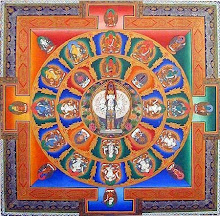


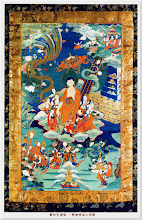

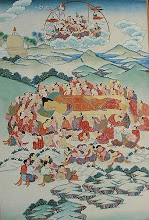


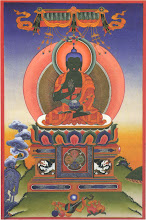


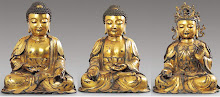.jpg)