Author: Shantideva Bodhisattva
(* Shantideva Bodhisattva is known as a direct disciple of Manjusri Bodhisattva)
The Key of becoming a Bodhisattva:
One who wishes to protect oneself and others quickly, should practice exchanging oneself for others, which is a great mystery.
All those who are unhappy in the world are so as a result of their desire for their own happiness.
All those who are happy in the world are so as a result of their desire for the happiness of others.
Enough of such talk!
Note the difference between the fool who seeks his own benefit, and the sage who works for the benefit of others.
One, who does not exchange his own happiness for the suffering of others, surely does not achieve Buddhahood. How could one find happiness even in the cycle of existence?
Therefore, in order to alleviate my own suffering and to alleviate the suffering of others, I give myself up to others, and I accept others as my own self.
--------------------------------------------------------------------------------
Chapter 1
Chapter 2
Chapter 3
Chapter 4
Chapter 5
Chapter 6
Chapter 7
Chapter 8
Chapter 9
[In copying this ancient manuscript we discovered various translations from different traditions. The reader can be comforted to know that they all agreed with one another in substance, however, some were easier to understand in places then others. In making this text available we worked hard to ensure that it would be comprehensible. In every case we selected the verse that we felt was easiest to understand. BIONA ED.]
--------------------------------------------------------------------------------
Chapter Five
Guarding Introspection
1. Those who wish to protect their practice should zealously guard the mind. The practice cannot be protected without guarding the unsteady mind.
2. Untamed, mad elephants do not inflict as much harm in this world as does the unleashed elephant of the mind in the Avichi Hell and the like.
3. But if the elephant of the mind is completely restrained by the rope of mindfulness, then all perils vanish and complete well-being is obtained.
4. Tigers, lions, elephants, bears, snakes, all enemies, all guardians of hells,
5. Dakinis (evil spirits) and demons become controlled by controlling the mind alone. By subduing the mind alone, they all become subdued.
6. For the Propounder of the Truth (The Buddha) said that all fears and immeasurable sufferings arise from the mind only.
7. Who diligently constructed the weapons in hell? Who devised the floor of heated iron? And from where have those women come?
8. The sage declared that all of that has arisen from the evil mind, so there is nothing else on the three worlds more formidable than the mind.
9. If the perfections of generosity makes the world free from poverty, how is it possible that the Protectors of the past acquired it, when the world is still impoverished today?
10. The perfection of generosity is interpreted simply as a state of mind due to the intention of giving away everything, together with the fruits of that, to all people.
11. Where can fish and the like be taken where I could not kill them? When the mind of renunciation is obtained, that is considered the perfection of ethical discipline.
12. How many malicious people, as unending as space, can I kill? When the mind state of anger is slain, all enemies are slain.
13. Where would there be leather enough to cover the entire world? There earth is covered over merely with the leather of my sanders.
14. Likewise, I am unable to restrain external phenomena, but I shall restrain my own mind, what need is there to restrain anything else?
15. Even when accompanied by body and speech, feeble mental activity does not have results such as Brahma hood and alike, which the mind alone has when clear.
16. The omniscient One stated that all recitations and austerities, even through performed for a long time, are actually useless if the mind is on something else or dull.
17. Those who have not cultivated the mind, which is the mystery and the very essence of Dharma, uselessly wander in space in order to eliminate suffering and find happiness.
18. Therefore, I should well control and well guard my mind. Once I have forsaken the vow of guarding the mind, of what use are many vows to me?
19. Just as those standing in the midst of boisterous people carefully guard their wounds, so those standing in the midst of evil people should always guard their minds.
20. Fearing slight pain from a wound, I guard it with great care. Why don't I, fearing the crushing of the mountains of the Samghata hell, guard the wound of my mind?
21. Living with this attitude even among evil people and among maidens, with steadfast effort, a persevering sage will not be defeated.
22. Let my possessions freely vanish; let my honor, my body, livelihood, and everything else pass away. But may my virtuous mind never be lost.
23. I appeal to those desiring to guard their minds: always diligently guard your mindfulness and introspection.
24. Just as a person smitten by disease is unfit for any work, so the mind lacking those two is not fit for any work.
25. What has been heard, pondered, and cultivated, like water in a cracked jar, does not remain in the memory of the mind that lacks introspection.
26. Even many people who have faith and extraordinary perseverance become defiled by vices on account of the fault of lacking introspection.
27. Even upon accumulating virtues, those who have been robbed by the thief of non-introspection, who come after the loss of mindfulness, enter miserable states of existence.
28. This band of thieves, the mental afflictions, looks for an entrance. Upon finding an entrance, it plunders and destroys life in fortunate realms of existence.
29. Therefore, mindfulness should never be displaced from the gate of the mind. If it is gone, it should be reinstated while recalling the anguish of hell.
30. Mindfulness easily arises for those of good fortune because of their association with a spiritual mentor, and for those who are reverent on account of the instruction of a preceptor and because of their fear.
31. The Buddhas and Bodhisattvas have unobstructed vision in all directions. Everything is in their presence; and I stand in front of them.
32. Meditating thus, one should remain filled with a sense of propriety, respect, and fear; and one should repeatedly think of the Buddhas in this way. 33. When mindfulness stands guard at the gate of the mind, introspection arrives, and once it has come, it does not depart again.
34. First, I should establish this mind in such a manner, and I should always remain still as if without sense faculties like a piece of wood.
35. One should never cast one's gaze around without purpose. One should always direct one's gaze downwards as if in meditation.
36. However, one should occasionally look around in order to relax the gaze; and if someone should appear in the field of ones vision, one should look up and give a greeting.
37. In order to detect danger on the road and so forth, one should look to the four directions for a moment. Pausing, one should look in the distance, looking behind only after turning around.
38. Upon looking forward or behind, one should go ahead or turn back. Likewise, in all situations one should proceed after realizing what needs to be done.
39. Thinking, "The body should remain like this," and resorting to action again, one should periodically look afresh to see how the body is positioned.
40. In this way the mad elephant of the mind should be watched diligently so that it is not loosed while tied to the great pillar of the thought of Dharma.
41. One should examine the mind in this way-where is mine engaged-so that it does not even for a moment leave the pole of concentration.
42. If one is unable to do so in the case of danger or a festive occasion, then one should be at ease. It is said that at the time of giving, ethical discipline may be held in abeyance.
43. Upon recognizing what needs to be undertaken, with a mind focused on that, one should attend to nothing else until one accomplishes it.
44. For in this way everything is well done. Otherwise neither will occur, and the mental affliction of non-introspection will increase as well.
45. One should eliminate yearning that arises for various idle conversations, which often take place, and for all kinds of entertainment.
46. If useless crushing of the earth, ripping of grass, or drawing in the dirt takes place, then fearfully recalling the teaching of the Tath¨¢gata, one should instantly stop it.
47. When one intends to move or when one intends to speak, one should first examine one's own mind and then act appropriately with composure.
48. When one sees one's own mind to be attached or repulsed, then one should neither act nor speak, but remain still like a piece of wood.
49. When my mind is haughty, sarcastic, full of conceit and arrogance, ridiculing, evasive, and deceitful,
50. When it is inclined to boast, or when it is contemptuous of others, abusive, and irritable, then I should remain still like a piece of wood.
51. When my mind seeks material gain, honor, and fame, or when it seeks attendance and service, then I will remain still like a piece of wood.
52. When my mind is averse to the interests of others and seeks my own self interest, or when it wishes to speak out of a desire for an audience, then I will remain still like a piece of wood.
53. When it is impatient, indolent, timid, impudent, garrulous, or biased in my own favor, then I will remain still like a piece of wood.
54. Perceiving in this way that the mind is afflicted or engaged in fruitless activities, the hero should always firmly control it by means of an antidote to that.
55. Resolute, confidant, steadfast, respectful and courteous, modest, meek, calm, devoted to pleasing others,
56. Un-distressed by the mutually incompatible desires of foolish people, endowed with compassion, knowing that they are like this as a consequence of the arising of their mental afflictions,
57. Always resorting to irreproachable things for the sake of myself and others, I will maintain my mind free of pride, like an apparition.
58. Remembering over and over again that after a long time the best of moments of leisure has been attained; I will keep this mind unshakable, like Sumeru.
59. One does not object when the body is dragged here and there by vultures coveting its flesh. Then why do so now?
60. Mind, why do you protect this body, appropriating it as your own? It is really separate from you, what good is it to you?
61. Oh fool, if you do not consider as your own a pure wooden statue, why are you guarding this foul machine composed of impurities?
62. First, with your own intellect, peel off this sheath of skin, and with the knife of wisdom loosen the flesh from the skeleton.
63. Breaking the bones, look inside at the marrow and examine for yourself, "where is the essence here?"
64. If searching carefully in this way, you do not see an essence here, then say why you are still protecting the body today.
65. If you would not eat it, as impure as it is, and if you would not drink the blood not suck out the entrails, then what will you do with the body?
66. However, it is proper to guard it for the sake of feeding the vultures and the jackets. This wretched body of humans is an instrument for action.
67. Even though you protect it so, merciless death will snatch the body away and give it to the vultures. What will you do then?
68. You do not give clothing and such to a servant if you think he will not stay. The body will eat and pass away. Then why do you waste yourself?
69. Therefore, mind, upon giving the body its wages, now serve your own needs, because not everything earned by a laborer should be given to him.
70. Consider the body as a ship because it is the basis of coming and going. Set the body in motion at your will in order to accomplish the welfare of sentient beings.
71. One who has become self-controlled in that way should always have a smiling face. One should give up frowning and grimacing, be the first to greet, and be a friend to the world.
72. One should not inconsiderately and noisily throw around chairs and the like. One should not pound on the door, and one should always delight in silence.
73. The crane, the cat, or the thief, moving silently and covertly, achieves its desired goal. A sage should always move in such a way.
74. One must respectfully accept the advice of those skilled in directing others and providing unsolicited aide. One should always be a pupil of everyone.
75. One should express one's appreciation for all good words. Having seen someone engaging in virtue, one should cheer him on with praises.
76. One should speak of other's good qualities in their absence and relate them again with satisfaction; and when one's own virtue is discussed, one should consider it as appreciation for good qualities.
77. All endeavors are for the sake of satisfaction, which is difficult to obtain, even by means of wealth. So I will enjoy the pleasure of satisfaction in good qualities diligently accomplished by others.
78. There will be no loss for me in this life, and there will be great happiness in the hereafter. But due to animosities, there is the suffering of aversion and great misery in the hereafter.
79. In a soft and gentle voice one should speak sincere, coherent words that have clear meaning and are agreeable, pleasant to the ear, and rooted in compassion.
80. One should always look straight at sentient beings as if drinking them in with the eyes, thinking, "relying on them alone, I shall attain Buddhahood."
81. Great blessing arises from continuous yearning for the fields of virtues and kindness, and from an antidote with regard to those who are suffering.
82. Skillful and vigorous one should always do the work oneself. With respect to all works, one should not leave the opportunity to someone else.
83. The perfections of generosity and so forth are progressively more and more lofty. One should not forsake a better one for the sake of a lesser, unless it is with accordance with the bridge of the Bodhisattva way of life.
84. Realizing this, one should always strive for the benefit of others. Even that which is prohibited has been permitted for the compassionate one who foresees benefit.
85. Sharing with those who have fallen into miserable states of existence, with those who have no protector, and with mendicants, one should eat moderately small proportions. Except for the three robes, one should give away everything.
86. For the sake of an insignificant benefit one should not harm the body that practices the sublime Dharma, for only in this way can one quickly fulfill the hopes of sentient beings.
87. Therefore, when the thought of compassion is impure, one should not sacrifice one's life, but it should be sacrificed when one's thought is unbiased. Thus, life must not be wasted.
88. One should not teach the profound and vast Dharma to the disrespectful, to a healthy person wearing a headdress, to a person with an umbrella, a stick, or a weapon, to one whose head is veiled,
89. To those who are inadequate (whose minds are unprepared), nor to women in the absence of a man. One should pay equal respect to inferior and superior Dharmas.
90. One should not expose a vessel of the vast Dharma to an inferior Dharma. Putting aside the Bodhisattva way of life one should not seduce them with Sutras and Mantras.
91. Flagrantly discarding a tooth-stick or spitting is undesirable and urinating or so forth in water or on land that is useable is contemptible.
92. One should not eat with a full mouth, noisily, or with the mouth wide open. One should not sit with ones legs outstretched, and one should not rub one's hands together.
93. One should not travel, lie, or sit alone with some one else's spouse. After observing and inquiring, one should forsake everything that does not please people.
94. One should not point out anything with one's finger but should respectfully show the way with one's whole right hand.
95. One should not call out to someone and wave one's arms when there is little urgency, instead should snap one's fingers or the like. Otherwise, one could lose composure.
96. One should lie down in the preferred direction in the lion's posture of the lords Nirvana. One should get up quickly with vigilance and a prior determination.
97. The conduct of Bodhisattvas is described as immeasurable. One should first surely engage in practices that purify the mind.
98. Three times by day and three times by night one should recite the Triskandha. By that means one alleviates the remaining downfalls because of ones reliance on the Jinas and the Spirit of Awakening.
99. One should diligently apply oneself to the trainings that pertain to those situations in which one finds oneself, either of one's own accord or under the influences of others.'
100. For there is nothing that the Children of the Jina should not learn. For the good person who behaves in this way, there is nothing that is non-virtuous.
101. One should do nothing other than benefit sentient beings either directly or indirectly; and for the sake of sentient beings alone, one should subordinate everything to Awakening.
102. Never, even at the cost of ones life, should one forsake the spiritual friend who observes the vows of the Bodhisattva and who is well versed in the matters of the Mahayana.
103. One should learn from the Srisambhavavimoksa respectful behavior towards mentors. This and other advice of the Buddha should be known through reciting the sutras.
104. The practices are found in the sutras; therefore one should recite them, and then one should study the primary downfalls in the akasagarbhasutra.
105. One should definitely study the Sikasamuccaya again and again, because good conduct is explained there in detail.
106. Alternatively, one should first look at it briefly, and then carefully read the Sutramuccaya composed by Arya Nargarjuna.
107. Seeing what is forbidden and what is prescribed, one should implement those teachings for the sake of protecting people's minds.
108. In brief, this alone is the definition of introspection: the repeated examination of the state of one's body and mind.
109. I shall practice it with my body. What is the use of merely reading the words? Will a sick person have any benefit merely by reading about medical treatments?
Showing posts with label Amitabha. Show all posts
Showing posts with label Amitabha. Show all posts
Monday, January 17, 2011


Sunday, August 17, 2008
Tathagata's Unimaginable State Sutra
(The full title is:)
Great, Upright and Broad Tathagata's Unimaginable State Sutra
Or
Maha-Vaipulya Tathagata's Unimaginable State Sutra
(Dai Forng Gworng Yiu Loy Bud See Yee Ging Gai Ging)
(Tripitaka No. 301)
Translated during the Tang Dynasty by Kustana Tripitaka Master Siksananda
Thus I have heard. At one time the Buddha achieved Samyak-Sambodhi (Correct Peerless Enlightenment) under the Bodhi-tree in Magadha state. The Bodhi-tree's name is Ahsipah, its root was deep in the soil, its trunk was tall, straight and had no knot, like a sandalwood column. Whenever birds approach, they had to fly back because they could not fly over the tree. The tree's skin was fine and glossy, with various interlaced colors, just like damasks. The tree was branchy and the crown of it was bushy and green.
Around the tree, there were many beautiful and lovely flowers blooming and emanating fragrance. They were much more beautiful than all other flowers except the Kovidars and Parijatas.
Around the tree, there were also many shorter trees. This Bodhi-tree, the king of trees, was splendid and handsome. It was like the Sumeru Mountain, which is the king of all mountains. It was so tall that even the people beyond 1 Yojana could see it. Its fragrance flows all around and its halo shines all around. People who saw it far away at night would suspect that it is a group of huge fires. The area under the tree was majestic, beautiful, spacious, and flat, like the happy garden, with luxuriant fragrant grass. It was like the neck of the peacock king, beautiful and fragrant, people do not tire of watching it.
At such a place, the Tathagata sat rightly and divinely, with many beings around him, just like a moon surrounded by stars.
At that time, coming from other directions, there were Buddhas as many as the atoms of ten Buddha-Worlds. In order to make the Bodhi-manda(site of enlightenment) of Vairocana more sublime, those Buddhas appeared as Bodhisattvas and joined the congregation. The names of their leaders are: Avalokitesvara(Contemplator of the World's Sounds) Bodhisattva, Manjusri Bodhisattva, Ksitigarbha(Earth Store) Bodhisattva, Akasagarbha(Space Store) Bodhisattva, Vajragarbha Bodhisattva, Vimalakirti Bodhisattva, Virtuous mighty light Bodhisattva, Extinguish all eclipses Bodhisattva, Ratna-Pani(Treasure Hand) Bodhisattva, Mahamati(Great Wisdom) Bodhisattva, Samantabhadra(Universal Goodness) Bodhisattva, and so on.
Moreover, hundred billions of Bodhisattvas appeared as Sravakas and came to join the congregation. The names of their leaders are: Shariputra, Maha-Maudgalyayana, Subhuti, Rahula, Ajnata-Kaundinya, Maha-Kasyapa, Upali, Aniruddha, Revata, Ananda, Devadatta, Upandanda, and so on. All of them had practiced the Six-Paramitas for a long time, and had already been very close to the Bodhi of Buddhas. In order to enlighten living beings, they appeared as Sravakas in this defiled world.
There were also innumerable Bhikshunis headed by Maha-Prajapati. All of them had already accomplished the meritorious virtues of great and wise men, in order to soothe the inferior living beings, they appeared as women.
There were also innumerable Sakra Devanam Indras, Brahmas, guardian gods, Devas, dragons, Yaksas, Gandharvas, Asuras, Garudas, Kinnaras, Mahoragas, human and nonhuman beings. They were all great Bodhisattvas, none of them was mundane person.
At that time, the Bhagavan(World Honored One), who was sitting under the Bodhi-tree, was sublime, pure, refined and wonderful, like the Wish-fulfilling pearl under the Citta tree. With the immovable Correct-Mindfulness, he was like the Sumeru Mountain. In order to make all Bodhisattvas and living beings understand the mighty and holy power of Buddhas' profound and secret Dhyana(Zen)s, he entered a Samadhi named Tathagata's Unimaginable State. Suddenly, each mark of the 32 marks of the Bhagavan revealed infinite Buddha-Worlds and Buddhas of the ten directions, just like a bright mirror reflecting various colors. Moreover, each mark of the 80 minor marks of the Bhagavan revealed his previous Bodhisattva-practices. From the Radiance king to the final incarnation at the place of Dipamkara(Burning Lamp) Buddha, all the difficult and arduous practices, the history that he completely donated all his heads, eyes, bodies, skins, fleshes, arms, legs, wives, servants, and the kingships, palaces, and so on.
This Samadhi has the great mighty power, all Buddhas are always in this Samadhi when they are eating, walking, teaching Dharmas, and even in Nirvana. Why? Because all Buddhas rely on this Samadhi to achieve boundless great mighty sacrosanct power, as far as to realize-and-prove(pravista) the vacuum nature of all dharmas, so they can manifest various unrestricted things at all Buddha-Worlds of the ten directions. For example, a person visualizes various fantastic things in his dream, but when he wakes up, all those things disappear. Likewise, for the mundane persons, because of the dreams of ignorance, they mistakenly think that all things are entities; meanwhile, all Buddhas are awakened and do not cling to anything, thus they can freely show infinite Buddha-Activities(Buddha-karya) within one infinitesimal thought, to profit all living beings and make them succeed, to help them comprehend innumerable abstruse and wonderful Liberation-Gates.
At that time, Virtue Store Bodhisattva, who had not yet achieved the perfection of Bodhi-Practices, asked Samantabhadra Bodhisattva: "What is the name of the Samadhi that the Tathagata entered into just now? How can he freely show various Buddha-Activities in all the worlds of the ten directions to rescue living beings?"
Then Samantabhadra Bodhisattva spoke to Virtue Store Bodhisattva: "Listen carefully and I'll tell you." At that time, all Bodhisattvas looked at them intently and reverently, and glorified together with one voice: "What an excellent question! How profound, delicate and wonderful! Arya(sage) Samantabhadra, who knows everything, is going to preach now." Instantly, the earth shook in six different ways, heaven rained down exquisite flowers, all living beings suffering from afflictions and distresses were relieved for a while.
Great, Upright and Broad Tathagata's Unimaginable State Sutra
Or
Maha-Vaipulya Tathagata's Unimaginable State Sutra
(Dai Forng Gworng Yiu Loy Bud See Yee Ging Gai Ging)
(Tripitaka No. 301)
Translated during the Tang Dynasty by Kustana Tripitaka Master Siksananda
Thus I have heard. At one time the Buddha achieved Samyak-Sambodhi (Correct Peerless Enlightenment) under the Bodhi-tree in Magadha state. The Bodhi-tree's name is Ahsipah, its root was deep in the soil, its trunk was tall, straight and had no knot, like a sandalwood column. Whenever birds approach, they had to fly back because they could not fly over the tree. The tree's skin was fine and glossy, with various interlaced colors, just like damasks. The tree was branchy and the crown of it was bushy and green.
Around the tree, there were many beautiful and lovely flowers blooming and emanating fragrance. They were much more beautiful than all other flowers except the Kovidars and Parijatas.
Around the tree, there were also many shorter trees. This Bodhi-tree, the king of trees, was splendid and handsome. It was like the Sumeru Mountain, which is the king of all mountains. It was so tall that even the people beyond 1 Yojana could see it. Its fragrance flows all around and its halo shines all around. People who saw it far away at night would suspect that it is a group of huge fires. The area under the tree was majestic, beautiful, spacious, and flat, like the happy garden, with luxuriant fragrant grass. It was like the neck of the peacock king, beautiful and fragrant, people do not tire of watching it.
At such a place, the Tathagata sat rightly and divinely, with many beings around him, just like a moon surrounded by stars.
At that time, coming from other directions, there were Buddhas as many as the atoms of ten Buddha-Worlds. In order to make the Bodhi-manda(site of enlightenment) of Vairocana more sublime, those Buddhas appeared as Bodhisattvas and joined the congregation. The names of their leaders are: Avalokitesvara(Contemplator of the World's Sounds) Bodhisattva, Manjusri Bodhisattva, Ksitigarbha(Earth Store) Bodhisattva, Akasagarbha(Space Store) Bodhisattva, Vajragarbha Bodhisattva, Vimalakirti Bodhisattva, Virtuous mighty light Bodhisattva, Extinguish all eclipses Bodhisattva, Ratna-Pani(Treasure Hand) Bodhisattva, Mahamati(Great Wisdom) Bodhisattva, Samantabhadra(Universal Goodness) Bodhisattva, and so on.
Moreover, hundred billions of Bodhisattvas appeared as Sravakas and came to join the congregation. The names of their leaders are: Shariputra, Maha-Maudgalyayana, Subhuti, Rahula, Ajnata-Kaundinya, Maha-Kasyapa, Upali, Aniruddha, Revata, Ananda, Devadatta, Upandanda, and so on. All of them had practiced the Six-Paramitas for a long time, and had already been very close to the Bodhi of Buddhas. In order to enlighten living beings, they appeared as Sravakas in this defiled world.
There were also innumerable Bhikshunis headed by Maha-Prajapati. All of them had already accomplished the meritorious virtues of great and wise men, in order to soothe the inferior living beings, they appeared as women.
There were also innumerable Sakra Devanam Indras, Brahmas, guardian gods, Devas, dragons, Yaksas, Gandharvas, Asuras, Garudas, Kinnaras, Mahoragas, human and nonhuman beings. They were all great Bodhisattvas, none of them was mundane person.
At that time, the Bhagavan(World Honored One), who was sitting under the Bodhi-tree, was sublime, pure, refined and wonderful, like the Wish-fulfilling pearl under the Citta tree. With the immovable Correct-Mindfulness, he was like the Sumeru Mountain. In order to make all Bodhisattvas and living beings understand the mighty and holy power of Buddhas' profound and secret Dhyana(Zen)s, he entered a Samadhi named Tathagata's Unimaginable State. Suddenly, each mark of the 32 marks of the Bhagavan revealed infinite Buddha-Worlds and Buddhas of the ten directions, just like a bright mirror reflecting various colors. Moreover, each mark of the 80 minor marks of the Bhagavan revealed his previous Bodhisattva-practices. From the Radiance king to the final incarnation at the place of Dipamkara(Burning Lamp) Buddha, all the difficult and arduous practices, the history that he completely donated all his heads, eyes, bodies, skins, fleshes, arms, legs, wives, servants, and the kingships, palaces, and so on.
This Samadhi has the great mighty power, all Buddhas are always in this Samadhi when they are eating, walking, teaching Dharmas, and even in Nirvana. Why? Because all Buddhas rely on this Samadhi to achieve boundless great mighty sacrosanct power, as far as to realize-and-prove(pravista) the vacuum nature of all dharmas, so they can manifest various unrestricted things at all Buddha-Worlds of the ten directions. For example, a person visualizes various fantastic things in his dream, but when he wakes up, all those things disappear. Likewise, for the mundane persons, because of the dreams of ignorance, they mistakenly think that all things are entities; meanwhile, all Buddhas are awakened and do not cling to anything, thus they can freely show infinite Buddha-Activities(Buddha-karya) within one infinitesimal thought, to profit all living beings and make them succeed, to help them comprehend innumerable abstruse and wonderful Liberation-Gates.
At that time, Virtue Store Bodhisattva, who had not yet achieved the perfection of Bodhi-Practices, asked Samantabhadra Bodhisattva: "What is the name of the Samadhi that the Tathagata entered into just now? How can he freely show various Buddha-Activities in all the worlds of the ten directions to rescue living beings?"
Then Samantabhadra Bodhisattva spoke to Virtue Store Bodhisattva: "Listen carefully and I'll tell you." At that time, all Bodhisattvas looked at them intently and reverently, and glorified together with one voice: "What an excellent question! How profound, delicate and wonderful! Arya(sage) Samantabhadra, who knows everything, is going to preach now." Instantly, the earth shook in six different ways, heaven rained down exquisite flowers, all living beings suffering from afflictions and distresses were relieved for a while.
Tuesday, August 12, 2008
A Spiritual Goal For This Lifetime
by Professor Li Ping-Nan
Master Chin Kung’s Dharma Teacher
--------------------------------------------
Professor Li Ping-Nan was Master Chin Kung’s Dharma Teacher. Professor Lee’s Dharma teacher was Patriarch Yin Guang.
The following article was adapted from a small book by Professor Lee titled “A Buddhist Goal that Can Be Achieved in One’s Present Life”. In this book, Professor Lee describes some of the characteristics of the Pure Land and explains how Pure Land practitioners can use the technique of Buddha recitation to achieve rebirth there.
Two important sections of this article are titled “Morning and Evening Devotions” and “The Ten Recitation Method”. These two sections explain exactly how you can practice Buddha recitation every day, at home.
--------------------------------------------
Life is difficult most of the time.
Who can avoid sickness, aging and weakness, separation from loved ones, deaths of friends and family members, loss of wealth, and hate and mistreatment from others?
The poor seek wealth, the childless want to have children, the unemployed want to find work, and on and on.
How many of these wishes can come true? Is there any way to solve these unfortunate problems?
Life is full of calamities.
Many people die in hurricanes, earthquakes, floods, and fires. Many others starve due to drought or too much rain. Unexpected death is facing us every year. In a nuclear or biological war, the human race could be eliminated. Is there any way to avoid these disasters?
The revolving wheel of birth and death is painful.
And death is not the end. A living body can die, but its consciousness never dies. Upon the death of the body, consciousness leaves the body and goes to one of the six paths: heaven, the human world, the asura world, the animal world, the hungry ghost world, or hell. Heaven and the human world are the better places of these six, but the cycle of birth and death is unavoidable. Everybody has to go through the birth-and-death cycle on one of the six paths. Imagine how terrible it must be in the animal world, and how painful it must be in hell! The birth-and-death cycle through the six paths is known as the “six-path revolving wheel of Birth-and-Death”. Is there any way to escape this revolving wheel of Birth-and-Death and secure a peaceful, happy eternal life?
Overcoming Life’s Difficulties and Escaping From the Cycle of Birth and Death
Eliminate life’s difficulties and divert calamities.
Whether we have a fortunate life or an unfortunate life is determined by our own mind and our own behavior. It is a system of cause and effect.
Causes and effects involve three time periods: the past, the present, and the future. A difficult life and the occurrence of disasters are results of previous evil thoughts or bad behavior. But can divert and avoid unfortunate events by reciting Buddha’s name. The Sutras tell us that serious offenses and crimes committed aeons ago can be eliminated by sincerely reciting Buddha’s name.
The Sutras also say that there is a limitless number of Buddhas in the universe who protect those who recite, “Amitabha Buddha”. Buddha possesses infinite virtue, supreme wisdom, and boundless might. If you have Buddha’s blessing, no disaster can befall you.
Master Chin Kung’s Dharma Teacher
--------------------------------------------
Professor Li Ping-Nan was Master Chin Kung’s Dharma Teacher. Professor Lee’s Dharma teacher was Patriarch Yin Guang.
The following article was adapted from a small book by Professor Lee titled “A Buddhist Goal that Can Be Achieved in One’s Present Life”. In this book, Professor Lee describes some of the characteristics of the Pure Land and explains how Pure Land practitioners can use the technique of Buddha recitation to achieve rebirth there.
Two important sections of this article are titled “Morning and Evening Devotions” and “The Ten Recitation Method”. These two sections explain exactly how you can practice Buddha recitation every day, at home.
--------------------------------------------
Life is difficult most of the time.
Who can avoid sickness, aging and weakness, separation from loved ones, deaths of friends and family members, loss of wealth, and hate and mistreatment from others?
The poor seek wealth, the childless want to have children, the unemployed want to find work, and on and on.
How many of these wishes can come true? Is there any way to solve these unfortunate problems?
Life is full of calamities.
Many people die in hurricanes, earthquakes, floods, and fires. Many others starve due to drought or too much rain. Unexpected death is facing us every year. In a nuclear or biological war, the human race could be eliminated. Is there any way to avoid these disasters?
The revolving wheel of birth and death is painful.
And death is not the end. A living body can die, but its consciousness never dies. Upon the death of the body, consciousness leaves the body and goes to one of the six paths: heaven, the human world, the asura world, the animal world, the hungry ghost world, or hell. Heaven and the human world are the better places of these six, but the cycle of birth and death is unavoidable. Everybody has to go through the birth-and-death cycle on one of the six paths. Imagine how terrible it must be in the animal world, and how painful it must be in hell! The birth-and-death cycle through the six paths is known as the “six-path revolving wheel of Birth-and-Death”. Is there any way to escape this revolving wheel of Birth-and-Death and secure a peaceful, happy eternal life?
Overcoming Life’s Difficulties and Escaping From the Cycle of Birth and Death
Eliminate life’s difficulties and divert calamities.
Whether we have a fortunate life or an unfortunate life is determined by our own mind and our own behavior. It is a system of cause and effect.
Causes and effects involve three time periods: the past, the present, and the future. A difficult life and the occurrence of disasters are results of previous evil thoughts or bad behavior. But can divert and avoid unfortunate events by reciting Buddha’s name. The Sutras tell us that serious offenses and crimes committed aeons ago can be eliminated by sincerely reciting Buddha’s name.
The Sutras also say that there is a limitless number of Buddhas in the universe who protect those who recite, “Amitabha Buddha”. Buddha possesses infinite virtue, supreme wisdom, and boundless might. If you have Buddha’s blessing, no disaster can befall you.
Saturday, August 9, 2008
The Sutra in Forty-two Sections Spoken by the Buddha (Section 38 to 42)
Lectures by the Venerable Master Hsuan Hua,
Given at Gold Mountain Monastery,
San Francisco, California, in 1974
The Sutra in Forty-two Sections Spoken by the Buddha
Section 38 to 42
-----------------------------------------------------------------------
Section 38
Birth Leads to Death
The Buddha asked a Shramana, how long is the human life span? "He replied, few days. "The Buddha said, you have not yet understood the Way."
He asked another Shramana, how long is the human life span? "The reply was, the space of a meal. "The Buddha said, you have not yet understood the Way."
He asked another Shramana, how long is the human life span? "He replied, the length of a single breath. "The Buddha said, excellent. You have understood the Way."
The Buddha asked a Shramana, how long is the human life span? "The Buddha asked this question deliberately. It wasn’t that the Buddha didn’t know the answer himself and had to ask the Shramana to find out. The Buddha asked because he knew that people don’t know the length of the human life span. So he asked a Shramana, how long is a human being life? How much time does a human life last? " He replied, few days. "The first Shramana said, probably after a few days we will die. Life is not very long. " The Buddha said, you have not yet understood the Way. You still don understand. "
He asked another Shramana, how long is the human life span? "The reply was, he space of a meal. "The Shramana answered, n the time it takes to eat a single meal, a person life is over. " The Buddha said, you have not yet understood the Way. "He, too, didn understand.
He asked another Shramana, how long is the human life span? "He replied, he length of a single breath. The life span of a human being lasts for one breath. "The Buddha said, excellent. You have understood the Way." The Shramana who gave this answer understood the Way.
In India there was once a king who believed in adherents of non-Buddhist religions that cultivated many kinds of ascetic practices. Some followed the precepts of cows and some the precepts of dogs; some smeared ashes on their bodies; and some slept on beds of nails. They cultivated all sorts of ascetic practices, such as those undertaken by yogis. Meanwhile, the Bhikshus who cultivated the Buddhadharma had it comparatively easy, because they didn cultivate those kinds of ascetic practices. Now, the king of that country said to the Buddha disciples, believe that although these non-Buddhists cultivate all kinds of ascetic practices, they still cannot stop their thoughts of sexual desire. How much less are you Bhikshus, who are so casual, able to stop your afflictions and your thoughts of sexual desire. You surely cannot put a stop to them. "
One of the Dharma Masters answered the king this way, take a man from jail who has been sentenced to execution and say to him, take this bowl of oil and carry it in your hands as you walk down the street. If you spill a single drop of the oil, I’ll have you executed. If you don’t spill a single drop, I’ll release you when you return. ' Then, send some beautiful women musicians out on the street to sing and play their instruments where the sentenced man is walking with his bowl of oil. If he should spill any oil, of course you’ll execute him. If he comes back without spilling a single drop, ask him what he seen on the road, and see what he says! "
Given at Gold Mountain Monastery,
San Francisco, California, in 1974
The Sutra in Forty-two Sections Spoken by the Buddha
Section 38 to 42
-----------------------------------------------------------------------
Section 38
Birth Leads to Death
The Buddha asked a Shramana, how long is the human life span? "He replied, few days. "The Buddha said, you have not yet understood the Way."
He asked another Shramana, how long is the human life span? "The reply was, the space of a meal. "The Buddha said, you have not yet understood the Way."
He asked another Shramana, how long is the human life span? "He replied, the length of a single breath. "The Buddha said, excellent. You have understood the Way."
The Buddha asked a Shramana, how long is the human life span? "The Buddha asked this question deliberately. It wasn’t that the Buddha didn’t know the answer himself and had to ask the Shramana to find out. The Buddha asked because he knew that people don’t know the length of the human life span. So he asked a Shramana, how long is a human being life? How much time does a human life last? " He replied, few days. "The first Shramana said, probably after a few days we will die. Life is not very long. " The Buddha said, you have not yet understood the Way. You still don understand. "
He asked another Shramana, how long is the human life span? "The reply was, he space of a meal. "The Shramana answered, n the time it takes to eat a single meal, a person life is over. " The Buddha said, you have not yet understood the Way. "He, too, didn understand.
He asked another Shramana, how long is the human life span? "He replied, he length of a single breath. The life span of a human being lasts for one breath. "The Buddha said, excellent. You have understood the Way." The Shramana who gave this answer understood the Way.
In India there was once a king who believed in adherents of non-Buddhist religions that cultivated many kinds of ascetic practices. Some followed the precepts of cows and some the precepts of dogs; some smeared ashes on their bodies; and some slept on beds of nails. They cultivated all sorts of ascetic practices, such as those undertaken by yogis. Meanwhile, the Bhikshus who cultivated the Buddhadharma had it comparatively easy, because they didn cultivate those kinds of ascetic practices. Now, the king of that country said to the Buddha disciples, believe that although these non-Buddhists cultivate all kinds of ascetic practices, they still cannot stop their thoughts of sexual desire. How much less are you Bhikshus, who are so casual, able to stop your afflictions and your thoughts of sexual desire. You surely cannot put a stop to them. "
One of the Dharma Masters answered the king this way, take a man from jail who has been sentenced to execution and say to him, take this bowl of oil and carry it in your hands as you walk down the street. If you spill a single drop of the oil, I’ll have you executed. If you don’t spill a single drop, I’ll release you when you return. ' Then, send some beautiful women musicians out on the street to sing and play their instruments where the sentenced man is walking with his bowl of oil. If he should spill any oil, of course you’ll execute him. If he comes back without spilling a single drop, ask him what he seen on the road, and see what he says! "
Thursday, August 7, 2008
The Sutra in Forty-two Sections Spoken by the Buddha (Section 36 to 37)
Lectures by the Venerable Master Hsuan Hua,
Given at Gold Mountain Monastery,
San Francisco, California, in 1974
The Sutra in Forty-two Sections Spoken by the Buddha
Section 36 to 37
--------------------------------------------------------------------------
Section 36
The Sequence that Leads to Success
The Buddha said, it is difficult for one to leave the evil destinies and become a human being.
Even if one does become a human being, it is still difficult to become a man rather than a woman.
Even if one does become a man, it is still difficult to have the six sense organs complete and perfect.
Even if the six sense organs are complete and perfect, it is still difficult for one to be born in a central country.
Even if one is born in a central country, it is still difficult to be born at a time when there is a Buddha in the world.
Even if one is born at a time when there is a Buddha in the world, it is still difficult to encounter the Way.
Even if one does encounter the Way, it is still difficult to bring forth faith.
Even if one brings forth faith, it is still difficult to resolve one mind on Bodhi.
Even if one does resolve one mind on Bodhi, it is still difficult to be beyond cultivation and attainment."
The thirty-sixth section discusses the difficulties of obtaining a human body, being born in a central country, meeting a Good and Wise Advisor, encountering a Buddha in the world, and various other difficulties.
The Buddha said, t is difficult for one to leave the evil destinies and become a human being. "The three evil destinies are the hells, the realm of hungry ghosts, and the realm of animals. It's very difficult to leave the three evil destinies and be reborn as a human being. When the Buddha was in the world, he once brought up a question for all the disciples to consider. The Buddha scooped up a handful of dirt and asked, all of you tell me, is there more dirt in my hand or on the whole earth? "
The Buddha disciples all answered, f course the dirt in the Buddha hand is less than the dirt on the whole earth! " Was there any need to ask about something as obvious as that?
The Buddha said, living beings who can leave the three evil destinies the hells, the realm of hungry ghosts, and the realm of animals and become humans are like the dirt in my hand. Those who remain in the three evil destinies and cannot obtain human bodies are like the dirt on the whole earth. " This shows that for beings to leave behind the evil destinies and become human is not easy. Thus it is said that becoming a human being is difficult.
Given at Gold Mountain Monastery,
San Francisco, California, in 1974
The Sutra in Forty-two Sections Spoken by the Buddha
Section 36 to 37
--------------------------------------------------------------------------
Section 36
The Sequence that Leads to Success
The Buddha said, it is difficult for one to leave the evil destinies and become a human being.
Even if one does become a human being, it is still difficult to become a man rather than a woman.
Even if one does become a man, it is still difficult to have the six sense organs complete and perfect.
Even if the six sense organs are complete and perfect, it is still difficult for one to be born in a central country.
Even if one is born in a central country, it is still difficult to be born at a time when there is a Buddha in the world.
Even if one is born at a time when there is a Buddha in the world, it is still difficult to encounter the Way.
Even if one does encounter the Way, it is still difficult to bring forth faith.
Even if one brings forth faith, it is still difficult to resolve one mind on Bodhi.
Even if one does resolve one mind on Bodhi, it is still difficult to be beyond cultivation and attainment."
The thirty-sixth section discusses the difficulties of obtaining a human body, being born in a central country, meeting a Good and Wise Advisor, encountering a Buddha in the world, and various other difficulties.
The Buddha said, t is difficult for one to leave the evil destinies and become a human being. "The three evil destinies are the hells, the realm of hungry ghosts, and the realm of animals. It's very difficult to leave the three evil destinies and be reborn as a human being. When the Buddha was in the world, he once brought up a question for all the disciples to consider. The Buddha scooped up a handful of dirt and asked, all of you tell me, is there more dirt in my hand or on the whole earth? "
The Buddha disciples all answered, f course the dirt in the Buddha hand is less than the dirt on the whole earth! " Was there any need to ask about something as obvious as that?
The Buddha said, living beings who can leave the three evil destinies the hells, the realm of hungry ghosts, and the realm of animals and become humans are like the dirt in my hand. Those who remain in the three evil destinies and cannot obtain human bodies are like the dirt on the whole earth. " This shows that for beings to leave behind the evil destinies and become human is not easy. Thus it is said that becoming a human being is difficult.
Tuesday, August 5, 2008
The Sutra in Forty-two Sections Spoken by the Buddha (Section 27 to 30)
Lectures by the Venerable Master Hsuan Hua,
Given at Gold Mountain Monastery,
San Francisco, California, in 1974
The Sutra in Forty-two Sections Spoken by the Buddha
Section 27 to 30
-----------------------------------------------------------------------
Section 27
One Attains the Way after Letting Go of Attachments
The Buddha said, person who follows the Way is like a floating piece of wood that courses along with the current. If it does not touch either shore; if people do not pluck it out; if ghosts and spirits do not intercept it; if it is not trapped in whirlpools; and if it does not rot, I guarantee that the piece of wood will reach the sea. If students of the Way are not deluded by emotion and desire, and if they are not caught up in the many crooked views, but are vigorous in their cultivation of the unconditioned, I guarantee that they will certainly attain the Way. "
The twenty-seventh section sets forth an analogy to explain that in cultivating the Way, one should stay clear of all kinds of obstacles. What are the two shores? The two shores refer to emotion and desire. Emotion and desire further divide into two kinds: (1) the emotion and desire of views and thought and (2) the emotion and desire of ignorance. With the first, you grow attached to birth and death, which is represented by this shore. With the second, you become attached to Nirvana, which is represented by the other shore. Wood that is plucked out by people is analogous to cultivators getting caught in the nets of crooked views. Wood that is intercepted by ghosts and spirits is analogous to cultivators who get covered by the nets of views and thoughts.
Being caught up in a whirlpool refers to being lazy, which is the opposite of being vigorous. Rotten wood represents the opposite of unconditioned dharmas. Some cultivators are not properly mindful of True Suchness in a straightforward manner, and although they often wish to be vigorous, they end up retreating. It is as if they were in a whirlpool: although the water flows fast, it merely circles in the same spot. Similarly, they return to where they started and cannot reach unconditioned dharmas. Since they cannot reach the unconditioned, they become attached to appearances and cannot perfect the cultivation of blessings and wisdom. People in this situation are likened to rotting wood. They are bound to sink, and they will not reach the other shore of Nirvana. They won be able to end birth and death. That the result of being confused by emotional desire and caught up in the myriad crooked bypaths of love and views. If one is properly mindful of True Suchness and vigorously cultivates, understands that the fundamental nature of the Dharma is originally unconditioned, and can withstand being turned by emotions and love, then one will certainly attain the Way. That is the general meaning of this section of the text.
Given at Gold Mountain Monastery,
San Francisco, California, in 1974
The Sutra in Forty-two Sections Spoken by the Buddha
Section 27 to 30
-----------------------------------------------------------------------
Section 27
One Attains the Way after Letting Go of Attachments
The Buddha said, person who follows the Way is like a floating piece of wood that courses along with the current. If it does not touch either shore; if people do not pluck it out; if ghosts and spirits do not intercept it; if it is not trapped in whirlpools; and if it does not rot, I guarantee that the piece of wood will reach the sea. If students of the Way are not deluded by emotion and desire, and if they are not caught up in the many crooked views, but are vigorous in their cultivation of the unconditioned, I guarantee that they will certainly attain the Way. "
The twenty-seventh section sets forth an analogy to explain that in cultivating the Way, one should stay clear of all kinds of obstacles. What are the two shores? The two shores refer to emotion and desire. Emotion and desire further divide into two kinds: (1) the emotion and desire of views and thought and (2) the emotion and desire of ignorance. With the first, you grow attached to birth and death, which is represented by this shore. With the second, you become attached to Nirvana, which is represented by the other shore. Wood that is plucked out by people is analogous to cultivators getting caught in the nets of crooked views. Wood that is intercepted by ghosts and spirits is analogous to cultivators who get covered by the nets of views and thoughts.
Being caught up in a whirlpool refers to being lazy, which is the opposite of being vigorous. Rotten wood represents the opposite of unconditioned dharmas. Some cultivators are not properly mindful of True Suchness in a straightforward manner, and although they often wish to be vigorous, they end up retreating. It is as if they were in a whirlpool: although the water flows fast, it merely circles in the same spot. Similarly, they return to where they started and cannot reach unconditioned dharmas. Since they cannot reach the unconditioned, they become attached to appearances and cannot perfect the cultivation of blessings and wisdom. People in this situation are likened to rotting wood. They are bound to sink, and they will not reach the other shore of Nirvana. They won be able to end birth and death. That the result of being confused by emotional desire and caught up in the myriad crooked bypaths of love and views. If one is properly mindful of True Suchness and vigorously cultivates, understands that the fundamental nature of the Dharma is originally unconditioned, and can withstand being turned by emotions and love, then one will certainly attain the Way. That is the general meaning of this section of the text.
Monday, August 4, 2008
The Sutra in Forty-two Sections Spoken by the Buddha (Section 17 to 26)
Lectures by the Venerable Master Hsuan Hua,
Given at Gold Mountain Monastery,
San Francisco, California, in 1974
The Sutra in Forty-two Sections Spoken by the Buddha
Section 17 to 26
--------------------------------------------------------------------
Section 17
When Light Arrives, Darkness Departs
The Buddha said, those who see the Way are like someone holding a torch who enters a dark room, dispelling the darkness so that only light remains. When you study the Way and see the truth, ignorance vanishes and light remains forever."
The seventeenth section reveals that darkness has no independent existence. Since it doesn’t have any independent existence, once it vanishes, it is gone for good. Once you see the Way, then all ignorance will vanish.
The Buddha said, those who see the Way are like someone holding a torch who enters a dark room, dispelling the darkness so that only light remains. A person who sees the Way is like someone who takes up a torch and goes into a dark room, immediately banishing the darkness so that only the light remains. The darkness is gone because he holds a torch. The torch represents our wisdom. This means that if we have wisdom, we can break through ignorance, which is represented by the dark room. If we have wisdom, the dark room will become bright.
When you study the Way and see the truth, ignorance vanishes and light remains forever. Someone who studies the Way and can see the actual truth will immediately vanquish ignorance, and wisdom will remain forever.
----------------------------------------------------------------------
Section 18
Thoughts and So Forth Are Basically Empty
The Buddha said, Dharma is the mindfulness that is both mindfulness and non-mindfulness. It is the practice that is both practice and non-practice. It is words that are words and non-words, and cultivation that is cultivation and non-cultivation. Those who understand are near to it; those who are confused are far away, indeed. It is not accessible by the path of language. It is not hindered by physical objects. If you are off by a hairsbreadth, you will lose it in an instant. "
The eighteenth section explains the relationship between the existence and non-existence of mindfulness and cultivation.
The Buddha said, Dharma is the mindfulness that is both mindfulness and non-mindfulness. "The Buddha said, Dharma is not being mindful that you are mindful; and even the thought of that not being mindful is not there. Therefore my Dharma is called a mindfulness that is mindfulness, and yet not mindfulness. It is the practice that is both practice and non-practice. In my Dharma, practice also is he Way of effortlessness. In cultivating, you don want to have any attachments. It should be the same as not cultivating. Even the shadow of o cultivating should not remain.”
It is words that are words and non-words. Don’t be attached to words and language. Further, even your intention not to be attached to words and language should be done away with. And it is cultivation that is cultivation and non-cultivation. It is the Way of effortlessness, cultivating and yet not cultivating, certifying and yet not certifying. There isn’t any thought of cultivating the Way. That means that you don have any attachments; all attachments are seen as empty. Even the emptiness is emptied out.
Those who understand are near to it. To understand something means to be clear about it. If you understand this doctrine, you are near to the Way. Those who are confused are far away, indeed. But if you fail to understand and are confused about the principle, then you will be far from the Way. What is the Way ultimately like? It tell you: It is not accessible by the path of language. You want to speak about it, but you can represent it in words. You want to think about it, but you can formulate the thought. You simply cannot speak of its wonder. It is said that the path of words and language is cut off, and the place of the mind workings ceases to be. What the mind wants to think about is gone, and absolutely everything is empty. It is not hindered by physical objects. Physical matter is itself the basic substance of True Suchness. If you are able to realize this state, then you will see that the mountains, the rivers, the earth, and all the myriad things are just the basic substance of True Suchness, and you will not be hindered by physical objects. If you are off by a hairsbreadth, if you are off by just a fraction of an inch, just a tiny bit, in the way you cultivate, you will lose it in an instant. You immediately lose it and won be able to find it. You should break through your attachments, and then you will be able to attain this state.
Given at Gold Mountain Monastery,
San Francisco, California, in 1974
The Sutra in Forty-two Sections Spoken by the Buddha
Section 17 to 26
--------------------------------------------------------------------
Section 17
When Light Arrives, Darkness Departs
The Buddha said, those who see the Way are like someone holding a torch who enters a dark room, dispelling the darkness so that only light remains. When you study the Way and see the truth, ignorance vanishes and light remains forever."
The seventeenth section reveals that darkness has no independent existence. Since it doesn’t have any independent existence, once it vanishes, it is gone for good. Once you see the Way, then all ignorance will vanish.
The Buddha said, those who see the Way are like someone holding a torch who enters a dark room, dispelling the darkness so that only light remains. A person who sees the Way is like someone who takes up a torch and goes into a dark room, immediately banishing the darkness so that only the light remains. The darkness is gone because he holds a torch. The torch represents our wisdom. This means that if we have wisdom, we can break through ignorance, which is represented by the dark room. If we have wisdom, the dark room will become bright.
When you study the Way and see the truth, ignorance vanishes and light remains forever. Someone who studies the Way and can see the actual truth will immediately vanquish ignorance, and wisdom will remain forever.
----------------------------------------------------------------------
Section 18
Thoughts and So Forth Are Basically Empty
The Buddha said, Dharma is the mindfulness that is both mindfulness and non-mindfulness. It is the practice that is both practice and non-practice. It is words that are words and non-words, and cultivation that is cultivation and non-cultivation. Those who understand are near to it; those who are confused are far away, indeed. It is not accessible by the path of language. It is not hindered by physical objects. If you are off by a hairsbreadth, you will lose it in an instant. "
The eighteenth section explains the relationship between the existence and non-existence of mindfulness and cultivation.
The Buddha said, Dharma is the mindfulness that is both mindfulness and non-mindfulness. "The Buddha said, Dharma is not being mindful that you are mindful; and even the thought of that not being mindful is not there. Therefore my Dharma is called a mindfulness that is mindfulness, and yet not mindfulness. It is the practice that is both practice and non-practice. In my Dharma, practice also is he Way of effortlessness. In cultivating, you don want to have any attachments. It should be the same as not cultivating. Even the shadow of o cultivating should not remain.”
It is words that are words and non-words. Don’t be attached to words and language. Further, even your intention not to be attached to words and language should be done away with. And it is cultivation that is cultivation and non-cultivation. It is the Way of effortlessness, cultivating and yet not cultivating, certifying and yet not certifying. There isn’t any thought of cultivating the Way. That means that you don have any attachments; all attachments are seen as empty. Even the emptiness is emptied out.
Those who understand are near to it. To understand something means to be clear about it. If you understand this doctrine, you are near to the Way. Those who are confused are far away, indeed. But if you fail to understand and are confused about the principle, then you will be far from the Way. What is the Way ultimately like? It tell you: It is not accessible by the path of language. You want to speak about it, but you can represent it in words. You want to think about it, but you can formulate the thought. You simply cannot speak of its wonder. It is said that the path of words and language is cut off, and the place of the mind workings ceases to be. What the mind wants to think about is gone, and absolutely everything is empty. It is not hindered by physical objects. Physical matter is itself the basic substance of True Suchness. If you are able to realize this state, then you will see that the mountains, the rivers, the earth, and all the myriad things are just the basic substance of True Suchness, and you will not be hindered by physical objects. If you are off by a hairsbreadth, if you are off by just a fraction of an inch, just a tiny bit, in the way you cultivate, you will lose it in an instant. You immediately lose it and won be able to find it. You should break through your attachments, and then you will be able to attain this state.
Sunday, August 3, 2008
The Sutra in Forty-two Sections Spoken by the Buddha (Section 13 to 16)
Lectures by the Venerable Master Hsuan Hua,
Given at Gold Mountain Monastery,
San Francisco, California, in 1974
The Sutra in Forty-two Sections Spoken by the Buddha
Section 13 to 16
-----------------------------------------------------------
Section 13
Questions about the Way and Past Lives
A Shramana asked the Buddha, what causes and conditions can I know my past lives and understand the ultimate Way? "
The Buddha said, purifying your mind and preserving your resolve, you can understand the ultimate Way. Just as when you polish a mirror, the dust vanishes and brightness remains, so too, if you cut off desire and do not seek, you then can know past lives. "
The thirteenth section helps people gain knowledge of past lives and an understanding of the Way. The Buddha tells us that if knowledge of past lives is our goal, we must understand the Way.
A Shramana asked, what causes and conditions can I know my past lives and understand the ultimate Way? "What causes and conditions, or what Dharma-doors, should I cultivate in order to obtain knowledge of past lives? How can I understand true principles? "
The Buddha said, purifying your mind and preserving your resolve, you can understand the ultimate Way. "The Buddha said, you should make your thoughts pure and guard your resolve. Firmly keep your resolve. Whatever vows you have made, you should uphold them. You can make vows and then forget them after only a few days. You can withdraw them after a short while. That not permissible. That not preserving your resolve. If you can purify your thoughts, if you can get rid of the darkness in your mind, the false thoughts, greed, hatred, and stupidity and if you can preserve your resolve, you will come naturally to understand the true Way, the highest Way." What is it like? Now I will give you an analogy.
Just as when you polish a mirror, the dust vanishes and bright-ness remains. It just like cleaning a mirror: when the dust is gone, the brightness of the mirror appears. This brightness refers to the penetration of past lives. So too, if you cut off desire and do not seek, you then can know past lives. If you can cut off your thoughts of desire and reach the level of not seeking for anything, then you can attain the penetration of knowing past lives. When people cultivate the Way, they certainly should not indulge in any scattered thinking or false thoughts. If you can do away with false and scattered thoughts, then no matter what Dharma-door you cultivate, you will quickly succeed with it. If you have false and scattered thoughts, as well as greed, hatred, and stupidity filling up your belly, then you certainly aren’t going to obtain a response, no matter what Dharma-door you cultivate. When we study and cultivate the Buddhadharma, we should first cut off desire and cast out love. You should sever thoughts of desire and reach the level of seeking nothing. If you seek for anything, just that seeking is suffering. No matter what you seek, if you cannot obtain it, you will experience the suffering of not getting what you want. Everyone should pay attention to this.
When we cultivate, what is it that we cultivate? We cultivate to get rid of false thoughts and thoughts of desire. That is real-skill. If you cleanse yourself of jealousy, obstructions, greed, hatred, and stupidity, then you can obtain the penetration of knowing past lives.
Given at Gold Mountain Monastery,
San Francisco, California, in 1974
The Sutra in Forty-two Sections Spoken by the Buddha
Section 13 to 16
-----------------------------------------------------------
Section 13
Questions about the Way and Past Lives
A Shramana asked the Buddha, what causes and conditions can I know my past lives and understand the ultimate Way? "
The Buddha said, purifying your mind and preserving your resolve, you can understand the ultimate Way. Just as when you polish a mirror, the dust vanishes and brightness remains, so too, if you cut off desire and do not seek, you then can know past lives. "
The thirteenth section helps people gain knowledge of past lives and an understanding of the Way. The Buddha tells us that if knowledge of past lives is our goal, we must understand the Way.
A Shramana asked, what causes and conditions can I know my past lives and understand the ultimate Way? "What causes and conditions, or what Dharma-doors, should I cultivate in order to obtain knowledge of past lives? How can I understand true principles? "
The Buddha said, purifying your mind and preserving your resolve, you can understand the ultimate Way. "The Buddha said, you should make your thoughts pure and guard your resolve. Firmly keep your resolve. Whatever vows you have made, you should uphold them. You can make vows and then forget them after only a few days. You can withdraw them after a short while. That not permissible. That not preserving your resolve. If you can purify your thoughts, if you can get rid of the darkness in your mind, the false thoughts, greed, hatred, and stupidity and if you can preserve your resolve, you will come naturally to understand the true Way, the highest Way." What is it like? Now I will give you an analogy.
Just as when you polish a mirror, the dust vanishes and bright-ness remains. It just like cleaning a mirror: when the dust is gone, the brightness of the mirror appears. This brightness refers to the penetration of past lives. So too, if you cut off desire and do not seek, you then can know past lives. If you can cut off your thoughts of desire and reach the level of not seeking for anything, then you can attain the penetration of knowing past lives. When people cultivate the Way, they certainly should not indulge in any scattered thinking or false thoughts. If you can do away with false and scattered thoughts, then no matter what Dharma-door you cultivate, you will quickly succeed with it. If you have false and scattered thoughts, as well as greed, hatred, and stupidity filling up your belly, then you certainly aren’t going to obtain a response, no matter what Dharma-door you cultivate. When we study and cultivate the Buddhadharma, we should first cut off desire and cast out love. You should sever thoughts of desire and reach the level of seeking nothing. If you seek for anything, just that seeking is suffering. No matter what you seek, if you cannot obtain it, you will experience the suffering of not getting what you want. Everyone should pay attention to this.
When we cultivate, what is it that we cultivate? We cultivate to get rid of false thoughts and thoughts of desire. That is real-skill. If you cleanse yourself of jealousy, obstructions, greed, hatred, and stupidity, then you can obtain the penetration of knowing past lives.
Sunday, July 20, 2008
Sutra of the Past Vows of Earth Store Bodhisattva (Chapter 8)
CHAPTER EIGHT
The Praises of the Multitudes of King Yama
________________________________________
Sutra:
At that time from within the Iron Ring Mountain came Yama, son of heaven, and with him limitless ghosts kings, all of whom appeared before the Buddha in the Trayastrimsa Heaven: the ghost king Evil Poison, the ghost king Many Evils, the ghost king Great Argument, the ghost king White Tiger, the ghost king Blood Tiger, the ghost king Crimson Tiger, the ghost king Disaster, the ghost king Flying Body, the ghost king Lightning Flash, the ghost king Wolf Tooth, the ghost king Thousand Eyes, the ghost king Animal Eater, the ghost king Rock Bearer, the ghost king Lord of Bad News, the ghost king Lord of Calamities, the ghost king Lord of Food, the ghost king Lord of Wealth, the ghost king Lord of Domestic Animals, the ghost king Lord of Birds, the ghost king Lord of Beasts, the ghost king Lord of Mountain Spirits, the ghost king Lord of Birth, the ghost king Lord of Life, the ghost king Lord of Sickness, the ghost king Lord of Danger, the ghost king Three Eyes, the ghost king Four Eyes, the ghost king Five Eyes, the Ch’i Li She King, the Great Ch’i Li She King, the Ch’i Li Ch’a King, the Great Ch’i Li Ch’a King, the No Ch’a King, the Great No Ch’a King, and other such great ghost kings. There were also hundreds of thousands of minor ghost kings who dwelt throughout Jambudvipa, each of whom ruled over something specific.
Commentary:
It is generally said that there are ten Yamas, chief officials over ghosts. In this text, however, we are discussing not merely the ten Yamas of Jambudvipa, but all the innumerable Yamas who came from all the worlds, from the moon, the planets, the stars, and other iron ring mountains. In general, wherever there are people there are Yamas, and where there are no people, there are no Yamas. This is because if there were no people there would be no ghosts, if there were no ghosts, there would be no Buddha, and if there were no Buddha there would be no Yama. What is most important to realize is that if there were no people, there would not be anything at all. People require, make, and use everything. If there were no people there would be no Buddha, no Bodhisattvas, no animals, no hungry ghosts, nor hells.
The Praises of the Multitudes of King Yama
________________________________________
Sutra:
At that time from within the Iron Ring Mountain came Yama, son of heaven, and with him limitless ghosts kings, all of whom appeared before the Buddha in the Trayastrimsa Heaven: the ghost king Evil Poison, the ghost king Many Evils, the ghost king Great Argument, the ghost king White Tiger, the ghost king Blood Tiger, the ghost king Crimson Tiger, the ghost king Disaster, the ghost king Flying Body, the ghost king Lightning Flash, the ghost king Wolf Tooth, the ghost king Thousand Eyes, the ghost king Animal Eater, the ghost king Rock Bearer, the ghost king Lord of Bad News, the ghost king Lord of Calamities, the ghost king Lord of Food, the ghost king Lord of Wealth, the ghost king Lord of Domestic Animals, the ghost king Lord of Birds, the ghost king Lord of Beasts, the ghost king Lord of Mountain Spirits, the ghost king Lord of Birth, the ghost king Lord of Life, the ghost king Lord of Sickness, the ghost king Lord of Danger, the ghost king Three Eyes, the ghost king Four Eyes, the ghost king Five Eyes, the Ch’i Li She King, the Great Ch’i Li She King, the Ch’i Li Ch’a King, the Great Ch’i Li Ch’a King, the No Ch’a King, the Great No Ch’a King, and other such great ghost kings. There were also hundreds of thousands of minor ghost kings who dwelt throughout Jambudvipa, each of whom ruled over something specific.
Commentary:
It is generally said that there are ten Yamas, chief officials over ghosts. In this text, however, we are discussing not merely the ten Yamas of Jambudvipa, but all the innumerable Yamas who came from all the worlds, from the moon, the planets, the stars, and other iron ring mountains. In general, wherever there are people there are Yamas, and where there are no people, there are no Yamas. This is because if there were no people there would be no ghosts, if there were no ghosts, there would be no Buddha, and if there were no Buddha there would be no Yama. What is most important to realize is that if there were no people, there would not be anything at all. People require, make, and use everything. If there were no people there would be no Buddha, no Bodhisattvas, no animals, no hungry ghosts, nor hells.
Monday, July 14, 2008
Sutra of the Past Vows of Earth Store Bodhisattva (Chapter 7)
CHAPTER SEVEN
Benefits for the Living and the Dead
________________________________________
Sutra:
At that time Earth Store Bodhisattva, Mahasattva, said to the Buddha, “World-Honored One, I see that almost every motion and stirring of thought of the living beings of Jambudvipa is an offense, and that those living beings lose the benefits they have obtained, many of them retreating from their initial resolve. If they encounter evil conditions, they harbor them in every thought. This is like a man carrying a heavy rock through the mud. With each step his rock becomes heavier and more ponderous, and he sinks even deeper. If he meets a powerful guide he may be exhorted and warned to set his feet on firm ground again; his load may be lightened or even totally removed. If he reaches level ground he should remain aware of the evil road and never traverse it again.”
Commentary:
When living beings in Jambudvipa generate thoughts, they usually commit offenses, because most of their thoughts are motivated by greed, desire, jealousy, obstructions, and arrogance. Proper thoughts respect those who are better in something than oneself and aid those who are less able. Because we beings have not resolved to act in this fashion, our thoughts almost all constitute offenses.
Many people study for a year or two and then decide to quit the Buddhadharma. In the first year of study the Buddha seems to be right before their eyes; after two years he seems to retreat a bit, and by the end of the third year he is eighty-four thousand miles away. After this he seems to retreat to the very border of the universe. These feelings represent withdrawal from one’s initial resolve. Even those who do not think about quitting should constantly inspect their thoughts and actions to be sure they are in accord with their resolve as it was when they first left home life. For example, those who have gone forth into the homeless life cannot speak casually all the time, because talking is a useless waste of vital energy and spirit and an impediment to cultivation. Constant inspection of your own behavior to ascertain that it is in accord with your initial resolve to study the Buddhadharma is a sign that you are not retreating from that resolve. Many people begin to cultivate and then encounter some demon or other and are turned away by it. Once you encounter evil conditions and become involved in them, they tend to increase and grow. However, the resolve for enlightenment can either grow day by day or diminish and scatter. Most living beings tend to decrease their thoughts of enlightenment, and to grow toward evil.
In the analogy given in this passage, the rock represents the heavy load of evil karma, the muddy bog represents the three states of woe, and the good guide is the Buddha, a Bodhisattva, or a Good- Knowing Adviser with great wisdom who takes some of the load.
Sutra:
“World-Honored One, the habitual evil of living beings extends from the subtle to the overwhelmingly great. Since all beings have such habits, their parents or relatives should create merit for them when they are on the verge of dying in order to assist them on the road ahead. This may be done by hanging banners and canopies, lighting lamps, reciting the holy sutras, or making offerings before the images of Buddhas and sages. It includes recitation of the names of Buddhas, Bodhisattvas, and Pratyekabuddhas in such a way that the recitation of each name passes by the ear of the dying one and is heard in his fundamental consciousness.
“The evil deeds done by living beings bear corresponding results, yet even if one ought to fall into the Evil Paths, his offenses may be eradicated if his survivors cultivate holy causes for him. During a period of forty-nine days after the death, they should do many good deeds that can cause the dead one to leave the Evil Paths, be born among male gods, and receive supremely wonderful bliss. The benefits that accrue to the survivors are also unlimited.”
Benefits for the Living and the Dead
________________________________________
Sutra:
At that time Earth Store Bodhisattva, Mahasattva, said to the Buddha, “World-Honored One, I see that almost every motion and stirring of thought of the living beings of Jambudvipa is an offense, and that those living beings lose the benefits they have obtained, many of them retreating from their initial resolve. If they encounter evil conditions, they harbor them in every thought. This is like a man carrying a heavy rock through the mud. With each step his rock becomes heavier and more ponderous, and he sinks even deeper. If he meets a powerful guide he may be exhorted and warned to set his feet on firm ground again; his load may be lightened or even totally removed. If he reaches level ground he should remain aware of the evil road and never traverse it again.”
Commentary:
When living beings in Jambudvipa generate thoughts, they usually commit offenses, because most of their thoughts are motivated by greed, desire, jealousy, obstructions, and arrogance. Proper thoughts respect those who are better in something than oneself and aid those who are less able. Because we beings have not resolved to act in this fashion, our thoughts almost all constitute offenses.
Many people study for a year or two and then decide to quit the Buddhadharma. In the first year of study the Buddha seems to be right before their eyes; after two years he seems to retreat a bit, and by the end of the third year he is eighty-four thousand miles away. After this he seems to retreat to the very border of the universe. These feelings represent withdrawal from one’s initial resolve. Even those who do not think about quitting should constantly inspect their thoughts and actions to be sure they are in accord with their resolve as it was when they first left home life. For example, those who have gone forth into the homeless life cannot speak casually all the time, because talking is a useless waste of vital energy and spirit and an impediment to cultivation. Constant inspection of your own behavior to ascertain that it is in accord with your initial resolve to study the Buddhadharma is a sign that you are not retreating from that resolve. Many people begin to cultivate and then encounter some demon or other and are turned away by it. Once you encounter evil conditions and become involved in them, they tend to increase and grow. However, the resolve for enlightenment can either grow day by day or diminish and scatter. Most living beings tend to decrease their thoughts of enlightenment, and to grow toward evil.
In the analogy given in this passage, the rock represents the heavy load of evil karma, the muddy bog represents the three states of woe, and the good guide is the Buddha, a Bodhisattva, or a Good- Knowing Adviser with great wisdom who takes some of the load.
Sutra:
“World-Honored One, the habitual evil of living beings extends from the subtle to the overwhelmingly great. Since all beings have such habits, their parents or relatives should create merit for them when they are on the verge of dying in order to assist them on the road ahead. This may be done by hanging banners and canopies, lighting lamps, reciting the holy sutras, or making offerings before the images of Buddhas and sages. It includes recitation of the names of Buddhas, Bodhisattvas, and Pratyekabuddhas in such a way that the recitation of each name passes by the ear of the dying one and is heard in his fundamental consciousness.
“The evil deeds done by living beings bear corresponding results, yet even if one ought to fall into the Evil Paths, his offenses may be eradicated if his survivors cultivate holy causes for him. During a period of forty-nine days after the death, they should do many good deeds that can cause the dead one to leave the Evil Paths, be born among male gods, and receive supremely wonderful bliss. The benefits that accrue to the survivors are also unlimited.”
Sunday, July 13, 2008
Sutra of the Past Vows of Earth Store Bodhisattva (Chapter 6)
CHAPTER SIX
The Thus Come One’s Praises
________________________________________
Sutra:
At that time the World-Honored One emitted a great bright light from his entire body, illuminating as many Buddha-lands as there are grains of sand in hundreds of thousands of millions of Ganges Rivers. With a great sound he spoke to all the Bodhisattvas, Mahasattvas, from all these Buddha-lands, as well as to the gods, dragons, ghosts and spirits, humans, nonhumans, and others, saying, “Listen as I now praise and extol Earth Store Bodhisattva, Mahasattva, who manifests great and inconceivable awesome spirit and compassionate power to rescue and protect living beings wherever they encounter misery and suffering. After my extinction, all of you Bodhisattvas, Great Beings, and all you gods, dragons, ghosts, spirits, and others should practice expedient devices for the sake of protecting this sutra and causing all living beings to testify to the bliss of nirvana.
Commentary:
The emission of light from the Buddha’s entire body indicates the importance of this sutra. The great sound with which he speaks leads all living beings who hear it to be joyful, even though it is as great as resounding thunder or a lion’s roar. The sound is so pleasing, like the clear ring of a toned brass bell, that those who hear it enter the Dharma-hearing Samadhi.
Sutra:
After the Buddha spoke, a Bodhisattva named Universally Expansive arose from the midst of the assembly, placed his palms together respectfully, and said to the Buddha, “We now hear the World-Honored One’s praise of Earth Store Bodhisattva’s awesome spiritual virtue. World-Honored One, for the sake of future living beings in the Dharma-Ending Age, please tell us how Earth Store Bodhisattva has benefited men and gods; caused the gods, dragons, and the remainder of the Eightfold Division, as well as other living beings of the future, to receive the Buddha’s teaching respectfully.”
At that time the World-Honored One said to the Bodhisattva Universally Expansive and to the Fourfold Assembly, “Listen attentively, listen attentively. I will briefly describe how Earth Store Bodhisattva’s blessings and virtues have benefited men and gods.”
Universally Expansive replied, “So be it, World-Honored One, we will be glad to hear.”
Commentary:
There are Five Blessings discussed in the section of the Book of History called the “Great Plan.” The first of these is called “blessings and longevity.” “Blessings” indicates a quality of comfort and ease, while “longevity” indicates life to an old age. These blessings are threefold: wealth, revenue, and long life. The first of these, wealth, refers to the goods that come to one naturally; the second indicates that which comes through a salary or other source of income; and the third is simply a protracted lifespan. If one has these three advantages, he is said to have blessings.
In China, when people think of longevity, they think of Nan Chi Ts’e, who had an extremely high forehead and no hair. Within his mind were three heavenly books, and he was able to know almost everything.
The second of the Five Blessings is “riches,” which includes both wealth and honor. The third is “soundness of body and serenity of mind,” the fourth is the “love of virtue,” and the fifth is “life crowned with good end” – in other words, a peaceful death.
In addition to the Five Blessings, there are Five Virtues. The first of these is “warmth,” that is, being neither too cold, like an immobile statue, nor too warm, like a playful flirt. The Superior Man is warm when there should be warmth; he laughs when there should be laughter, and he speaks when there should be speaking.
The second of the Five Virtues is “good-heartedness.” The third is “respect,” a virtue that should be applied to everyone. The fourth, “thrift,” is very important, as is the fifth, “yielding.”
To be thrifty is to avoid wasting a single thing, to economize wherever possible. If, for example, we usually eat five bowls of food, we might economize and eat only three, thus saving two bowls for those who do not have anything themselves. One ought to be thrifty with respect to his own person and also with respect to his merit. It is not a good idea to have much food, to own many clothes, or to have too large a place to live in. Always be sparing.
The fifth virtue, “yielding,” is the quality of always letting others go first and always being polite. Long ago in China there was an official named Kung Yung, to whom the proverbial phrase, “Kung Yung yielded the pears of four,” refers. When Kung Yung was a little boy of four, a visitor came to his home and brought a crate of pears. All the children in the household were summoned together and allowed to choose a pear each, and Kung Yung deliberately sought out the smallest of the lot. When questioned as to the reason for this action, he replied that since he was the smallest, he should take the least amount and leave the rest for his older brothers.
Another saying, “Huang Hsiang warmed the sheets at nine,” refers to a boy who dutifully warmed his parents’ cold sheets before he himself would go to sleep. Both of these show virtuous conduct which embodies the Five Virtues.
Sutra:
The Buddha told the Bodhisattva Universally Expansive, “If in the future good men or good women hear Earth Store Bodhisattva, Mahasattva’s name, worship, and fix their gaze on him, they will overcome the offenses of thirty kalpas. Universally Expansive, if good men or good women paint, draw, use earth, stone, lacquerware, gold, silver, brass, or iron to make this Bodhisattva’s image, gaze at it, and bow but once, they will be reborn one hundred times in the Heaven of the Thirty-Three, and will eternally avoid falling into the Evil Paths. If their heavenly merit becomes exhausted and they are born below in the human world, they will be powerful kings.
Commentary:
Gazing at the image means to stare reverently, as if forgetting everything else, much as people in love stare at one another. The good retributions for cultivating such practices include rebirth as kings, and from this we should realize that those who are kings and presidents in this world are all persons who have worshiped Earth Store Bodhisattva in the past.
Sutra:
“If there are women who detest the body of a woman, and who full-heartedly make offerings to Earth Store Bodhisattva’s image, whether the image be a painting or made of earth, stone, lacquerware, brass, iron, or some other material, and if they do so day after day without fail, using flowers, incense, food, drink, clothing, colored silks, banners, money, jewels, and other items as offerings, when the female retribution body of those good women is exhausted, for hundreds of thousands of tens of thousands of aeons they will never again be born in worlds where there are women, much less be one, unless it be through the strength of their compassionate vows to liberate living beings. From the power of the meritorious virtues resulting from these offerings to Earth Store Bodhisattva, they will not receive the bodies of women throughout hundreds of thousands of tens of thousands of aeons.
Commentary:
Do not think that being a woman is a good thing, for being a woman involves a great deal of trouble. There are women who do not like it and always wonder why they have to be women; they want to learn what they can do about it. Through worship of Earth Store Bodhisattva these questions can be resolved.
What is the trouble involved in being a woman? Because there are people who might like to investigate this further, I will go into a bit more detail. You should not think of this as an attempt to cause women to dislike their state and leave home. If that occurred then there might be even more problems for me to deal with.
There are Five Obstructions and Ten Evils encountered by women. First we will discuss the Five Obstruction. The first is that women are not able to become the Great Brahma Lord because that position is accomplished through purity, and the body of a woman has a great many impurities. Second, women cannot become Sakra. An astute student may object that earlier we discussed the thirty-three women who became lords of the heavens of the Thirty-Three. This objection is a valid one, but it should be realized that upon reaching the heavens their bodies became male, because only males can be lords of the heavens. Although Sakra has some desire remaining that desire is quite light; women; on the other hand, are extremely libidinous and consequently cannot become Sakra.
The Thus Come One’s Praises
________________________________________
Sutra:
At that time the World-Honored One emitted a great bright light from his entire body, illuminating as many Buddha-lands as there are grains of sand in hundreds of thousands of millions of Ganges Rivers. With a great sound he spoke to all the Bodhisattvas, Mahasattvas, from all these Buddha-lands, as well as to the gods, dragons, ghosts and spirits, humans, nonhumans, and others, saying, “Listen as I now praise and extol Earth Store Bodhisattva, Mahasattva, who manifests great and inconceivable awesome spirit and compassionate power to rescue and protect living beings wherever they encounter misery and suffering. After my extinction, all of you Bodhisattvas, Great Beings, and all you gods, dragons, ghosts, spirits, and others should practice expedient devices for the sake of protecting this sutra and causing all living beings to testify to the bliss of nirvana.
Commentary:
The emission of light from the Buddha’s entire body indicates the importance of this sutra. The great sound with which he speaks leads all living beings who hear it to be joyful, even though it is as great as resounding thunder or a lion’s roar. The sound is so pleasing, like the clear ring of a toned brass bell, that those who hear it enter the Dharma-hearing Samadhi.
Sutra:
After the Buddha spoke, a Bodhisattva named Universally Expansive arose from the midst of the assembly, placed his palms together respectfully, and said to the Buddha, “We now hear the World-Honored One’s praise of Earth Store Bodhisattva’s awesome spiritual virtue. World-Honored One, for the sake of future living beings in the Dharma-Ending Age, please tell us how Earth Store Bodhisattva has benefited men and gods; caused the gods, dragons, and the remainder of the Eightfold Division, as well as other living beings of the future, to receive the Buddha’s teaching respectfully.”
At that time the World-Honored One said to the Bodhisattva Universally Expansive and to the Fourfold Assembly, “Listen attentively, listen attentively. I will briefly describe how Earth Store Bodhisattva’s blessings and virtues have benefited men and gods.”
Universally Expansive replied, “So be it, World-Honored One, we will be glad to hear.”
Commentary:
There are Five Blessings discussed in the section of the Book of History called the “Great Plan.” The first of these is called “blessings and longevity.” “Blessings” indicates a quality of comfort and ease, while “longevity” indicates life to an old age. These blessings are threefold: wealth, revenue, and long life. The first of these, wealth, refers to the goods that come to one naturally; the second indicates that which comes through a salary or other source of income; and the third is simply a protracted lifespan. If one has these three advantages, he is said to have blessings.
In China, when people think of longevity, they think of Nan Chi Ts’e, who had an extremely high forehead and no hair. Within his mind were three heavenly books, and he was able to know almost everything.
The second of the Five Blessings is “riches,” which includes both wealth and honor. The third is “soundness of body and serenity of mind,” the fourth is the “love of virtue,” and the fifth is “life crowned with good end” – in other words, a peaceful death.
In addition to the Five Blessings, there are Five Virtues. The first of these is “warmth,” that is, being neither too cold, like an immobile statue, nor too warm, like a playful flirt. The Superior Man is warm when there should be warmth; he laughs when there should be laughter, and he speaks when there should be speaking.
The second of the Five Virtues is “good-heartedness.” The third is “respect,” a virtue that should be applied to everyone. The fourth, “thrift,” is very important, as is the fifth, “yielding.”
To be thrifty is to avoid wasting a single thing, to economize wherever possible. If, for example, we usually eat five bowls of food, we might economize and eat only three, thus saving two bowls for those who do not have anything themselves. One ought to be thrifty with respect to his own person and also with respect to his merit. It is not a good idea to have much food, to own many clothes, or to have too large a place to live in. Always be sparing.
The fifth virtue, “yielding,” is the quality of always letting others go first and always being polite. Long ago in China there was an official named Kung Yung, to whom the proverbial phrase, “Kung Yung yielded the pears of four,” refers. When Kung Yung was a little boy of four, a visitor came to his home and brought a crate of pears. All the children in the household were summoned together and allowed to choose a pear each, and Kung Yung deliberately sought out the smallest of the lot. When questioned as to the reason for this action, he replied that since he was the smallest, he should take the least amount and leave the rest for his older brothers.
Another saying, “Huang Hsiang warmed the sheets at nine,” refers to a boy who dutifully warmed his parents’ cold sheets before he himself would go to sleep. Both of these show virtuous conduct which embodies the Five Virtues.
Sutra:
The Buddha told the Bodhisattva Universally Expansive, “If in the future good men or good women hear Earth Store Bodhisattva, Mahasattva’s name, worship, and fix their gaze on him, they will overcome the offenses of thirty kalpas. Universally Expansive, if good men or good women paint, draw, use earth, stone, lacquerware, gold, silver, brass, or iron to make this Bodhisattva’s image, gaze at it, and bow but once, they will be reborn one hundred times in the Heaven of the Thirty-Three, and will eternally avoid falling into the Evil Paths. If their heavenly merit becomes exhausted and they are born below in the human world, they will be powerful kings.
Commentary:
Gazing at the image means to stare reverently, as if forgetting everything else, much as people in love stare at one another. The good retributions for cultivating such practices include rebirth as kings, and from this we should realize that those who are kings and presidents in this world are all persons who have worshiped Earth Store Bodhisattva in the past.
Sutra:
“If there are women who detest the body of a woman, and who full-heartedly make offerings to Earth Store Bodhisattva’s image, whether the image be a painting or made of earth, stone, lacquerware, brass, iron, or some other material, and if they do so day after day without fail, using flowers, incense, food, drink, clothing, colored silks, banners, money, jewels, and other items as offerings, when the female retribution body of those good women is exhausted, for hundreds of thousands of tens of thousands of aeons they will never again be born in worlds where there are women, much less be one, unless it be through the strength of their compassionate vows to liberate living beings. From the power of the meritorious virtues resulting from these offerings to Earth Store Bodhisattva, they will not receive the bodies of women throughout hundreds of thousands of tens of thousands of aeons.
Commentary:
Do not think that being a woman is a good thing, for being a woman involves a great deal of trouble. There are women who do not like it and always wonder why they have to be women; they want to learn what they can do about it. Through worship of Earth Store Bodhisattva these questions can be resolved.
What is the trouble involved in being a woman? Because there are people who might like to investigate this further, I will go into a bit more detail. You should not think of this as an attempt to cause women to dislike their state and leave home. If that occurred then there might be even more problems for me to deal with.
There are Five Obstructions and Ten Evils encountered by women. First we will discuss the Five Obstruction. The first is that women are not able to become the Great Brahma Lord because that position is accomplished through purity, and the body of a woman has a great many impurities. Second, women cannot become Sakra. An astute student may object that earlier we discussed the thirty-three women who became lords of the heavens of the Thirty-Three. This objection is a valid one, but it should be realized that upon reaching the heavens their bodies became male, because only males can be lords of the heavens. Although Sakra has some desire remaining that desire is quite light; women; on the other hand, are extremely libidinous and consequently cannot become Sakra.
Sutra of the Past Vows of Earth Store Bodhisatva (Chapter 5)
CHAPTER FIVE
The Names of the Hells
________________________________________
Sutra:
At that time Universal Worthy Bodhisattva, Mahasattva, said to Earth Store Bodhisattva, “Humane One, for the sake of the gods, dragons, and the fourfold assembly, as well as for all living beings of the present and future, please speak about the names of the hells and describe the retributions for evil undergone by living beings of Jambudvipa in the Saha world.”
Earth Store Bodhisattva replied, “Humane One, receiving the Buddha’s awesome spirit as well as your strength, I shall speak in general terms of the names of the hells, and of the retributions for offenses and evil.
“Humane One, east of Jambudvipa there is a mountain called Iron Ring, which is totally black and has neither sun nor moonlight. There is a great hell there called Uninterrupted, and another called the Great Avici. There is also a hell called Four Pointed, a hell called Flying Knives, a hell called Flying Arrows, and a hell called Squeezing Mountains; a hell called Piercing Spears, a hell called Iron Carts, a hell called Iron Beds, and a hell called Iron Ox; a hell called Iron Clothing, a hell called Thousand Blades, a hell called Iron Asses, and a hell called Molten Brass; a hell called Embracing Pillar, a hell called Flowing Fire, a hell called Plowing Tongues, and a hell called Head Chopping; a hell called Burning Feet, a hell called Eye Pecking, a hell called Iron Pellets, and a hell called Quarreling; a hell called Iron Ax, and a hell called Much Hatred.”
Earth Store Bodhisattva said, “Humane One, such is the unlimited number of hells within the Iron Ring. In addition there is the hell of Crying Out, the hell of Pulling Tongues, the hell of Dung and Urine, and the hell of Brazen Locks; the hell of Fire Elephants, the hell of Fire Dogs, the hell of Fire Horses, and the hell of Fire Oxen; the hell of Fire Mountains, the hell of Fire Stones, the hell of Fire Beds, and the hell of Fire Beams; the hell of Fire Eagles, the hell of Sawing Teeth, the hell of Flaying skin, and the hell of Blood Drinking; the hell of Burning Hands, the hell of Burning Feet, the hell of Hanging Thorns, and the hell of Fire Houses; the hell of Iron Rooms, and the hell of Fire Wolves.
“Such are the hells, and within each of them there are one, two, three, four, or as many as hundreds of thousands of smaller hells, each with its own name.”
Earth Store Bodhisattva told the Universal Worthy Bodhisattva, “Humane One, such are the karmic retributions of the living beings of Jambudvipa who do evil. The power of karma is extremely great and can rival Mount Sumeru; it can deepen the great ocean and can obstruct the way of wisdom. For this reason, living beings should not slight small evils and consider them as being no offense, for after death retribution is undergone in the most exact detail. Father and son may be close, but their roads diverge and each goes his own way, and even if they should meet, neither would consent to undergo suffering in the other’s place. Now, drawing on the awesome spiritual power of the Buddha, I shall speak of the events of hellish retributions for offenses. Please, Humane One, hear these words.”
The Names of the Hells
________________________________________
Sutra:
At that time Universal Worthy Bodhisattva, Mahasattva, said to Earth Store Bodhisattva, “Humane One, for the sake of the gods, dragons, and the fourfold assembly, as well as for all living beings of the present and future, please speak about the names of the hells and describe the retributions for evil undergone by living beings of Jambudvipa in the Saha world.”
Earth Store Bodhisattva replied, “Humane One, receiving the Buddha’s awesome spirit as well as your strength, I shall speak in general terms of the names of the hells, and of the retributions for offenses and evil.
“Humane One, east of Jambudvipa there is a mountain called Iron Ring, which is totally black and has neither sun nor moonlight. There is a great hell there called Uninterrupted, and another called the Great Avici. There is also a hell called Four Pointed, a hell called Flying Knives, a hell called Flying Arrows, and a hell called Squeezing Mountains; a hell called Piercing Spears, a hell called Iron Carts, a hell called Iron Beds, and a hell called Iron Ox; a hell called Iron Clothing, a hell called Thousand Blades, a hell called Iron Asses, and a hell called Molten Brass; a hell called Embracing Pillar, a hell called Flowing Fire, a hell called Plowing Tongues, and a hell called Head Chopping; a hell called Burning Feet, a hell called Eye Pecking, a hell called Iron Pellets, and a hell called Quarreling; a hell called Iron Ax, and a hell called Much Hatred.”
Earth Store Bodhisattva said, “Humane One, such is the unlimited number of hells within the Iron Ring. In addition there is the hell of Crying Out, the hell of Pulling Tongues, the hell of Dung and Urine, and the hell of Brazen Locks; the hell of Fire Elephants, the hell of Fire Dogs, the hell of Fire Horses, and the hell of Fire Oxen; the hell of Fire Mountains, the hell of Fire Stones, the hell of Fire Beds, and the hell of Fire Beams; the hell of Fire Eagles, the hell of Sawing Teeth, the hell of Flaying skin, and the hell of Blood Drinking; the hell of Burning Hands, the hell of Burning Feet, the hell of Hanging Thorns, and the hell of Fire Houses; the hell of Iron Rooms, and the hell of Fire Wolves.
“Such are the hells, and within each of them there are one, two, three, four, or as many as hundreds of thousands of smaller hells, each with its own name.”
Earth Store Bodhisattva told the Universal Worthy Bodhisattva, “Humane One, such are the karmic retributions of the living beings of Jambudvipa who do evil. The power of karma is extremely great and can rival Mount Sumeru; it can deepen the great ocean and can obstruct the way of wisdom. For this reason, living beings should not slight small evils and consider them as being no offense, for after death retribution is undergone in the most exact detail. Father and son may be close, but their roads diverge and each goes his own way, and even if they should meet, neither would consent to undergo suffering in the other’s place. Now, drawing on the awesome spiritual power of the Buddha, I shall speak of the events of hellish retributions for offenses. Please, Humane One, hear these words.”
Thursday, July 10, 2008
Sutra of the Past Vows of Earth Store Bodhisattva (Chapter 4)
CHAPTER FOUR
Karmic Retribution of Living Beings
________________________________________
Sutra:
At that time Earth Store Bodhisattva said to the Buddha, “World-Honored One, because I have received the awesome spiritual power of the Buddha, the Thus Come One, I reduplicate my body and rescue living beings from their karmic retributions everywhere, throughout hundreds of thousands of millions of worlds. If it were not for the great compassionate strength of the Thus Come One, I would be unable to perform such changes and transformations. Now, I receive the World-Honored One’s entrustment; until the coming of Ajita, I will cause all living beings in the Six Paths to attain liberation. So it is, World-Honored One, do not be concerned.”
Commentary:
Earth Store Bodhisattva does not brag, “I have great spiritual penetrations, far-reaching wisdom, and charismatic eloquence.” Instead, he says humbly that because he has received the Buddha’s power, he is able to reduplicate his body and rescue living beings who have doubts, commit karma, and undergo subsequent retributions. The process by which the reduplicated bodies which did not formerly exist come into being is called “transformation.”
Ajita is another name of the Bodhisattva Maitreya, and it means both “invincible” and “the kind one.” Since there is none who can overcome him, he can be victorious over all, and since he cannot be defeated, he constantly laughs and is never angry. It is from these qualities that his wisdom comes.
Sutra:
The Buddha then told Earth Store Bodhisattva, “Living beings who have not yet obtained liberation have unfixed natures and consciousness. They may practice evil or good and reap the corresponding karma. Their good or evil acts arise in accordance with their states, and they turn in the Five Paths without a moment’s rest. They pass through kalpas as numerous as motes of dust, confused, deluded, obstructed, and afflicted by difficulties, like fish swimming down a long stream through nets. They may slip about through the nets for a long time, but, after temporary liberation, they again are snagged. It is for such as these that I would be concerned, but since you have made extensive vows and sworn to cross over such offenders throughout many kalpas, I have no cause for worry.”
Commentary:
People who have unfixed natures and consciousness have no determined resolve. First they decide to study the Buddhadharma and then they change their minds. Their good or evil acts arise in accordance with their states. If they encounter a healthy environment, good friends who explain Dharma and teach them to benefit others, they continue their study. If they meet bad friends who lead them into debauchery, they follow along and their good acts cease.
The same process of influences is at work everywhere. If you are always with energetic people, little by little you too become vigorous. If you associate with lazy people, even though you may be energetic by nature, you become lazy too. This is what is meant by the proverb, “Be near rouge and turn red, be near ink and turn black.” Things take on the color to which they are exposed. Dye cloth tan and it becomes tan; put it in yellow dye and it turns yellow. If you become friends with drinkers, you unsuspectingly become one of them; if you run with people who take drugs, you end up like them. We should always be cautious in choosing our friends, since it is their advice to which we listen most. If your friends are good ones, you should listen to them, but if they are bad, they should be ignored.
The Five Paths are the hells, hungry ghosts, animals, humans, and gods. While it is common to refer to the Six Paths, they may also be reckoned as five, since asuras appear in all paths. Living beings turn in the paths like fish swimming down a long stream through nets. The analogies in the Buddhist sutras certainly are fitting.
Sutra:
When this was said, a Bodhisattva, Mahasattva, named Samadhi Self-Existent King arose from the midst of the assembly and said to the Buddha, “World-Honored One, what vows has Earth Store Bodhisattva made during these many kalpas that he now receives the World-Honored One’s special praise? Please, World-Honored One, speak about this.”
The World-Honored One said to Samadhi Self-Existent King, “Listen attentively, consider this well. I shall now explain this matter for you.”
Commentary:
A Mahasattva is a great being. Because he cultivated samadhi and attained a self-contained existence, this Bodhisattva is called Samadhi Self-Existent King.
Sutra:
“Once, limitless asamkhyeyas of nayutas of kalpas ago, there was a Buddha named All-Knowledge-Accomplished Thus Come One, the One Worthy of Offerings, the One of Right and Equal Enlightenment, the One Perfect in Clarity and Conduct, the Well-Gone-Forth One, the Unsurpassed Scholar Who Comprehends the World, the Valiant Tamer and Guide, the Master of Gods and Men, the Buddha, the World-Honored One. That Buddha’s lifespan was sixty thousand kalpas. Before leaving home he had been the king of a small country and had been friendly with the king of a neighboring country with whom he practiced the Ten Good Deeds and benefited living beings. Because the citizens of these countries did many evil acts, the kings agreed to perfect expedient devices for them. One vowed, ‘I will accomplish the Buddha Way quickly and then cross over all the others without exception.”
“The other king vowed, ‘If I do not first cross over all those who suffer for their offenses, and cause them to attain peace and Bodhi, I shall not accomplish Buddhahood.’”
The Buddha told the Bodhisattva Samadhi Self-Existent King, “The King who vowed to become a Buddha quickly is All-Knowing-Accomplished Thus Come One. The king who vowed not to become a Buddha until he had seen all others safely across is Earth Store Bodhisattva.”
Commentary:
Asamkhyeya and nayuta are the names of very large numbers that describe the time when All-Knowledge-Accomplished Thus Come One appeared in the world. There are Three Kinds of Knowledge:
1. All Knowledge
2. Knowledge of the Way
3. Knowledge of All Modes
The third of these encompasses the other two.
The sutra text describes this Buddha by means of the Ten Designations of the Buddha. The first is Thus Come One. A layman once asked me if Amitabha Buddha and Thus Come One Buddha were different. You should know that all Buddhas are called Thus Come One. There is Amitabha Thus Come One, Sakyamuni Thus come One, Medicine Master Thus Come One, and so forth. This use of names is similar to that found among people. Everyone has his own personal name, which may be used by his peers or by those above him who know him well, but most people also have a title by which they are known to people with whom they are only distantly acquainted. Each of the Ten Designations of the Buddha has its own descriptive title. The designation Thus Come One, for example, has the title “Identity with the Former Virtuous Ones.”
Karmic Retribution of Living Beings
________________________________________
Sutra:
At that time Earth Store Bodhisattva said to the Buddha, “World-Honored One, because I have received the awesome spiritual power of the Buddha, the Thus Come One, I reduplicate my body and rescue living beings from their karmic retributions everywhere, throughout hundreds of thousands of millions of worlds. If it were not for the great compassionate strength of the Thus Come One, I would be unable to perform such changes and transformations. Now, I receive the World-Honored One’s entrustment; until the coming of Ajita, I will cause all living beings in the Six Paths to attain liberation. So it is, World-Honored One, do not be concerned.”
Commentary:
Earth Store Bodhisattva does not brag, “I have great spiritual penetrations, far-reaching wisdom, and charismatic eloquence.” Instead, he says humbly that because he has received the Buddha’s power, he is able to reduplicate his body and rescue living beings who have doubts, commit karma, and undergo subsequent retributions. The process by which the reduplicated bodies which did not formerly exist come into being is called “transformation.”
Ajita is another name of the Bodhisattva Maitreya, and it means both “invincible” and “the kind one.” Since there is none who can overcome him, he can be victorious over all, and since he cannot be defeated, he constantly laughs and is never angry. It is from these qualities that his wisdom comes.
Sutra:
The Buddha then told Earth Store Bodhisattva, “Living beings who have not yet obtained liberation have unfixed natures and consciousness. They may practice evil or good and reap the corresponding karma. Their good or evil acts arise in accordance with their states, and they turn in the Five Paths without a moment’s rest. They pass through kalpas as numerous as motes of dust, confused, deluded, obstructed, and afflicted by difficulties, like fish swimming down a long stream through nets. They may slip about through the nets for a long time, but, after temporary liberation, they again are snagged. It is for such as these that I would be concerned, but since you have made extensive vows and sworn to cross over such offenders throughout many kalpas, I have no cause for worry.”
Commentary:
People who have unfixed natures and consciousness have no determined resolve. First they decide to study the Buddhadharma and then they change their minds. Their good or evil acts arise in accordance with their states. If they encounter a healthy environment, good friends who explain Dharma and teach them to benefit others, they continue their study. If they meet bad friends who lead them into debauchery, they follow along and their good acts cease.
The same process of influences is at work everywhere. If you are always with energetic people, little by little you too become vigorous. If you associate with lazy people, even though you may be energetic by nature, you become lazy too. This is what is meant by the proverb, “Be near rouge and turn red, be near ink and turn black.” Things take on the color to which they are exposed. Dye cloth tan and it becomes tan; put it in yellow dye and it turns yellow. If you become friends with drinkers, you unsuspectingly become one of them; if you run with people who take drugs, you end up like them. We should always be cautious in choosing our friends, since it is their advice to which we listen most. If your friends are good ones, you should listen to them, but if they are bad, they should be ignored.
The Five Paths are the hells, hungry ghosts, animals, humans, and gods. While it is common to refer to the Six Paths, they may also be reckoned as five, since asuras appear in all paths. Living beings turn in the paths like fish swimming down a long stream through nets. The analogies in the Buddhist sutras certainly are fitting.
Sutra:
When this was said, a Bodhisattva, Mahasattva, named Samadhi Self-Existent King arose from the midst of the assembly and said to the Buddha, “World-Honored One, what vows has Earth Store Bodhisattva made during these many kalpas that he now receives the World-Honored One’s special praise? Please, World-Honored One, speak about this.”
The World-Honored One said to Samadhi Self-Existent King, “Listen attentively, consider this well. I shall now explain this matter for you.”
Commentary:
A Mahasattva is a great being. Because he cultivated samadhi and attained a self-contained existence, this Bodhisattva is called Samadhi Self-Existent King.
Sutra:
“Once, limitless asamkhyeyas of nayutas of kalpas ago, there was a Buddha named All-Knowledge-Accomplished Thus Come One, the One Worthy of Offerings, the One of Right and Equal Enlightenment, the One Perfect in Clarity and Conduct, the Well-Gone-Forth One, the Unsurpassed Scholar Who Comprehends the World, the Valiant Tamer and Guide, the Master of Gods and Men, the Buddha, the World-Honored One. That Buddha’s lifespan was sixty thousand kalpas. Before leaving home he had been the king of a small country and had been friendly with the king of a neighboring country with whom he practiced the Ten Good Deeds and benefited living beings. Because the citizens of these countries did many evil acts, the kings agreed to perfect expedient devices for them. One vowed, ‘I will accomplish the Buddha Way quickly and then cross over all the others without exception.”
“The other king vowed, ‘If I do not first cross over all those who suffer for their offenses, and cause them to attain peace and Bodhi, I shall not accomplish Buddhahood.’”
The Buddha told the Bodhisattva Samadhi Self-Existent King, “The King who vowed to become a Buddha quickly is All-Knowing-Accomplished Thus Come One. The king who vowed not to become a Buddha until he had seen all others safely across is Earth Store Bodhisattva.”
Commentary:
Asamkhyeya and nayuta are the names of very large numbers that describe the time when All-Knowledge-Accomplished Thus Come One appeared in the world. There are Three Kinds of Knowledge:
1. All Knowledge
2. Knowledge of the Way
3. Knowledge of All Modes
The third of these encompasses the other two.
The sutra text describes this Buddha by means of the Ten Designations of the Buddha. The first is Thus Come One. A layman once asked me if Amitabha Buddha and Thus Come One Buddha were different. You should know that all Buddhas are called Thus Come One. There is Amitabha Thus Come One, Sakyamuni Thus come One, Medicine Master Thus Come One, and so forth. This use of names is similar to that found among people. Everyone has his own personal name, which may be used by his peers or by those above him who know him well, but most people also have a title by which they are known to people with whom they are only distantly acquainted. Each of the Ten Designations of the Buddha has its own descriptive title. The designation Thus Come One, for example, has the title “Identity with the Former Virtuous Ones.”
Monday, July 7, 2008
Sutra of the Past Vows of Earth Store Bodhisattva (Chapter 2)
CHAPTER TWO
The Assembly of the Reduplicated Bodies
________________________________________
Sutra:
At that time the reduplicated bodies of Earth Store Bodhisattva assembled in the palace of the Trayastrimsa Heaven from a hundred thousand tens of thousands of millions of inconceivable, unutterable, immeasurable, ineffable, asamkhyeyas of worlds, from all the places where there are hells. Because of the spiritual power of the Thus Come One, each came from his own direction together with thousands of ten thousands of nayutas of those who had obtained liberation from the paths of karma. All came holding incense and flowers as offerings to the Buddha. Because of the teachings of Earth Store Bodhisattva all of those who came were irreversible from Anuttarasamyaksambodhi, even though long kalpas ago they had been wandering in birth and death, undergoing suffering within Six Paths without even temporary respite. Because of Earth Store Bodhisattva’s great compassion and deep vows, however, each had borned testimony to the fruits. When they came to the Trayastrimsa Heaven, their hearts jumping, they gazed at the Thus Come One, their eyes not leaving him for a moment.
Commentary:
It could be said that the reduplicated body is also the “reduplicated spirit,” “reduplicated nature,” or “reduplicated heart.” Bodhisattvas have a king of spiritually efficacious response, and thus it is said, “A penetration effected, everywhere there is response.” This is also what is meant by the phrases,
A thousand pools of water,
Moons in a thousand pools;
Ten thousand miles without a cloud,
Ten thousand miles of sky.
The moon is reflected in as many pools of water as there are; if there are ten thousand pools, there are as many reflected moons. The moon in the pool represents the “spiritual” being discussed here. It is also “nature” and you might say a “thought” as well. Although there are the appearances of a thousand moons reflected in a thousand pools, the substance of the moon does not reduplicate.
Likewise, the reduplicated bodies of Earth Store Bodhisattva created by living beings. By way of a simple analogy, the reduplicated bodies are like photographs. Originally, there is just one person, but an unlimited number of copies of his photograph may be made. The difference between photographs and reduplicated bodies is that the photographs do not have the ability to function, spiritual response, or the breath of life. The reduplicated bodies of Earth Store Bodhisattva, on the other hand, are identical with his original body and are referred to as the “hundred thousand million transformation bodies.” Wherever Earth Store Bodhisattva sees a hell, no matter where in the world system of a billion worlds it may be, he dispatches a transformation body to teach living beings there. He does this in accord with his vow to teach all the living beings in the hells.
The number of worlds from which the reduplicated bodies of Earth Store Bodhisattva returned to the Trayastrimsa Heaven is completely beyond calculation or comprehension, for the reduplicated bodies exist because of the needs of the limitless number of living beings who are flowing, floating and drowning, dying, and then being reborn again and again in the wheel of life and death, as many as waves on the sea. Because of Earth Store Bodhisattva’s great compassion and deep vows, many had borne testimony to the fruits of the path. He vowed, “Only when the hells are emptied will I become a Buddha; only when living beings have all been saved, will I attain to Bodhi.” Their hearts jumping, they gazed at the Thus Come One, their eyes not leaving him for a moment. This is a sign of utmost sincerity.
Sutra:
At that time the World-Honored One stretched forth his golden-colored arm and rubbed the crowns of all the reduplicated bodies of Earth Store Bodhisattva, from the hundreds of thousands of tens of thousands of millions of unthinkable, unutterable, immeasurable, ineffable, limitless asamkhyeyas of worlds, and said, “I teach and transform obstinate living beings within the evil worlds of the Five Turbidities, causing their minds to be regulated and subdued, to renounce the improper and return to the proper. One or two of ten, however, have bad habits remaining and I also divide into hundreds of thousands of millions of bodies in order to establish numerous expedient devices for them. There are those of keen roots who hear and then faithfully accept; there are others who have already reaped good retribution and who have been energetically exhorted to accomplishment. Yet others are dark and dull and must long be taught and transformed in order to effect their return, while others whose karma is heavy do not give rise to respect. The reduplication bodies cross over and release all of these manifold kinds of living beings by being manifested as the bodies of men, women, gods, dragons, spirits, or ghosts. They may be manifested as mountains, forests, streams, springs, and rivers; as lakes, fountains, or wells, in order to benefit people. All of these may save beings. The bodes of divine emperors, Brahma kings, wheel-turning kings, laymen, kings of countries, prime ministers, officials, bhiksus, bhiksunis, upasakas, upasika, Sound-Hearers, Arhats, Pratyekabuddhas, and Bodhisattvas, may be manifested in order to teach and rescue beings. It is not only the body of a Buddha which manifests.”
The Assembly of the Reduplicated Bodies
________________________________________
Sutra:
At that time the reduplicated bodies of Earth Store Bodhisattva assembled in the palace of the Trayastrimsa Heaven from a hundred thousand tens of thousands of millions of inconceivable, unutterable, immeasurable, ineffable, asamkhyeyas of worlds, from all the places where there are hells. Because of the spiritual power of the Thus Come One, each came from his own direction together with thousands of ten thousands of nayutas of those who had obtained liberation from the paths of karma. All came holding incense and flowers as offerings to the Buddha. Because of the teachings of Earth Store Bodhisattva all of those who came were irreversible from Anuttarasamyaksambodhi, even though long kalpas ago they had been wandering in birth and death, undergoing suffering within Six Paths without even temporary respite. Because of Earth Store Bodhisattva’s great compassion and deep vows, however, each had borned testimony to the fruits. When they came to the Trayastrimsa Heaven, their hearts jumping, they gazed at the Thus Come One, their eyes not leaving him for a moment.
Commentary:
It could be said that the reduplicated body is also the “reduplicated spirit,” “reduplicated nature,” or “reduplicated heart.” Bodhisattvas have a king of spiritually efficacious response, and thus it is said, “A penetration effected, everywhere there is response.” This is also what is meant by the phrases,
A thousand pools of water,
Moons in a thousand pools;
Ten thousand miles without a cloud,
Ten thousand miles of sky.
The moon is reflected in as many pools of water as there are; if there are ten thousand pools, there are as many reflected moons. The moon in the pool represents the “spiritual” being discussed here. It is also “nature” and you might say a “thought” as well. Although there are the appearances of a thousand moons reflected in a thousand pools, the substance of the moon does not reduplicate.
Likewise, the reduplicated bodies of Earth Store Bodhisattva created by living beings. By way of a simple analogy, the reduplicated bodies are like photographs. Originally, there is just one person, but an unlimited number of copies of his photograph may be made. The difference between photographs and reduplicated bodies is that the photographs do not have the ability to function, spiritual response, or the breath of life. The reduplicated bodies of Earth Store Bodhisattva, on the other hand, are identical with his original body and are referred to as the “hundred thousand million transformation bodies.” Wherever Earth Store Bodhisattva sees a hell, no matter where in the world system of a billion worlds it may be, he dispatches a transformation body to teach living beings there. He does this in accord with his vow to teach all the living beings in the hells.
The number of worlds from which the reduplicated bodies of Earth Store Bodhisattva returned to the Trayastrimsa Heaven is completely beyond calculation or comprehension, for the reduplicated bodies exist because of the needs of the limitless number of living beings who are flowing, floating and drowning, dying, and then being reborn again and again in the wheel of life and death, as many as waves on the sea. Because of Earth Store Bodhisattva’s great compassion and deep vows, many had borne testimony to the fruits of the path. He vowed, “Only when the hells are emptied will I become a Buddha; only when living beings have all been saved, will I attain to Bodhi.” Their hearts jumping, they gazed at the Thus Come One, their eyes not leaving him for a moment. This is a sign of utmost sincerity.
Sutra:
At that time the World-Honored One stretched forth his golden-colored arm and rubbed the crowns of all the reduplicated bodies of Earth Store Bodhisattva, from the hundreds of thousands of tens of thousands of millions of unthinkable, unutterable, immeasurable, ineffable, limitless asamkhyeyas of worlds, and said, “I teach and transform obstinate living beings within the evil worlds of the Five Turbidities, causing their minds to be regulated and subdued, to renounce the improper and return to the proper. One or two of ten, however, have bad habits remaining and I also divide into hundreds of thousands of millions of bodies in order to establish numerous expedient devices for them. There are those of keen roots who hear and then faithfully accept; there are others who have already reaped good retribution and who have been energetically exhorted to accomplishment. Yet others are dark and dull and must long be taught and transformed in order to effect their return, while others whose karma is heavy do not give rise to respect. The reduplication bodies cross over and release all of these manifold kinds of living beings by being manifested as the bodies of men, women, gods, dragons, spirits, or ghosts. They may be manifested as mountains, forests, streams, springs, and rivers; as lakes, fountains, or wells, in order to benefit people. All of these may save beings. The bodes of divine emperors, Brahma kings, wheel-turning kings, laymen, kings of countries, prime ministers, officials, bhiksus, bhiksunis, upasakas, upasika, Sound-Hearers, Arhats, Pratyekabuddhas, and Bodhisattvas, may be manifested in order to teach and rescue beings. It is not only the body of a Buddha which manifests.”
Sunday, July 6, 2008
Sutra of the Past Vows of Earth Store Bodhisattva
This is one of the books in a series published under the sponsorship of The Institute for Advanced studies of World Religions New York, U.S.A. with the aim of making religious texts translated from various languages accessible in English.
The Collected Lectures of Tripitaka Master Hsuan Hua
Translated by American Bhiksu Heng Ching; Revised by American Bhiksuni Heng Ch’ih;
Polished by American Bhiksu Heng Kuan; Certified by Gold Mountain Sramana Dhyana Master Hsuan Hua
Buddhist Text Translation Society
The Institute for Advanced Studies of World Religions Publishers, New York, N.Y.
The translator dedicates this translation to his grandmother, Rose Klarer, and to his parents, David and Ruth Klarer.
International Standard Book Number: 0-915078-00-7
Library of Congress Catalog Card Number: 74-18135
© 1974 by the Sino-American Buddhist Association, San Francisco
All rights reserved
Printed and bound in the United States of America
_________________________________________________
Namo Earth Store Bodhisattva
Namo Ti Tsang Wang Pu Sa
Namo Ksitigarbha Bodhisattva
The sutra often instructs practitioners to recite the name of Earth Store Bodhisattva, as well as the names of various Buddhas. This is traditionally done by prefacing the name with the Sanskrit word Namo, which means praise or homage to, take refuge in, revere, etc. Thus the Bodhisattva’s name would be recited in English, Chinese, and Sanskrit as above.
________________________________________
ACKNOWLEDGMENTS
________________________________________
THIS TRANSLATION OF THE Sutra of the Past Vows of Earth Store Bodhisattva, with the explanatory lectures of Tripitaka Master Hsuan Hua, has been prepared by the Buddhist Text Translation Society of the Sino-American Buddhist Association, with headquarters at Gold Mountain Dhyana Monastery, 1731 15th Street, San Francisco, California 94103 U.S.A.
Since everyone who hears or reads a lecture has his or her own understanding, the views of a great many people have been consulted in the preparation of the translation. Although space precludes the mention of every individual, the following members of the Buddhist Text Translation society must be singled out: Dharma Masters Heng Ch’ien and Heng Shou, who, although, they did not work on this text specifically, have given a great deal of advice and criticism on many aspects of translation over the years, Upasaka I Kuo Jung has also been of great help in this regard. The task of refining the English of the initial translation has been performed by Dharma Master Heng Kuan, editor-in-chief of Vajra Bodhi Sea and chairman of the Polishing Committee of the Buddhist Text Translation Society.
In addition to an enormous amount of editorial work, a great deal of preliminary rewriting and sifting had to be done. Much of this work was done by Dharma Master Heng Ch’ih of the Revision Committee of the Buddhist Text Translation Society, who not only helped in rewriting but undertook a great deal of laborious research into Sanskrit forms and niceties of presentation. She is also responsible for putting the entire manuscript into finished typed form, a job of no small matter in itself.
Many people took part in the earlier stages of preparation of this work. Special thanks are due to the following members of the Buddhist Text Translation Society: Dharma Masters Heng Shou and Heng Chu, who did a great deal of the proof-reading and made many useful suggestions: Upasakas Kuo T’ang Yager, Ph.D. candidate; Kuo Hui Weber; Kuo Kuei Bach; Upasika Kuo Chin Vickers, who provided valuable help in preparing copies of the manuscript; and especially Upasika Kuo Tsung Bach, who handled the complex and difficult task of turning the first rough typed manuscript into presentable form.
Special thanks are due to the Venerable Dhyana Master Hsuan Hua, chairman of the Certification Board of the Buddhist Text Translation Society, for having delivered the lectures in the first place and for his constant and patient aid during the preparation of this work.
Special mention must also be made of the Institute for Advanced Studies of World Religions, which has undertaken to have this sutra published, and of Nora A. Larke and Institute copy editors Upasika Yeshe Tsomo and Leah Zahler, who devoted much talent and effort to the preparation of the work. The skilled guidance provided by Nai Yung Chang of Harry N. Abrams, Inc., in the production of this book is likewise greatly appreciated.
Buddhist Text Translation Society
________________________________________
FOREWORD
________________________________________
FROM ANCIENT TIMES, the Sutra of the Past Vows of Earth Store Bodhisattva has been one of the most popular Chinese Buddhist sutras. “Earth Store” is a literal rendering of the bodhisattva’s original Sanskrit name, Ksitigarbha. In the Buddhist pantheon, he is one of the most highly celebrated bodhisattva, along with Manjusri, Avalokitesvara, and Samantabhadra. These four represent the four basic Mahayana qualities: Manjusri represents great wisdom; Avalokitesvara, great compassion; Samantabhadra, great meritorious deeds; and Ksitigarbha, the great vow – the vow to help and to cross over all sentient beings. “If I do not go to hell (to help them there), who else will go?” is the famous pronouncement of Bodhisattva Ksitigarbha.
In the seventh century A.D., this sutra was translated by Siksananda from the Sanskrit into Chinese, but not until this publication has it ever been translated into English. Dharma Master Heng Ching’s work is not a critical study in the traditional Western scholarly sense. However, it bears special importance, as it is accompanied by the comprehensive commentary of Tripitaka Master Hsuan Hua. Without such an accompaniment, it would be very difficult, if not impossible, for Western readers to understand the significance and applications of this sutra.
One of the aims of the Institute for Advanced Studies of World Religions is to make available religious teachings that were previously inaccessible to the English-speaking student of religion. In this light, the Institute is honored to publish this invaluable source of learning and awareness.
The Institute for Advanced Studies of World Religions
APRIL 1974
________________________________________
PREFACE
________________________________________
DIRECTLY PRIOR TO THE END of the Buddha’s appearance in this world, he and his following of bhiksus journeyed to the Trayastrimsa Heaven so that the Buddha might repay the kindness of his mother by speaking Dharma on her behalf. The Dharma which he spoke on that occasion still exists to this day and is known as the Sutra of the Past Vows of Earth Store Bodhisattva. This sutra deals with filial piety – not only that which pertains to the relationship between oneself and one’s parents but rather a universal code of duty for all living beings. A skyscraper is not built from the top down, however, and as an initial step toward embodying one’s universal duty, one begins with duty to one’s immediate family and friends, of which parents are foremost in importance. Hence, when the Buddha answers the Bodhisattva Manjusri’s question concerning the past vows of the Bodhisattva Earth Store in the first chapter of this sutra, he begins by telling him of the Bodhisattva’s filial duty to his parents, which led to his illimitable vows to save all living beings.
The Bodhisattva Earth Store, drawing upon the infinite power of his unwavering resolve, appears throughout the ten directions in an innumerable number of bodies in order to lead even the most obstinate and confused living beings to step from the sea of suffering onto the shore of Nirvana. Although his vows are infinite in their scope, they still do not go beyond the simple relationship called filial piety; the only difference is one of magnitude. Whereas an ordinary person considers even the most perfunctory duty to his parents to be sufficient, the Bodhisattva Earth Store, realizing that at some time during the countless aeons of the past all living beings have been his father and mother, includes all living beings within the scope of his filial duty, a duty which can only be ultimately fulfilled by leading all beings to gain eternal bliss. Since living beings are unlimited in number, it naturally follows that the Bodhisattva’s vows are infinite in magnitude.
In order for us to take the first step out of the sea of suffering, it is necessary for us to become aware of the danger which results from allowing our actions to be affected by the confused emotions which lie so heavily upon us. To this end the Bodhisattva elucidates cause and effect, the realm of karma, informing us of the sufferings of the hells and the actions which lead to such retributions, as well as of the pleasures of the heavens and the actions which they reward. It is not the Bodhisattva’s intention, however, that we turn away in revulsion from the former and grasp at the latter, but rather that we understand the sphere of cause and effect – that simple law which says that one reaps what one sows – and that we learn to avoid planting causes for either the heavens or the hells. Furthermore, in order that we plant the seed for future contact with the Dharma, the Bodhisattva wishes to impress upon us the benefits obtained from engaging in wholesome actions, as opposed to unwholesome ones, so that we will be induced to establish a strong affinity with the Triple Jewel. Although many of the practices mentioned in this sutra are not the direct cause of Buddhahood, the seed of Buddhahood is nurtured by wholesome conduct and cultivation of the Way. These auxiliary causes lead to the direct cause, and for that reason the Bodhisattva encourages us to embody them in our practice.
This sutra is extremely practical, and it is because of this that Dhyana Master Hsuan Hua wished it to be one of the first sutras to be translated into English. With the additional enlightening aid of his lectures, even those most unfamiliar with the Dharma are enabled to grasp the essence of the teaching. The lectures were given in 1968-69 and were at that time orally translated from the Master’s Chinese into English by Dharma Master Heng Ching, who has also bestowed upon us the present translation of the sutra text and the Master’s commentary.
It is through the efforts of Dharma Master Heng Ching that this sutra can now be studied by students of Dharma in the West, with the knowledge that it agrees with the original principles of Buddhism as they were elucidated by the Buddha. When I say efforts, I do not refer merely to the work of translation; for although it was a task which required many months of diligent attention, it rests upon years of study of the Chinese language and actual cultivation of the principles of the Buddhist path to enlightenment. Dharma Master Heng Ching has studied the Chinese language for more than ten years, and he spent the last five of those years under the expert tutelage of the Dhyana Master, who is not only an embodiment of the very heart of Buddhism but also an extremely erudite scholar. Thus Dharma Master Heng Ching has become intimately acquainted with both the doctrinal and practical aspects of the Dharma in a manner that is shared by few people. Under the Master’s guidance he has studied and helped give oral translations of literally thousands of lectures on sutras such as the Surangama Sutra, the Wonderful Dharma Lotus Blossom Sutra, the Diamond Sutra, the Heart Sutra, and the Avatamsaka Sutra, among others. He has also personally delivered lectures on this sutra, the Surangama Sutra, the Heart Sutra, and the Divination of Good and Evil Karmic Retribution Sutra.
In addition to Dharma Master Heng Ching’s daily practice, he has attended many Buddha Recitation Sessions, Mantra Recitation Sessions, and Meditation Sessions, one of which lasted for ninety-eight days, with twenty-one hours of practice each day. What is most important, however, is not that he attended so many lectures and participated in so many sessions, but that he has actually made a good deal of progress in his cultivation. This puts him far above ordinary scholars, not to speak of those people who have reduced the Dharma to a pathetic exchange of witty remarks based on nothing but sheer confusion. Thus, it is with pleasure that I introduce this sutra to other students of the Dharma.
American Bhiksu Heng Ch’ien
Buddhist Lecture Hall, Hong Kong
Earth Store Bodhisattva’s Birthday,
AUGUST, 1973
________________________________________
TRANSLATOR’S INTRODUCTION
________________________________________
THOUSANDS OF YEARS OF TRADITION have shown that there is no substitute for oral instruction. What is more, we in the West have long been hampered in our study of Buddhism by the lack of both adequate texts in English and qualified interpreters to transmit traditional explanations. Even though a few teachers have come to the West, there still remain the problems of access and linguistics. This work provides a solution to these problems by presenting in English translation what was originally a lectured commentary in Chinese.
Dhyana Master Hsuan Hua, founder of the Sino-American Buddhist Association, has been delivering oral commentaries on Buddhist texts for many years. Although based in an age-old tradition, he reveals the Buddhist tradition in a manner that speaks not only to specialists and historians but to all those faced with the continuing problems of human existence in a modern age. All the Master’s lectures since 1968 have been recorded and are being translated, this book being the second in a series of his collected lectures.
That the Master’s lectures are truly effective in terms of the real aim of Buddhism, which is to bring about a change in the lives of the audience, is quite obvious to those who have experienced his teaching. On several occasions during this lecture series, particularly when he discussed the depths of Earth Store Bodhisattva’s filial practice in past lives, many members of the audience were moved to tears. This is not, of course, to say that the Master’s style evokes weeping only; on many occasions his lively wit introduced a humorous and lighthearted mood in the assembly.
Unfortunately, in the transformation of a spoken lecture to the printed page, most such effects are necessarily lost. We have tried as much as possible to retain the flavor of the spoken word while avoiding some of the tedium that can come from a mere verbatim transcription. On the other hand, as we tried to approach the conventions of written English, we have dropped some of the more trivial scholarly niceties. Thus the reader will not find Sanskrit and Chinese words set off by italics; they will be presented as any other word in context and explained.
The good points of the translation are due to the combined efforts of all the member of the Sino-American Buddhist Association, the Buddhist Text Translation Society, the Institute for Advanced Studies of World Religions, and the editorial staff of Vajra Bodhi Sea, in whose journal these lectures first appeared. Any errors or faults are, of course, solely the translator’s responsibility.
American Bhiksu Heng Ching
Gold Mountain Dhyana Monastery, San Francisco
Earth Store Bodhisattva’s Birthday,
AUGUST, 1973
________________________________________
CONTENTS
________________________________________
INTRODUCTION
CHAPTER ONE
Spiritual Penetrations in the Palace of the Trayastrimsa Heaven
CHAPTER TWO
The Assembly of the Reduplicated Bodies
CHAPTER THREE
Contemplating the Karmic Conditions of Living Beings
CHAPTER FOUR
Karmic Retribution of Living Beings
CHAPTER FIVE
The Names of the Hells
CHAPTER SIX
The Thus Come One’s Praises
CHAPTER SEVEN
Benefits for the Living and the Dead
CHAPTER EIGHT
The Praises of the Multitudes of King Yama
CHAPTER NINE
The Names of Buddhas
CHAPTER TEN
The Conditions and Comparative Merits of Giving
CHAPTER ELEVEN
The Dharma Protection of the Earth Spirit
CHAPTER TWELVE
The Benefits from Seeing and Hearing
CHAPTER THIRTEEN
The Entrustment of Men and Gods
GLOSSARY
BUDDHIST TEXT TRANSLATION SOCIETY
________________________________________
INTRODUCTION
________________________________________
SUTRAS MAY BE INTRODUCED in a number of ways, all of which help bring out the basic meaning of the text. In studying this sutra we shall approach the text through the investigation of the following six items:
I. The reasons for the arising of the teaching
II. The division and vehicle to which the sutra belongs
III. A determination of the sutra’s principle
IV. A full explanation of the title
V. A history of the translation
VI. A detailed explanation of the sutra
I. THE REASONS FOR THE ARISING OF THE TEACHING
Shortly after Sakyamuni’s birth from his mother’s side, his mother died and ascended to the heavens. After he had become a Buddha and had spoken Dharma for forty-nine years at over three hundred assemblies, he went to the Trayastrimsa Heaven to teach her. This occurred between the speaking of The Wonderful Dharma Lotus Blossom Sutra and The Nirvana Sutra. He stayed in that heaven for three months and spoke this sutra of filial piety, The Sutra of the Past Vows of Earth Store Bodhisattva.
II. THE DIVISION AND VEHICLE TO WHICH THE SUTRA BELONGS
Division refers to the three divisions of the canon, the Sutras, the Sastras, and the Vinaya. The Sutras encompass the study of Samadhi, the Sastras, the study of wisdom, and the Vinaya, the study of moral precepts. Since this sutra discusses morality it belongs to both the Sutra and Vinaya stores.
Vehicle refers to the Five Vehicles. Although some people say that there are only three – the Vehicles of the Sound-hearers, of Those Enlightened to Causation, and of Bodhisattvas – the Vehicles of Men and Gods can be added to these to make five. This sutra deals with the Vehicles of Men, Gods, and Bodhisattvas.
III. A DETERMINATION OF THE SUTRA’S PRINCIPLE
The foundations of this sutra are principles contained in eight terms grouped in four headings:
1. The practice of filial piety
2. The crossing over of living beings
3. The rescuing of sufferers
4. The repaying of kindness
1. To practice filial piety means to be “filial” to one’s parents and thus to be a dazzling light over the entire world. Both heaven and earth are greatly pleased by filial piety and so it is said, “Heaven and earth deem filial piety essential; filial piety is foremost. With one filial son, an entire family is peaceful.” If you are filial to your parents, your children will be filial to you; if you are not filial to your parents, your children will treat you in the same manner.
One may think, “What is the point of being human? Isn’t it merely to try to get by as well as possible?”
It certainly is not! The first duty of human beings is to be filial to their parents. Father and mother are heaven and earth, father and mother are all the elders, and father and mother are all the Buddhas. If you had no parents you would have no body, and if you had no body, you could not become a Buddha. If you want to become a Buddha, you must start out by being filial to your parents.
2. The crossing over of living beings. To cross means to go from one shore to another, from affliction to Bodhi; the Six Paramitas are also known as the six crossings-over. To cross beings over does not mean to cross over merely one, two, three, or four, but to cross all the ten kinds of living beings, so that they reach Buddhahood.
3. The rescuing of sufferers. This sutra is able to pull living beings out of their sufferings.
4. The repaying of kindness. This means to repay the kindness of parents.
I have mentioned only the essential points of these four phrases and will leave it to you to make further investigation of them.
At the mention of the first of these headings, the practice of filial piety, some people will immediately think of rushing home to be filial to their parents. This in itself is an excellent wish and is quite commendable. It is extremely important, however, that those who return home to care for their parents not forget everything they have learned and find themselves slipping back into their old habits. The way to practice ultimate filial piety is to learn how to be a model for and a benefit to the world; the very best way to do that is to study and practice the Buddhadharma.
There are four basic kinds of filial piety: limited, extensive, contemporary, and classic. Limited filial piety is to be filial within your own family but to be unable to “treat others’ elders as your own, treat others’ children as your own.” With extensive filial piety you reach throughout the world and take all fathers and mothers in the world as your own. Although this filial piety is large, it is by no means ultimate.
What then is ultimate filial piety? It is far beyond the scope of the four mentioned above. Sakyamuni Buddha’s father locked him in the palace and he stole away to cultivate a life of austerity in the Himalayas for six years, after which he finally realized Buddhahood beneath the Bodhi tree. After he had become a Buddha, he ascended to the heavens to speak Dharma for his mother. This ultimate filial piety.
Contemporary filial piety is to model oneself on present-day methods of filial piety and to study their methods of behavior.
Classic filial piety is to be filial to all the myriad things, in the same way as the Twenty-four Paragons of Filial Virtue in China. But even classic filial piety is not ultimate. If you want to practice ultimate filial piety you should investigate and practice the Buddhadharma; learn to be a good person and a positive force in the world. The practice of acts that benefit society is being genuinely filial to your parents.
IV. A FULL EXPLANATION OF THE TITLE
The name of this sutra is the Sutra of the Past Vows of Earth Store Bodhisattva, and among the seven classifications of sutra titles it belongs to those made up of a person and a dharma. Earth Store Bodhisattva is the person and past vows a dharma. Past vows can also be said to represent karma, since they are deeds that he performed in the past.
Earth Store Bodhisattva is named after the earth, which not only gives birth to things and makes them grow but can store a great many things within itself as well. Because this Bodhisattva is like the earth, he can produce the myriad things and make them grow. Anyone who believes in him may obtain the treasures stored in the ground: gold, silver, lapis lazuli, crystal, mother-of-pearl, red pearls, and carnelian.
Bodhisattva is composed of two words: Bodhi, which means “enlightenment,” and sattva, which means “being.” A Bodhisattva can be said to be either one who enlightens living beings or an enlightened living being.
Past Vows also mean fundamental vows, vows that were made aeons ago. Long ago in the distant past Earth Store Bodhisattva vowed, “If the hells are not empty I will not become a Buddha; when living beings have all been saved, I will attain to Bodhi.”
The hells cannot cease to exist until the karma and the afflictions of living beings have come to an end, and that can never happen because of the nature of living beings. Viewed in the light of modern science and philosophy, isn’t Earth Store Bodhisattva’s behavior irrational? Doesn’t it mean that Earth Store Bodhisattva will never have the opportunity to become a Buddha?
No, it does not mean that he cannot become a Buddha, and his vow is by no means irrational. In fact, his behavior is a manifestation of great compassion.
The Collected Lectures of Tripitaka Master Hsuan Hua
Translated by American Bhiksu Heng Ching; Revised by American Bhiksuni Heng Ch’ih;
Polished by American Bhiksu Heng Kuan; Certified by Gold Mountain Sramana Dhyana Master Hsuan Hua
Buddhist Text Translation Society
The Institute for Advanced Studies of World Religions Publishers, New York, N.Y.
The translator dedicates this translation to his grandmother, Rose Klarer, and to his parents, David and Ruth Klarer.
International Standard Book Number: 0-915078-00-7
Library of Congress Catalog Card Number: 74-18135
© 1974 by the Sino-American Buddhist Association, San Francisco
All rights reserved
Printed and bound in the United States of America
_________________________________________________
Namo Earth Store Bodhisattva
Namo Ti Tsang Wang Pu Sa
Namo Ksitigarbha Bodhisattva
The sutra often instructs practitioners to recite the name of Earth Store Bodhisattva, as well as the names of various Buddhas. This is traditionally done by prefacing the name with the Sanskrit word Namo, which means praise or homage to, take refuge in, revere, etc. Thus the Bodhisattva’s name would be recited in English, Chinese, and Sanskrit as above.
________________________________________
ACKNOWLEDGMENTS
________________________________________
THIS TRANSLATION OF THE Sutra of the Past Vows of Earth Store Bodhisattva, with the explanatory lectures of Tripitaka Master Hsuan Hua, has been prepared by the Buddhist Text Translation Society of the Sino-American Buddhist Association, with headquarters at Gold Mountain Dhyana Monastery, 1731 15th Street, San Francisco, California 94103 U.S.A.
Since everyone who hears or reads a lecture has his or her own understanding, the views of a great many people have been consulted in the preparation of the translation. Although space precludes the mention of every individual, the following members of the Buddhist Text Translation society must be singled out: Dharma Masters Heng Ch’ien and Heng Shou, who, although, they did not work on this text specifically, have given a great deal of advice and criticism on many aspects of translation over the years, Upasaka I Kuo Jung has also been of great help in this regard. The task of refining the English of the initial translation has been performed by Dharma Master Heng Kuan, editor-in-chief of Vajra Bodhi Sea and chairman of the Polishing Committee of the Buddhist Text Translation Society.
In addition to an enormous amount of editorial work, a great deal of preliminary rewriting and sifting had to be done. Much of this work was done by Dharma Master Heng Ch’ih of the Revision Committee of the Buddhist Text Translation Society, who not only helped in rewriting but undertook a great deal of laborious research into Sanskrit forms and niceties of presentation. She is also responsible for putting the entire manuscript into finished typed form, a job of no small matter in itself.
Many people took part in the earlier stages of preparation of this work. Special thanks are due to the following members of the Buddhist Text Translation Society: Dharma Masters Heng Shou and Heng Chu, who did a great deal of the proof-reading and made many useful suggestions: Upasakas Kuo T’ang Yager, Ph.D. candidate; Kuo Hui Weber; Kuo Kuei Bach; Upasika Kuo Chin Vickers, who provided valuable help in preparing copies of the manuscript; and especially Upasika Kuo Tsung Bach, who handled the complex and difficult task of turning the first rough typed manuscript into presentable form.
Special thanks are due to the Venerable Dhyana Master Hsuan Hua, chairman of the Certification Board of the Buddhist Text Translation Society, for having delivered the lectures in the first place and for his constant and patient aid during the preparation of this work.
Special mention must also be made of the Institute for Advanced Studies of World Religions, which has undertaken to have this sutra published, and of Nora A. Larke and Institute copy editors Upasika Yeshe Tsomo and Leah Zahler, who devoted much talent and effort to the preparation of the work. The skilled guidance provided by Nai Yung Chang of Harry N. Abrams, Inc., in the production of this book is likewise greatly appreciated.
Buddhist Text Translation Society
________________________________________
FOREWORD
________________________________________
FROM ANCIENT TIMES, the Sutra of the Past Vows of Earth Store Bodhisattva has been one of the most popular Chinese Buddhist sutras. “Earth Store” is a literal rendering of the bodhisattva’s original Sanskrit name, Ksitigarbha. In the Buddhist pantheon, he is one of the most highly celebrated bodhisattva, along with Manjusri, Avalokitesvara, and Samantabhadra. These four represent the four basic Mahayana qualities: Manjusri represents great wisdom; Avalokitesvara, great compassion; Samantabhadra, great meritorious deeds; and Ksitigarbha, the great vow – the vow to help and to cross over all sentient beings. “If I do not go to hell (to help them there), who else will go?” is the famous pronouncement of Bodhisattva Ksitigarbha.
In the seventh century A.D., this sutra was translated by Siksananda from the Sanskrit into Chinese, but not until this publication has it ever been translated into English. Dharma Master Heng Ching’s work is not a critical study in the traditional Western scholarly sense. However, it bears special importance, as it is accompanied by the comprehensive commentary of Tripitaka Master Hsuan Hua. Without such an accompaniment, it would be very difficult, if not impossible, for Western readers to understand the significance and applications of this sutra.
One of the aims of the Institute for Advanced Studies of World Religions is to make available religious teachings that were previously inaccessible to the English-speaking student of religion. In this light, the Institute is honored to publish this invaluable source of learning and awareness.
The Institute for Advanced Studies of World Religions
APRIL 1974
________________________________________
PREFACE
________________________________________
DIRECTLY PRIOR TO THE END of the Buddha’s appearance in this world, he and his following of bhiksus journeyed to the Trayastrimsa Heaven so that the Buddha might repay the kindness of his mother by speaking Dharma on her behalf. The Dharma which he spoke on that occasion still exists to this day and is known as the Sutra of the Past Vows of Earth Store Bodhisattva. This sutra deals with filial piety – not only that which pertains to the relationship between oneself and one’s parents but rather a universal code of duty for all living beings. A skyscraper is not built from the top down, however, and as an initial step toward embodying one’s universal duty, one begins with duty to one’s immediate family and friends, of which parents are foremost in importance. Hence, when the Buddha answers the Bodhisattva Manjusri’s question concerning the past vows of the Bodhisattva Earth Store in the first chapter of this sutra, he begins by telling him of the Bodhisattva’s filial duty to his parents, which led to his illimitable vows to save all living beings.
The Bodhisattva Earth Store, drawing upon the infinite power of his unwavering resolve, appears throughout the ten directions in an innumerable number of bodies in order to lead even the most obstinate and confused living beings to step from the sea of suffering onto the shore of Nirvana. Although his vows are infinite in their scope, they still do not go beyond the simple relationship called filial piety; the only difference is one of magnitude. Whereas an ordinary person considers even the most perfunctory duty to his parents to be sufficient, the Bodhisattva Earth Store, realizing that at some time during the countless aeons of the past all living beings have been his father and mother, includes all living beings within the scope of his filial duty, a duty which can only be ultimately fulfilled by leading all beings to gain eternal bliss. Since living beings are unlimited in number, it naturally follows that the Bodhisattva’s vows are infinite in magnitude.
In order for us to take the first step out of the sea of suffering, it is necessary for us to become aware of the danger which results from allowing our actions to be affected by the confused emotions which lie so heavily upon us. To this end the Bodhisattva elucidates cause and effect, the realm of karma, informing us of the sufferings of the hells and the actions which lead to such retributions, as well as of the pleasures of the heavens and the actions which they reward. It is not the Bodhisattva’s intention, however, that we turn away in revulsion from the former and grasp at the latter, but rather that we understand the sphere of cause and effect – that simple law which says that one reaps what one sows – and that we learn to avoid planting causes for either the heavens or the hells. Furthermore, in order that we plant the seed for future contact with the Dharma, the Bodhisattva wishes to impress upon us the benefits obtained from engaging in wholesome actions, as opposed to unwholesome ones, so that we will be induced to establish a strong affinity with the Triple Jewel. Although many of the practices mentioned in this sutra are not the direct cause of Buddhahood, the seed of Buddhahood is nurtured by wholesome conduct and cultivation of the Way. These auxiliary causes lead to the direct cause, and for that reason the Bodhisattva encourages us to embody them in our practice.
This sutra is extremely practical, and it is because of this that Dhyana Master Hsuan Hua wished it to be one of the first sutras to be translated into English. With the additional enlightening aid of his lectures, even those most unfamiliar with the Dharma are enabled to grasp the essence of the teaching. The lectures were given in 1968-69 and were at that time orally translated from the Master’s Chinese into English by Dharma Master Heng Ching, who has also bestowed upon us the present translation of the sutra text and the Master’s commentary.
It is through the efforts of Dharma Master Heng Ching that this sutra can now be studied by students of Dharma in the West, with the knowledge that it agrees with the original principles of Buddhism as they were elucidated by the Buddha. When I say efforts, I do not refer merely to the work of translation; for although it was a task which required many months of diligent attention, it rests upon years of study of the Chinese language and actual cultivation of the principles of the Buddhist path to enlightenment. Dharma Master Heng Ching has studied the Chinese language for more than ten years, and he spent the last five of those years under the expert tutelage of the Dhyana Master, who is not only an embodiment of the very heart of Buddhism but also an extremely erudite scholar. Thus Dharma Master Heng Ching has become intimately acquainted with both the doctrinal and practical aspects of the Dharma in a manner that is shared by few people. Under the Master’s guidance he has studied and helped give oral translations of literally thousands of lectures on sutras such as the Surangama Sutra, the Wonderful Dharma Lotus Blossom Sutra, the Diamond Sutra, the Heart Sutra, and the Avatamsaka Sutra, among others. He has also personally delivered lectures on this sutra, the Surangama Sutra, the Heart Sutra, and the Divination of Good and Evil Karmic Retribution Sutra.
In addition to Dharma Master Heng Ching’s daily practice, he has attended many Buddha Recitation Sessions, Mantra Recitation Sessions, and Meditation Sessions, one of which lasted for ninety-eight days, with twenty-one hours of practice each day. What is most important, however, is not that he attended so many lectures and participated in so many sessions, but that he has actually made a good deal of progress in his cultivation. This puts him far above ordinary scholars, not to speak of those people who have reduced the Dharma to a pathetic exchange of witty remarks based on nothing but sheer confusion. Thus, it is with pleasure that I introduce this sutra to other students of the Dharma.
American Bhiksu Heng Ch’ien
Buddhist Lecture Hall, Hong Kong
Earth Store Bodhisattva’s Birthday,
AUGUST, 1973
________________________________________
TRANSLATOR’S INTRODUCTION
________________________________________
THOUSANDS OF YEARS OF TRADITION have shown that there is no substitute for oral instruction. What is more, we in the West have long been hampered in our study of Buddhism by the lack of both adequate texts in English and qualified interpreters to transmit traditional explanations. Even though a few teachers have come to the West, there still remain the problems of access and linguistics. This work provides a solution to these problems by presenting in English translation what was originally a lectured commentary in Chinese.
Dhyana Master Hsuan Hua, founder of the Sino-American Buddhist Association, has been delivering oral commentaries on Buddhist texts for many years. Although based in an age-old tradition, he reveals the Buddhist tradition in a manner that speaks not only to specialists and historians but to all those faced with the continuing problems of human existence in a modern age. All the Master’s lectures since 1968 have been recorded and are being translated, this book being the second in a series of his collected lectures.
That the Master’s lectures are truly effective in terms of the real aim of Buddhism, which is to bring about a change in the lives of the audience, is quite obvious to those who have experienced his teaching. On several occasions during this lecture series, particularly when he discussed the depths of Earth Store Bodhisattva’s filial practice in past lives, many members of the audience were moved to tears. This is not, of course, to say that the Master’s style evokes weeping only; on many occasions his lively wit introduced a humorous and lighthearted mood in the assembly.
Unfortunately, in the transformation of a spoken lecture to the printed page, most such effects are necessarily lost. We have tried as much as possible to retain the flavor of the spoken word while avoiding some of the tedium that can come from a mere verbatim transcription. On the other hand, as we tried to approach the conventions of written English, we have dropped some of the more trivial scholarly niceties. Thus the reader will not find Sanskrit and Chinese words set off by italics; they will be presented as any other word in context and explained.
The good points of the translation are due to the combined efforts of all the member of the Sino-American Buddhist Association, the Buddhist Text Translation Society, the Institute for Advanced Studies of World Religions, and the editorial staff of Vajra Bodhi Sea, in whose journal these lectures first appeared. Any errors or faults are, of course, solely the translator’s responsibility.
American Bhiksu Heng Ching
Gold Mountain Dhyana Monastery, San Francisco
Earth Store Bodhisattva’s Birthday,
AUGUST, 1973
________________________________________
CONTENTS
________________________________________
INTRODUCTION
CHAPTER ONE
Spiritual Penetrations in the Palace of the Trayastrimsa Heaven
CHAPTER TWO
The Assembly of the Reduplicated Bodies
CHAPTER THREE
Contemplating the Karmic Conditions of Living Beings
CHAPTER FOUR
Karmic Retribution of Living Beings
CHAPTER FIVE
The Names of the Hells
CHAPTER SIX
The Thus Come One’s Praises
CHAPTER SEVEN
Benefits for the Living and the Dead
CHAPTER EIGHT
The Praises of the Multitudes of King Yama
CHAPTER NINE
The Names of Buddhas
CHAPTER TEN
The Conditions and Comparative Merits of Giving
CHAPTER ELEVEN
The Dharma Protection of the Earth Spirit
CHAPTER TWELVE
The Benefits from Seeing and Hearing
CHAPTER THIRTEEN
The Entrustment of Men and Gods
GLOSSARY
BUDDHIST TEXT TRANSLATION SOCIETY
________________________________________
INTRODUCTION
________________________________________
SUTRAS MAY BE INTRODUCED in a number of ways, all of which help bring out the basic meaning of the text. In studying this sutra we shall approach the text through the investigation of the following six items:
I. The reasons for the arising of the teaching
II. The division and vehicle to which the sutra belongs
III. A determination of the sutra’s principle
IV. A full explanation of the title
V. A history of the translation
VI. A detailed explanation of the sutra
I. THE REASONS FOR THE ARISING OF THE TEACHING
Shortly after Sakyamuni’s birth from his mother’s side, his mother died and ascended to the heavens. After he had become a Buddha and had spoken Dharma for forty-nine years at over three hundred assemblies, he went to the Trayastrimsa Heaven to teach her. This occurred between the speaking of The Wonderful Dharma Lotus Blossom Sutra and The Nirvana Sutra. He stayed in that heaven for three months and spoke this sutra of filial piety, The Sutra of the Past Vows of Earth Store Bodhisattva.
II. THE DIVISION AND VEHICLE TO WHICH THE SUTRA BELONGS
Division refers to the three divisions of the canon, the Sutras, the Sastras, and the Vinaya. The Sutras encompass the study of Samadhi, the Sastras, the study of wisdom, and the Vinaya, the study of moral precepts. Since this sutra discusses morality it belongs to both the Sutra and Vinaya stores.
Vehicle refers to the Five Vehicles. Although some people say that there are only three – the Vehicles of the Sound-hearers, of Those Enlightened to Causation, and of Bodhisattvas – the Vehicles of Men and Gods can be added to these to make five. This sutra deals with the Vehicles of Men, Gods, and Bodhisattvas.
III. A DETERMINATION OF THE SUTRA’S PRINCIPLE
The foundations of this sutra are principles contained in eight terms grouped in four headings:
1. The practice of filial piety
2. The crossing over of living beings
3. The rescuing of sufferers
4. The repaying of kindness
1. To practice filial piety means to be “filial” to one’s parents and thus to be a dazzling light over the entire world. Both heaven and earth are greatly pleased by filial piety and so it is said, “Heaven and earth deem filial piety essential; filial piety is foremost. With one filial son, an entire family is peaceful.” If you are filial to your parents, your children will be filial to you; if you are not filial to your parents, your children will treat you in the same manner.
One may think, “What is the point of being human? Isn’t it merely to try to get by as well as possible?”
It certainly is not! The first duty of human beings is to be filial to their parents. Father and mother are heaven and earth, father and mother are all the elders, and father and mother are all the Buddhas. If you had no parents you would have no body, and if you had no body, you could not become a Buddha. If you want to become a Buddha, you must start out by being filial to your parents.
2. The crossing over of living beings. To cross means to go from one shore to another, from affliction to Bodhi; the Six Paramitas are also known as the six crossings-over. To cross beings over does not mean to cross over merely one, two, three, or four, but to cross all the ten kinds of living beings, so that they reach Buddhahood.
3. The rescuing of sufferers. This sutra is able to pull living beings out of their sufferings.
4. The repaying of kindness. This means to repay the kindness of parents.
I have mentioned only the essential points of these four phrases and will leave it to you to make further investigation of them.
At the mention of the first of these headings, the practice of filial piety, some people will immediately think of rushing home to be filial to their parents. This in itself is an excellent wish and is quite commendable. It is extremely important, however, that those who return home to care for their parents not forget everything they have learned and find themselves slipping back into their old habits. The way to practice ultimate filial piety is to learn how to be a model for and a benefit to the world; the very best way to do that is to study and practice the Buddhadharma.
There are four basic kinds of filial piety: limited, extensive, contemporary, and classic. Limited filial piety is to be filial within your own family but to be unable to “treat others’ elders as your own, treat others’ children as your own.” With extensive filial piety you reach throughout the world and take all fathers and mothers in the world as your own. Although this filial piety is large, it is by no means ultimate.
What then is ultimate filial piety? It is far beyond the scope of the four mentioned above. Sakyamuni Buddha’s father locked him in the palace and he stole away to cultivate a life of austerity in the Himalayas for six years, after which he finally realized Buddhahood beneath the Bodhi tree. After he had become a Buddha, he ascended to the heavens to speak Dharma for his mother. This ultimate filial piety.
Contemporary filial piety is to model oneself on present-day methods of filial piety and to study their methods of behavior.
Classic filial piety is to be filial to all the myriad things, in the same way as the Twenty-four Paragons of Filial Virtue in China. But even classic filial piety is not ultimate. If you want to practice ultimate filial piety you should investigate and practice the Buddhadharma; learn to be a good person and a positive force in the world. The practice of acts that benefit society is being genuinely filial to your parents.
IV. A FULL EXPLANATION OF THE TITLE
The name of this sutra is the Sutra of the Past Vows of Earth Store Bodhisattva, and among the seven classifications of sutra titles it belongs to those made up of a person and a dharma. Earth Store Bodhisattva is the person and past vows a dharma. Past vows can also be said to represent karma, since they are deeds that he performed in the past.
Earth Store Bodhisattva is named after the earth, which not only gives birth to things and makes them grow but can store a great many things within itself as well. Because this Bodhisattva is like the earth, he can produce the myriad things and make them grow. Anyone who believes in him may obtain the treasures stored in the ground: gold, silver, lapis lazuli, crystal, mother-of-pearl, red pearls, and carnelian.
Bodhisattva is composed of two words: Bodhi, which means “enlightenment,” and sattva, which means “being.” A Bodhisattva can be said to be either one who enlightens living beings or an enlightened living being.
Past Vows also mean fundamental vows, vows that were made aeons ago. Long ago in the distant past Earth Store Bodhisattva vowed, “If the hells are not empty I will not become a Buddha; when living beings have all been saved, I will attain to Bodhi.”
The hells cannot cease to exist until the karma and the afflictions of living beings have come to an end, and that can never happen because of the nature of living beings. Viewed in the light of modern science and philosophy, isn’t Earth Store Bodhisattva’s behavior irrational? Doesn’t it mean that Earth Store Bodhisattva will never have the opportunity to become a Buddha?
No, it does not mean that he cannot become a Buddha, and his vow is by no means irrational. In fact, his behavior is a manifestation of great compassion.
Subscribe to:
Posts (Atom)


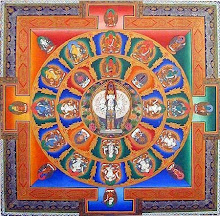


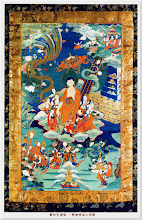

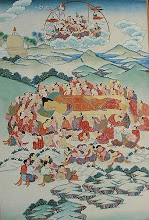


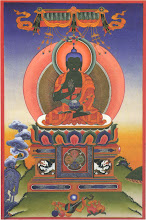


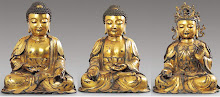.jpg)